








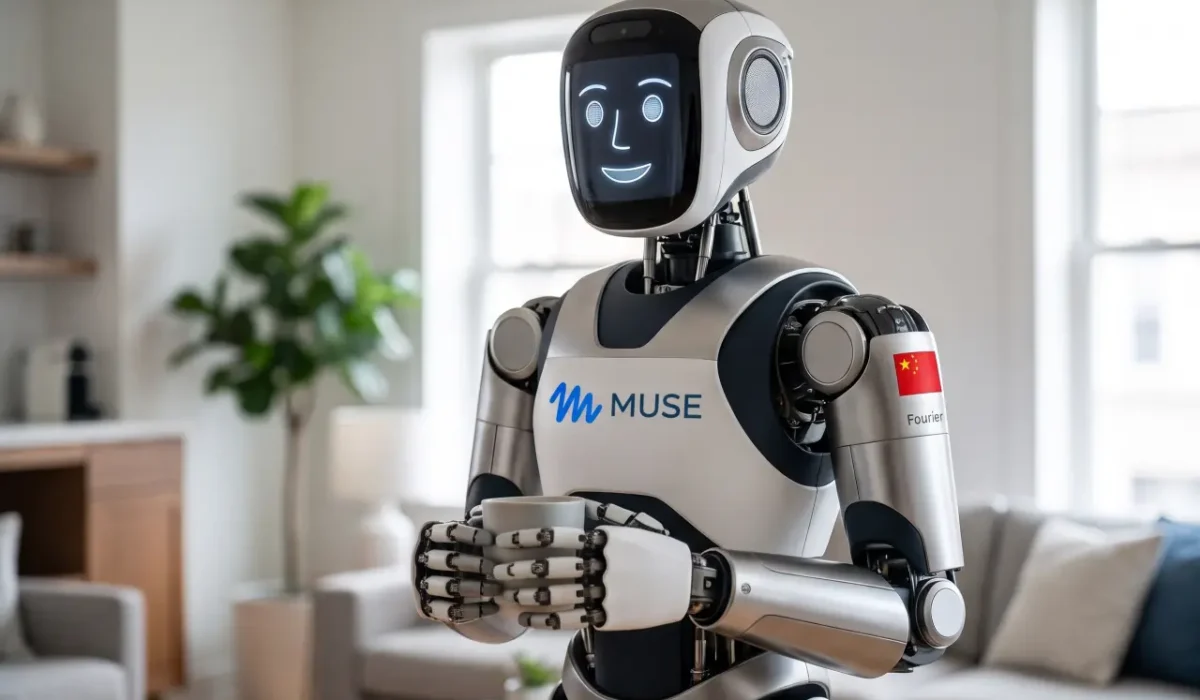
Meta is reportedly advancing its footprint in the physical automation sector by developing humanoid robot prototypes. According to a recent industry report published by The Information, the social media and artificial intelligence giant has initiated collaborative efforts with Fourier Intelligence, a prominent Chinese robotics startup recognized for its advanced bipedal and humanoid systems. This strategic move aligns Meta with a growing cohort of major technology enterprises investing heavily in embodied artificial intelligence, signaling a potential shift from purely digital and virtual environments into the physical robotics market.
The collaboration centers on leveraging Fourier Intelligence’s established hardware expertise, specifically drawing upon its GR series of humanoid robots. Fourier Intelligence, founded in 2015, has spent nearly a decade refining bipedal locomotion, dexterity, and rehabilitation robotics. By integrating its foundational hardware frameworks with Meta’s cutting-edge artificial intelligence models, the partnership aims to bridge the gap between advanced cognitive software and physical actuation. Industry insiders suggest that Meta’s initial phase involves building and testing hardware prototypes rather than launching a consumer-ready commercial product immediately, allowing the company to evaluate how its proprietary AI models perform in dynamic, real-world physical spaces.
The Convergence of Advanced AI and Physical Robotics
The intersection of generative artificial intelligence and humanoid robotics has accelerated dramatically over the past two years. For companies like Meta, which have traditionally focused on software, social platforms, hardware such as the Ray-Ban Meta smart glasses, and generative AI models like Llama, expanding into robotics represents a natural progression. Developing general-purpose artificial intelligence requires robust multimodal training data, and physical embodiment offers a unique environment for AI systems to interact with gravity, spatial dimensions, and unpredictable human surroundings.
While Meta has not historically manufactured industrial or humanoid hardware, its heavy investments in computer vision, spatial computing, and foundational AI models provide a strong theoretical base for robotic control systems. Fourier Intelligence brings the necessary mechanical engineering capability, including high-torque actuators and structural designs capable of bipedal balance. This division of labor—software and cognitive architecture from Meta paired with mechanical architecture from Fourier—reflects a broader trend in the tech industry where software giants partner with specialized hardware manufacturers to accelerate timelines and bypass the steep learning curve of mechanical manufacturing.
Chronology of Meta’s Hardware and Robotics Expansion
Meta’s exploration of physical robotics does not occur in a vacuum; it follows a calculated trajectory of hardware investments and organizational restructuring. Over recent years, the company has systematically expanded its physical product ecosystem.
In 2023 and 2024, Meta accelerated its development of augmented reality (AR) glasses and mixed-reality headsets under its Reality Labs division, led by Andrew Bosworth. The success of the Ray-Ban Meta smart glasses demonstrated the company’s ability to successfully commercialize lightweight, AI-integrated wearable technology. Concurrently, Meta’s Fundamental AI Research (FAIR) team has continuously pushed the boundaries of multimodal machine learning, creating models capable of processing text, audio, images, and spatial data simultaneously.
The decision to explore humanoid robotics marks a distinct escalation from wearables to autonomous physical agents. Although Meta has maintained a relatively guarded public stance regarding its specific robotics roadmap, industry leaks and supply chain reports indicate that internal prototype testing began gaining momentum in late 2024 and early 2025. The collaboration with Fourier Intelligence signifies a pivot toward external partnerships, allowing Meta to bypass the lengthy R&D cycles typically required to design proprietary bipedal chassis from scratch.

Industry Landscape and the Rise of Jetson-Class Processing
The broader humanoid robotics landscape is experiencing a massive influx of capital and technological convergence, driven largely by breakthroughs in semiconductor processing. Modern humanoid robots require immense onboard computational power to execute real-time simultaneous localization and mapping (SLAM), balance algorithms, and complex neural network inferences.
Competitors in the space, ranging from well-funded startups like Figure AI and Boston Dynamics to established tech conglomerates, rely heavily on specialized edge-AI processors. The adoption of advanced computing architectures, such as NVIDIA’s Jetson ecosystem and upcoming high-performance robotics chips, has enabled humanoid platforms to process sensory inputs with unprecedented speed. For Meta, utilizing robust processing units allows its experimental prototypes to run complex vision-language models locally, minimizing latency and reducing reliance on continuous cloud connectivity during physical operation.
Official Responses and Corporate Strategy
Executives at Meta have consistently emphasized that artificial intelligence will eventually extend beyond screens and into the physical world, though leadership has remained cautious about overpromising commercial timelines. Andrew Bosworth, Meta’s Chief Technology Officer, has frequently noted that the company’s investments in generative AI and foundational models like Muse and Llama are designed to be universally applicable across multiple form factors.
While official corporate commentary regarding the Fourier Intelligence partnership remains sparse due to the confidential nature of early-stage prototyping, the strategic logic is clear. Meta views embodied AI as the logical next frontier for artificial intelligence research. By embedding sophisticated AI brains into physical bodies, researchers can gather invaluable datasets on physical interaction, manipulation, and navigation—data that cannot be adequately replicated in simulated environments alone.
Broader Economic and Technological Implications
The entry of Meta into the humanoid robotics sphere carries significant implications for the global technology market, particularly regarding US-China technological collaboration. Fourier Intelligence, while maintaining a global footprint with offices and research centers internationally, is fundamentally rooted in China’s rapidly expanding robotics manufacturing ecosystem. Partnerships between American software giants and Chinese hardware innovators highlight the complex, interconnected nature of the global supply chain for advanced automation.
From an economic perspective, the mass deployment of humanoid robots faces several hurdles, including high manufacturing costs, energy efficiency constraints, and safety regulations. However, analysts suggest that even if consumer-facing humanoid robots remain years away from mainstream adoption, the intermediate applications in logistics, manufacturing, and structured environments could yield massive productivity gains.
As Meta continues to refine its humanoid prototypes alongside Fourier Intelligence, the tech industry is watching closely to see how the company plans to integrate its proprietary AI models with physical hardware. Whether these prototypes eventually transition into commercially viable products or serve primarily as internal research vehicles to test the limits of embodied AI, Meta’s movement into this space underscores a definitive industry consensus: the future of artificial intelligence is not just digital, but physical.