








Google has officially introduced Gemini 4 Hydrogen, its latest high-performance artificial intelligence model designed to deliver cutting-edge intelligence with unprecedented speed and efficiency. Positioned as a versatile tool for everyday coding tasks and complex agentic workflows, Hydrogen joins the expanding Gemini 4 family, following the previous releases of Gemini 4 Carbon and Gemini 4 Argon. By focusing on rapid execution and scalable utility, Google aims to redefine the baseline for enterprise-grade and consumer-facing artificial intelligence applications, bridging the gap between raw computational power and practical day-to-day productivity.
Background Context and Evolution of the Gemini Family
The rollout of Gemini 4 Hydrogen is part of Google’s broader, aggressive strategy to dominate the artificial intelligence landscape across multiple tiers of deployment. Over the past several years, the tech giant has systematically updated its foundational models to improve contextual understanding, multimodal integration, and execution speed. Preceded by models such as the Gemini 3.8 Flash, the Gemini 4 series represents a fundamental architectural
shift toward specialized model variants optimized for specific operational profiles.
While Carbon and Argon were engineered to handle heavy reasoning and massive context processing at scale, Hydrogen is tailored specifically for high-velocity tasks that require minimal latency. This segmentation allows developers and enterprise clients to choose models based on precise computational budgets, ensuring that routine processes do not unnecessarily drain system resources. The introduction of Hydrogen addresses a critical market demand: the need for lightweight, highly responsive agents capable of executing autonomous workflows without sacrificing cognitive depth.
Performance Metrics and Architectural Enhancements
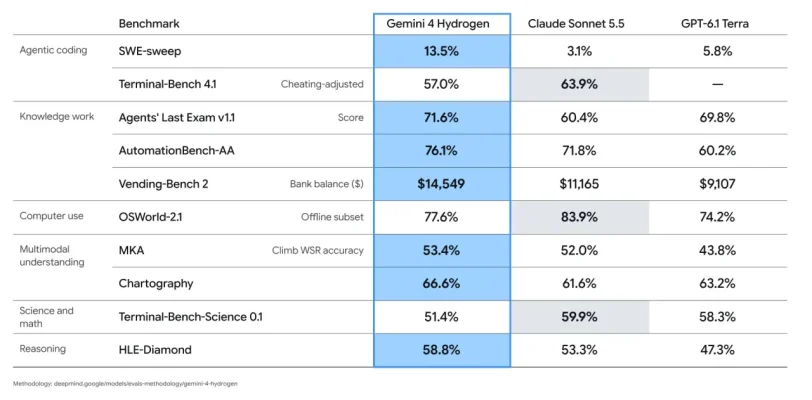
According to technical specifications released by Google, Gemini 4 Hydrogen achieves a staggering performance leap, operating approximately 2.5 times faster than its predecessor, Gemini 3.8 Flash. Furthermore, the model demonstrates a fivefold increase in output generation speed, drastically reducing waiting times for complex multi-step queries. In rigorous standardized evaluations, such as the Terminal-Bench 4.1, Hydrogen posted an impressive 18.2% performance improvement, alongside a 57% reduction in error rates compared to earlier iterations.
One of the defining features of Gemini 4 Hydrogen is its multi-tiered thinking capability. Users can select from four distinct thinking levels—ranging from low, medium, and high, to an advanced xhigh setting. This dynamic adjustment mechanism allows the model to scale its internal reasoning depth depending on the complexity of the prompt. For simpler tasks, the model runs swiftly on minimal resources; for intricate programming logic or multi-document synthesis, it engages deeper analytical frameworks.
The model also retains an expansive context window, enabling seamless processing of large-scale documentation, extensive PDF files, code repositories, and structured datasets. This capability is complemented by advanced data ingestion pipelines that allow Hydrogen to process mixed media formats simultaneously, maintaining high fidelity across lengthy conversational threads and complex analytical assignments.
Benchmark Comparisons and Competitive Positioning
In competitive evaluations, Gemini 4 Hydrogen has established itself as a formidable contender against top-tier industry alternatives, including Anthropic’s Claude Sonnet 5.5 and OpenAI’s GPT-6.1 Terra. On the Artificial Analysis Intelligence Index, Hydrogen secured strong positioning, rivaling and occasionally surpassing models traditionally reserved for heavier enterprise workloads.
In specialized agentic benchmarks, such as the Vals Tax Agent evaluation hosted on Agent Arena, Hydrogen achieved a success rate of 52.3%. More impressively, when integrated into specialized multi-agent testing frameworks, the model demonstrated task completion rates exceeding 81% on standardized corporate workflows. These benchmarks indicate that Hydrogen is not merely a conversational assistant, but a reliable execution engine capable of performing multi-step administrative, financial, and technical operations with minimal human oversight.
Integration with Google Search and Enterprise Ecosystems
A core pillar of Gemini 4 Hydrogen’s utility is its deep integration with Google Search and the broader Google workspace ecosystem. By leveraging advanced query fan-out techniques, the model can decompose complex user prompts into multiple parallel search threads, aggregate the results, and synthesize verified, up-to-date information in real time. This minimizes hallucinations and ensures that responses involving current events or technical specifications are grounded in factual data.
Furthermore, Google has embedded Hydrogen directly into enterprise productivity suites, including Gmail, Google Drive, Airtable, and Dropbox. Integration with Google Sheets allows users to deploy Gemini agents for automated data analysis, formula generation, and complex financial modeling using natural language commands. These capabilities are being rolled out immediately to subscribers of Google AI Pro and Ultra tiers, positioning the technology as a direct competitor to rival office automation assistants.
Pricing, Availability, and API Access
Google has structured the pricing for Gemini 4 Hydrogen to encourage widespread adoption among developers and enterprise clients. Available immediately through the Gemini API, the model is priced competitively at $1.50 per million input tokens and $7.50 per million output tokens, reflecting a significant cost reduction for handling large-context workloads compared to previous generations.
Enterprise customers leveraging Google AI Pro and Ultra subscriptions will gain immediate access to advanced developer tools, including integration environments like Google Antigravity. As organizations increasingly transition toward autonomous agent architectures, Google’s aggressive pricing and performance benchmarks for Gemini 4 Hydrogen signal a concerted push to capture market share across both consumer applications and enterprise software development.