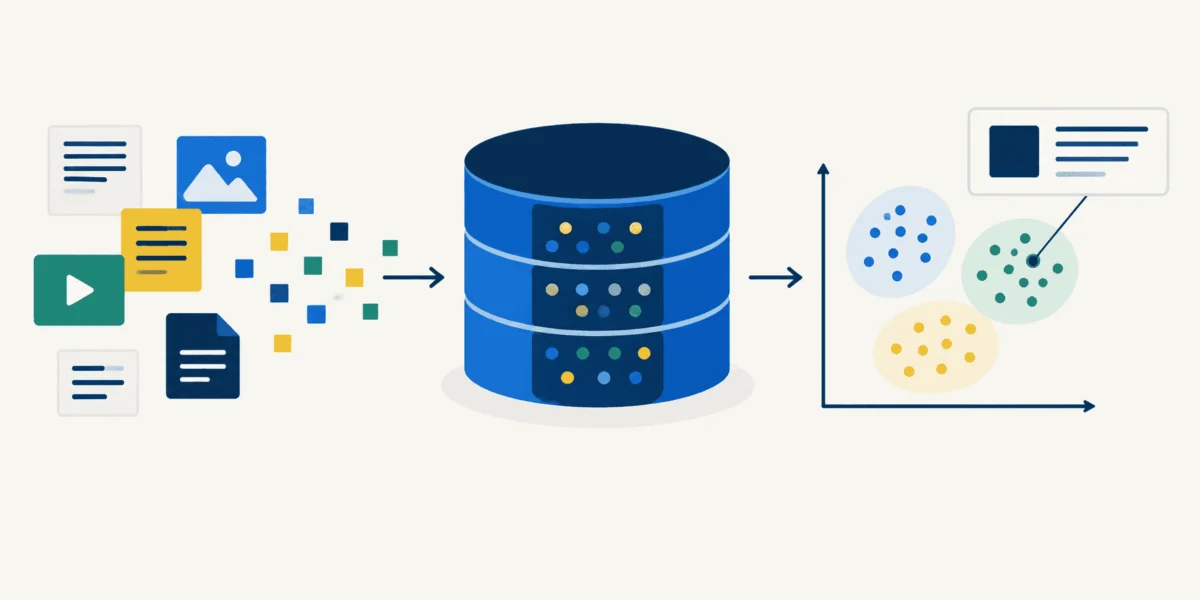
In the rapidly evolving landscape of artificial intelligence and modern data architecture, vector databases have emerged as an indispensable infrastructure component. Unlike traditional relational or keyword-based search engines that retrieve information by matching exact character strings or lexical tokens, vector databases operate on the fundamental principles of semantic meaning. By translating unstructured data—such as text documents, images, and audio files—into high-dimensional numerical vectors, these specialized storage systems enable applications to surface contextually relevant information based on conceptual proximity rather than superficial keyword overlaps.
Understanding the internal mechanics of a vector database has historically required navigating complex C++ codebases, distributed systems, and proprietary enterprise software. However, developers can demystify this technology by constructing a fully functional, lightweight vector database from scratch using Python and the NumPy library. This ten-step implementation requires no dedicated graphics processing units (GPUs) or external API keys, relying instead on a single pre-trained transformer model and foundational linear algebra operations.
The Evolution of Semantic Search and Embedding Models
The shift from lexical search to semantic search represents a major paradigm shift in natural language processing (NLP). Traditional information retrieval systems, such as those built on inverted indexes and Term Frequency-Inverse Document Frequency (TF-IDF) algorithms, excel at finding exact terms but frequently fail when users employ synonyms, alternative phrasing, or conceptual descriptions.
Vector databases bridge this gap by leveraging sentence transformers—deep learning models designed to map sentences and paragraphs into a dense vector space. In this mathematical space, semantically similar concepts are positioned closely together, while unrelated topics are pushed far apart.
To explore this architecture hands-on, developers establish a working environment using three primary components: a core database script managing vector storage and retrieval, a corpus file containing simulated sample documents paired with categorical metadata, and a test suite ensuring implementation integrity. By utilizing standard libraries alongside NumPy and the sentence-transformers package, engineers can instantiate a local vector database capable of encoding and indexing text rapidly.
Index Construction and the Mechanics of Dimensionality
The foundation of any vector database is its index. When documents are ingested into the database, an embedding model converts each text block into a fixed-length numerical array—typically a 384-dimensional vector composed of 32-bit floating-point numbers.
A critical characteristic of this architecture is that the physical size of the index is determined entirely by the number of documents and the dimensionality of the embedding model, rather than the length of the source texts. Whether a document consists of a six-word sentence or a multi-page essay, it occupies the exact same footprint: 384 floating-point numbers, equating to precisely 1,536 bytes of data. This uniformity makes vector storage highly predictable, scalable, and computationally efficient to scan.
During the indexing phase, documents are encoded sequentially or in batches. Performance benchmarks demonstrate that lightweight models can process dozens of documents in fractions of a second, generating compact indexes that consume minimal memory. For instance, an index containing 25 documents with 384-dimensional vectors requires merely 37.5 kilobytes of storage, operating entirely within system memory for instantaneous retrieval.
Querying by Meaning: Bridging Lexical Gaps
The primary utility of a vector database becomes evident during search operations. When a user submits a natural language query, the database encodes the query into a vector of the identical dimensionality as the indexed documents. It then calculates the mathematical similarity between the query vector and every document vector in the index.
Because similarity is evaluated geometrically, queries can successfully retrieve relevant documents without sharing a single common word. For example, a query regarding "why does my loaf taste sour" successfully retrieves documents detailing sourdough fermentation, acetic acid, and wild yeast, despite the terms "loaf" and "sour" appearing nowhere in the target texts. Similarly, queries concerning abstract concepts like "superheroes" accurately surface profiles of comic book characters based purely on semantic alignment.
Behind the scenes, this process relies on vector normalization. By scaling each embedding vector to a length of 1, the computational burden of calculating cosine similarity is reduced to a simple dot product. Ranking an entire corpus of documents then requires a single matrix multiplication, enabling high-speed retrieval even as dataset sizes expand.
Metadata Filtering and Enterprise Guardrails
While semantic similarity is powerful, real-world enterprise applications require strict governance, filtering, and data integrity checks. Pure vector search can occasionally yield false positives—such as retrieving a comic book excerpt about fictional biology when a user asks a rigorous scientific question about cellular energy.
To mitigate this, production-grade vector databases incorporate metadata filtering. By associating structured key-value pairs (such as topic tags) with each document, developers can apply pre-filters that restrict the search space to specific categories before similarity ranking occurs. This ensures that conceptually similar but contextually irrelevant entries are excluded from final results.
Furthermore, robust implementations require strict guardrails during the data ingestion phase. Ensuring a strict one-to-one correspondence between input texts, metadata dictionaries, and computed vectors prevents silent data corruption. Validation checks raise immediate exceptions if data structures are misaligned, safeguarding index integrity.
Scalability and Production Implications
As organizations scale their artificial intelligence pipelines, the performance characteristics of vector databases remain a primary consideration. While flat, brute-force vector scans using NumPy dot products are exceptionally fast for small to medium datasets, larger corpora containing hundreds of thousands or millions of vectors require advanced indexing algorithms—such as Hierarchical Navigable Small World (HNSW) graphs or Inverted File Indexing (IVF)—to maintain sub-millisecond query latencies.
Performance benchmarks illustrate how memory consumption and search times scale with dataset volume. An index containing 1,000 documents consumes roughly 1.5 megabytes of memory, with scan times registering below a millisecond. Scaling the corpus to 100,000 documents increases the memory footprint to approximately 146.5 megabytes, while query scan times remain remarkably efficient at under 4 milliseconds.
Ultimately, the core design principles governing local, NumPy-based vector databases mirror the architectures powering enterprise-grade managed vector services. Whether managing dozens of records or tens of millions, the underlying mechanics rely on linear algebra, geometric proximity, and meticulous metadata management. By mastering these fundamentals from scratch, developers gain a transparent, mechanistic understanding of how modern AI retrieval systems operate under the hood.