The landscape of artificial intelligence is undergoing a profound acoustic shift. Voice interfaces, long relegated to the novelty status of early smartphone assistants and rudimentary automated phone trees, have rapidly evolved into the critical standard for human-computer interaction. From sophisticated customer service call centers and clinical healthcare triage systems to embedded smart home ecosystems, voice agents are becoming the primary gateway through which everyday users access complex AI infrastructure. For developers and systems architects already well-versed in large language models (LLMs) and text-based conversational interfaces, transitioning to voice engineering offers a compelling frontier. However, this evolution is not merely a matter of swapping out a keyboard for a microphone; it requires a fundamental rethinking of latency, pipeline architecture, and human-computer conversation design.
Defining the Voice Agent Architecture
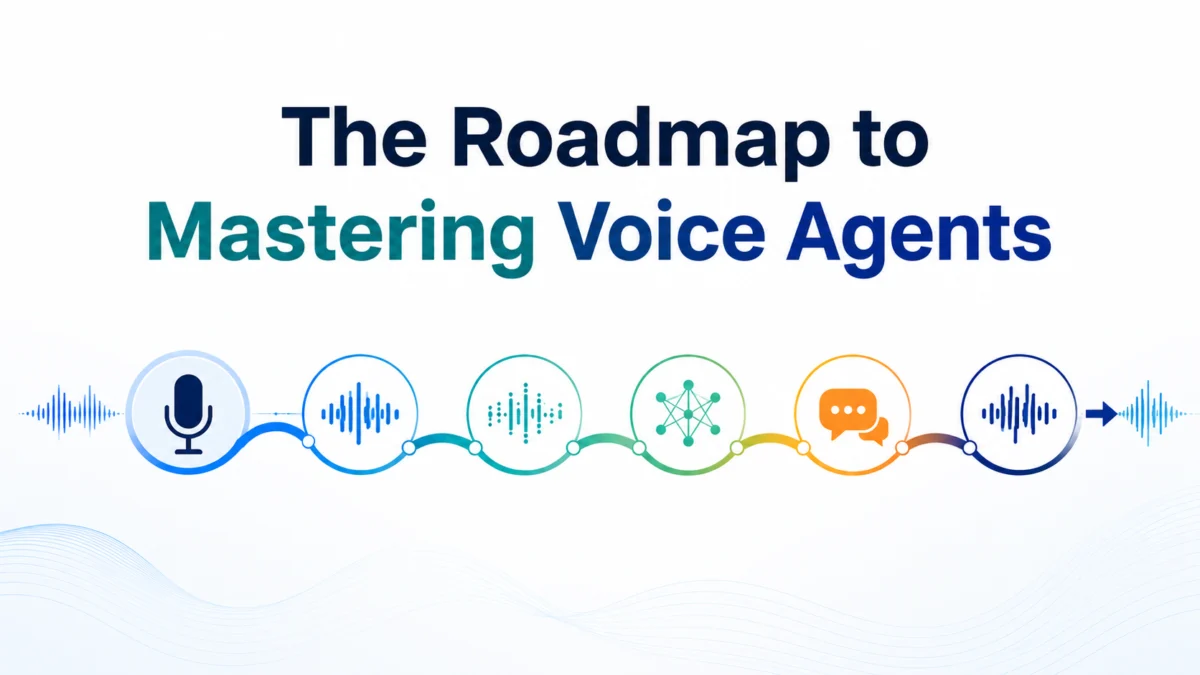
At its structural core, a voice agent is an autonomous artificial intelligence system capable of receiving, interpreting, and responding to spoken natural language. While text-based agents interact via written tokens in chat windows, voice agents must bridge the physical world of sound waves and the digital realm of neural network tokens. This requires the integration of a complex, multi-stage processing pipeline that operates seamlessly in real time.
The architecture relies fundamentally on three sequential operational layers:
- Speech-to-Text (STT): Often referred to as Automatic Speech Recognition (ASR), this initial gateway listens to incoming acoustic audio signals—captured via microphones or telephony channels—and transcribes the spoken words into structured text.
- Language Understanding and Reasoning: Once transcribed, the text is fed into a large language model or a specialized reasoning engine. This layer operates identically to a text-based agent, interpreting intent, retrieving relevant contextual data from databases or APIs, and generating a coherent textual response.
- Text-to-Speech (TTS): Finally, the generated text is processed by a neural synthesis engine that converts the written words back into natural-sounding, expressive spoken audio, which is then played back to the user through a speaker or telecommunications line.
The primary engineering constraint governing this entire pipeline is time. While a text-based user interface can easily absorb a two- or three-second generation delay without breaking user trust, a spoken conversation immediately registers such a pause as an awkward, unnatural silence. Consequently, voice agent architecture demands rigorous optimization at every junction to maintain conversational momentum.
Structural Differences: Why Voice Is Not Just Text with Audio
Developers transitioning from text-centric AI development quickly discover that voice environments introduce an entirely distinct set of engineering challenges. These variances dictate every downstream decision regarding model selection, infrastructure hosting, and prompt engineering.
Latency Management: In speech interactions, millisecond thresholds dictate success. Streaming architectures, where text fragments are dispatched to the TTS engine incrementally as the LLM generates them, are frequently required to prevent noticeable lag.
The Absence of Visual Formatting: Text interfaces rely heavily on visual cues such as bold typography, bulleted lists, hyperlinks, and code blocks to organize dense information. Voice agents possess none of these tools. All data must be communicated strictly through pacing, sentence structure, and precise word choice. Consequently, verbal responses must be concise, punchy, and structurally intuitive when heard rather than read.
Handling Natural Human Dynamics: Human conversation is inherently messy. People interrupt one another, correct themselves mid-sentence, trail off, and use conversational fillers. A robust voice agent cannot operate on rigid turn-taking assumptions; it must possess the real-time capability to handle interruptions and dynamic topic shifts gracefully.
Acoustic Variability and Environmental Noise: Unlike a pristine digital text string, incoming audio is subject to the physical realities of the environment. Background noise, diverse regional accents, variable speaking speeds, and low-quality microphones can severely degrade STT accuracy, introducing downstream errors into the language model.
Error Propagation: Because the voice pipeline is strictly sequential, errors are compounding. If the STT layer misinterprets a critical homophone, the language model processes incorrect semantic input, generates an irrelevant answer, and the TTS engine reads that flawed response aloud. Every stage represents a critical vulnerability point.
The Strategic Seven-Stage Roadmap for Voice Engineering
Mastering the creation of production-grade voice agents requires a systematic, layered educational progression. Jumping straight into advanced deployment without mastering foundational audio mechanics invariably leads to architectural bottlenecks and unstable systems. Industry experts recommend a structured, seven-stage learning roadmap.
Stage 1: Dissecting the Core Pipeline
Before writing code, engineers must develop an intimate mental model of the STT-LLM-TTS triad. This foundational phase involves studying raw audio data formats (such as PCM, WAV, and Opus), analyzing how various ASR models cope with acoustic noise and accents, understanding the metrics of Word Error Rate (WER), and evaluating the trade-offs between different neural speech synthesis models regarding latency and vocal expressiveness.
Stage 2: Mastering the Language Processing Layer
Building upon standard LLM competencies, this stage focuses on optimizing prompt engineering for the unique constraints of spoken output. Because responses must be brief, conversational, and resilient against imperfectly transcribed input, developers must learn to craft system prompts that enforce brevity, clarity, and an appropriate conversational cadence without sacrificing factual accuracy.
Stage 3: Implementing Real-Time Streaming Architectures
Latency is the ultimate enemy of conversational voice systems. Stage three shifts the focus to systems engineering, requiring developers to design asynchronous, event-driven pipelines. By utilizing streaming token generation alongside incremental text-to-speech synthesis, engineers can dramatically reduce time-to-first-audio, creating fluid, responsive interactions that mimic human pacing.
Stage 4: Studying Conversation Design (VUI)
Technically flawless agents often fail in the market due to poor user experience. Conversation design draws heavily from linguistics, cognitive psychology, and human-computer interaction (HCI) research. Developers must learn how to design graceful error-recovery loops, establish consistent agent personas, manage complex multi-turn dialog states, and craft prompts that sound natural when spoken aloud rather than read from a screen.
Stage 5: Integrating Tools, APIs, and Memory
A static voice agent is of limited utility. This stage integrates external capabilities, enabling voice agents to invoke APIs, execute function-calling protocols, query vector databases for retrieval-augmented generation (RAG), and maintain robust conversational memory across single sessions as well as persistent historical interactions. This elevates the agent from a simple answering script to a functional digital assistant.
Stage 6: Production Deployment, Telephony, and Evaluation
Deploying a voice agent at scale introduces complex infrastructure challenges far removed from local testing environments. Developers must master telephony integrations (using protocols like SIP, WebRTC, and VoIP gateways), manage real-time transcription scaling costs, and monitor audio encoding standards. Furthermore, evaluation shifts from reading static text logs to auditing audio recordings, measuring task-completion success rates, and analyzing drop-off points in conversational flow.
Stage 7: Advanced Topics and Specialization
The final frontier of voice agent mastery involves cutting-edge capabilities. These include building multilingual agents capable of real-time language switching, implementing emotion detection algorithms to dynamically alter the agent’s vocal tone based on user sentiment, utilizing voice cloning to establish proprietary corporate audio branding, and developing advanced interruption-handling mechanisms.
Industry Implications and Future Outlook
The commercial momentum behind voice agents is accelerating across multiple economic sectors. In healthcare, voice agents are increasingly utilized for automated patient intake, post-discharge check-ins, and preliminary symptom triage, significantly reducing administrative overhead for clinical staff. In financial services and retail, sophisticated voice bots capable of executing complex transactional workflows are replacing traditional touch-tone menus, driving customer satisfaction while scaling support operations.
For software engineers and AI practitioners, acquiring proficiency in voice agent architecture represents a high-value career expansion. As hardware acceleration improves and edge-AI capabilities expand, the boundary between human and machine spoken interaction will continue to dissolve. By approaching voice agent development through a disciplined, stage-by-stage engineering framework—balancing rigorous low-latency pipeline architecture with empathetic, human-centric conversation design—developers can build robust, production-ready systems capable of thriving in the demanding landscape of modern enterprise AI deployment.