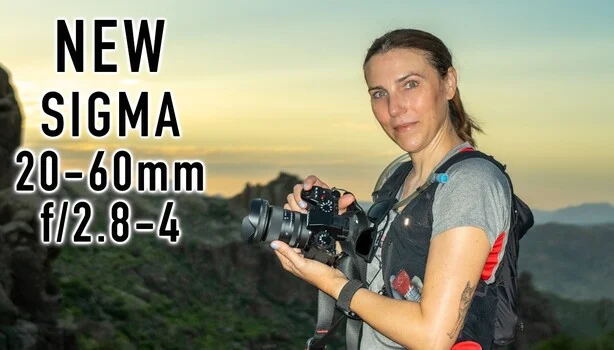
The evolution of standard zoom lenses has historically revolved around predictable focal lengths, anchored by the ubiquitous 24-70mm focal range that has served as a staple for photojournalists, event shooters, and landscape photographers for decades. However, shifts in consumer demand and advancements in optical engineering are beginning to challenge these long-standing conventions. Sigma’s recent introduction of the 20-60mm f/2.8-4 DG Contemporary lens represents a calculated departure from traditional design paradigms, offering a wider field of view at the short end combined with a variable aperture that outperforms standard kit lenses. To evaluate the practical applications of this new optic, photographer Leigh of the YouTube channel Leigh & Raymond Photography conducted a rigorous field test in the challenging environment of the Sonoran Desert, putting the lens through its paces in pre-sunrise hiking conditions and controlled studio environments.
Field Testing in Extreme Conditions
The testing protocol involved a pre-sunrise excursion through the rugged terrain of the Sonoran Desert, an environment characterized by dense brush, sharp rocks, and unpredictable wildlife. Operating in these conditions requires meticulous attention to equipment weight and ergonomics. Leigh paired the L-mount iteration of the Sigma 20-60mm f/2.8-4 DG Contemporary with a Lumix S5 II camera body, a setup specifically chosen for its mobility. While the lens is also manufactured in a Sony E-mount configuration, the L-mount alliance combination proved advantageous for physical handling on a punishing walk.
Throughout the trek, the compact and lightweight construction of the lens allowed the gear to remain accessible in the photographer’s hands rather than being stowed away in a hydration vest—a common necessity when handling heavier professional zoom kits. This operational readiness was underscored by an unexpected encounter with a rattlesnake shortly after sunrise, where the mobility of a lightweight, unobtrusive setup facilitated safe navigation around the hazard without physical hindrance. The ability to traverse difficult terrain while keeping the camera mounted and ready highlights the operational utility of downscaled optical designs in outdoor photography.
Optical Specifications and Comparative Analysis
The defining characteristic of the Sigma 20-60mm f/2.8-4 DG Contemporary is its deliberate pivot toward a wider focal spectrum. While standard travel and walkaround lenses typically commence at 24mm, the introduction of a 20mm wide end significantly expands the spatial capture capabilities of the lens. According to field metrics, the horizontal and vertical field of view at 24mm encompasses approximately 70 percent of the area captured at the 20mm setting, a structural 4mm variance that yields markedly different compositional results in tight spatial constraints or expansive landscapes.
Furthermore, the lens incorporates unexpected macro capabilities, enabling close-focus operations that allow photographers to fill the frame with small subjects, such as regional flora, without swapping to a dedicated macro lens. Positioned within Sigma’s Contemporary product line—which bridges the gap between the high-performance Art series and the ruggedized Sports series—this model is engineered to balance optical fidelity, physical handling, and cost-efficiency.
To ascertain the practical value of the new optic, a direct head-to-head comparison was conducted against the Panasonic Lumix S 20-60mm f/3.5-5.6, a widely adopted kit lens introduced with the original Lumix S5. On paper, the Sigma offers a distinct advantage with a brighter variable aperture of f/2.8-4, translating to enhanced light-gathering capabilities in low-light scenarios such as pre-dawn landscapes.
To quantify performance differences, a controlled studio test was executed using the Lumix S5 II. A series of 20 distinct frames were captured across varying apertures, focus points, and focal lengths. Subsequent analysis focused on worst-case scenarios, specifically corner sharpness at maximum aperture and longest focal length settings. When pixel-peeping and directly contrasting the Sigma against the Lumix equivalent, evaluations revealed no statistically or visually significant discrepancy in baseline image quality between the two lenses, suggesting that the Sigma’s primary value propositions lie in its wider aperture and build configuration rather than raw resolution anomalies alone.
Historical Evolution of Standard Zooms
The introduction of specialized focal ranges like the 20-60mm reflects a broader industry-wide reevaluation of what constitutes a primary walkaround lens. For years, the optical industry operated under the consensus that a 24-70mm range provided the optimal compromise for general-purpose photography, leaning heavily into portrait-friendly focal lengths between 50mm and 70mm. However, the rise of landscape, architecture, and environmental content creation has spurred a counter-trend.
Makers of street and landscape imagery have increasingly prioritized wider initial focal lengths, accepting a truncated telephoto reach in exchange for the capacity to capture expansive vistas and tight architectural interiors without necessitating lens changes or physical repositioning. The addition of a 20mm baseline allows a single optical instrument to manage wide environmental portraits, architectural interiors, and sweeping outdoor panoramas. When paired with close-focus macro performance, the need to carry supplementary prime lenses or specialized macro glass is diminished, streamlining field kits for mobile creators.
Industry Implications and Market Positioning
Market analysts observing the release note that lenses of this class target a specific demographic: mobile shooters, adventure photographers, and content creators who operate primarily on foot and require maximum versatility from a single mounted optic. By providing a brighter aperture than typical kit lenses while maintaining a compact form factor, manufacturers are addressing the ergonomic fatigue associated with carrying professional-grade f/2.8 zoom packages over long distances.
Industry feedback indicates that while photographers already invested in the competing Lumix 20-60mm f/3.5-5.6 may find limited incentive to upgrade unless they specifically require the additional light-gathering capabilities of the f/2.8-4 maximum aperture, newcomers to the L-mount or E-mount ecosystems evaluating do-everything travel options are presented with a compelling alternative. The Sigma 20-60mm f/2.8-4 DG Contemporary establishes a new benchmark for utility, demonstrating that optical design can successfully adapt to the demands of modern outdoor and travel photography without compromising portability.