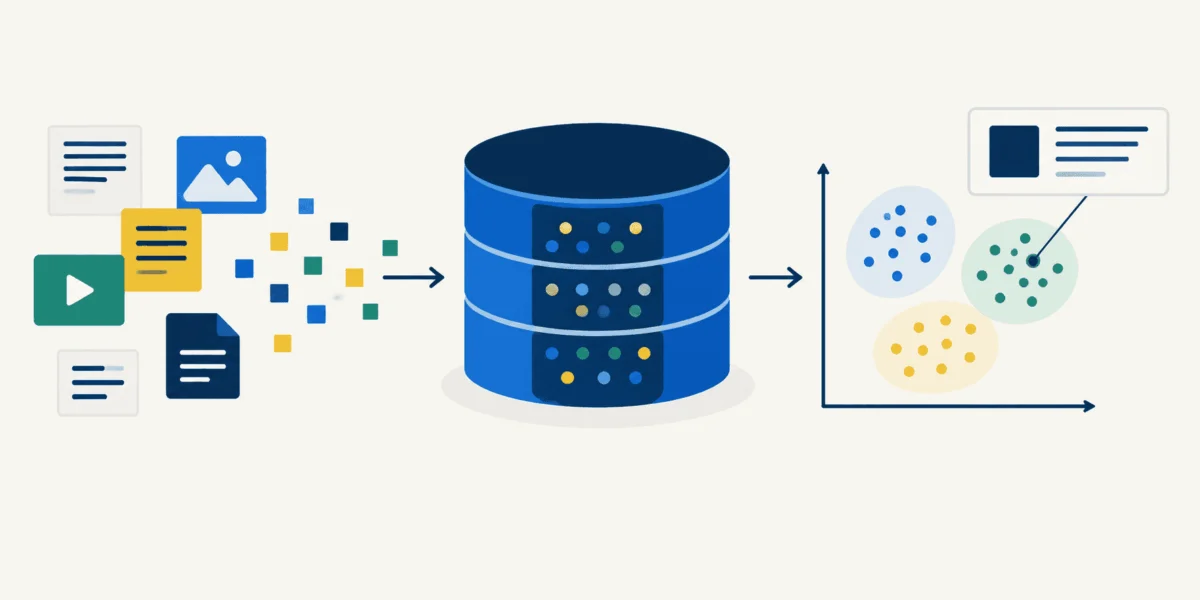
Modern artificial intelligence applications increasingly rely on semantic search capabilities to retrieve relevant information based on conceptual meaning rather than rigid keyword matching. Traditional relational databases and inverted index search engines excel at exact string lookups, but they often struggle to comprehend context, synonyms, and underlying intent. To bridge this gap, developers turn to vector databases, specialized systems designed to store, manage, and query high-dimensional numerical representations of text, images, and other unstructured data types. Understanding the mechanics of these systems typically requires navigating complex documentation or enterprise-grade software frameworks. However, building a functional vector database from the ground up using fundamental programming constructs reveals that the core architecture is remarkably straightforward.
By leveraging Python and the NumPy numerical computing library, engineers can construct a fully operational vector database in ten incremental steps without needing specialized hardware accelerators like GPUs or external cloud application programming interface (API) keys. This hands-on implementation demystifies the internal operations of vector search engines, illustrating how mathematical operations such as dot products and matrix multiplications translate abstract textual concepts into quantifiable similarity scores.
Background Context and the Rise of Vector Embeddings
The proliferation of Large Language Models (LLMs) and advanced transformer architectures over the past half-decade has fundamentally shifted how software systems handle unstructured data. Historically, text search relied heavily on algorithms like TF-IDF (Term Frequency-Inverse Document Frequency) and BM25, which evaluate document relevance by counting exact keyword overlaps and statistical term distributions. While efficient for structured queries, these methods fail when a user searches for a concept using terminology entirely absent from the source document.
Vector embeddings solve this limitation by mapping words, sentences, or entire documents into a dense, high-dimensional vector space—typically consisting of hundreds of continuous numerical dimensions. Within this space, semantic similarity is represented by spatial proximity. Concepts with similar meanings are positioned close to one another, regardless of the specific vocabulary used to express them. Vector databases serve as the persistent storage and fast retrieval engines for these embeddings, acting as long-term memory systems for retrieval-augmented generation (RAG) pipelines, recommendation engines, and semantic search platforms.
Setting Up the Development Environment
The foundation of any custom software implementation begins with proper dependency management and project structuring. Recreating this educational vector database requires a minimal working environment consisting of three core files: the database engine itself, a corpus of simulated source documents with topic tags, and a test suite to verify system integrity.
To initiate the project, developers install two primary external dependencies: NumPy for high-performance matrix and vector operations, and the sentence-transformers library for generating text embeddings.
pip install numpy sentence-transformers
#
Once installed, the project script initializes with necessary modules, including time measurement utilities and path management tools. Two helper functions facilitate the execution workflow: a header generator to maintain readable console output across the ten operational steps, and a search result formatter that displays retrieval scores, topic tags, and truncated document snippets. At this initial stage, executing the script produces no output, confirming that the environment is correctly configured and awaiting instantiation commands.
Building and Indexing the Document Corpus
The second phase of development involves initializing the database instance and populating it with textual data. Instantiating the custom VectorDB class automatically loads a pre-trained sentence-transformer model—specifically the lightweight and efficient all-MiniLM-L6-v2 architecture. This model encodes each natural language document into a 384-dimensional vector of 32-bit floating-point numbers.
When the database ingests a corpus of twenty-five sample documents via its addition method, it converts every text string into its corresponding numerical embedding. Performance metrics collected during this process demonstrate the efficiency of modern embedding models: loading the model takes approximately 1.64 seconds, while encoding the entire document corpus requires roughly 0.14 seconds, averaging around 6 milliseconds per document.
A critical architectural characteristic of vector databases is that the physical size of the index depends strictly on the number of vectors and their dimensionality, rather than the length of the source documents. Whether a document consists of a brief six-word sentence or an exhaustive multi-page essay, its vector representation occupies a fixed footprint of precisely 1,536 bytes (384 dimensions multiplied by 4 bytes per float32 value). For the twenty-five-document corpus, the resulting index occupies a mere 37.5 kilobytes of memory. This predictable sizing profile ensures that vector indices scale linearly and remain computationally inexpensive to scan relative to raw text databases.
Executing Semantic Searches Without Keyword Overlap
The primary utility of a vector database becomes apparent during search operations. When a user submits a natural language query, the system converts the query string into a vector of identical dimensionality to the stored documents. It then computes the mathematical similarity between the query vector and every vector in the index.
Consider a query regarding cellular energy supply: "what keeps a cell supplied with energy?" When processed by the database, the system retrieves relevant entries, ranking a direct biological statement ("The mitochondria is the powerhouse of the cell") at the top with a high positive similarity score, followed by related aerodynamic respiration data. Intriguingly, the third-ranked result originates from a comic book corpus discussing fictional character attributes, illustrating how semantic matching captures thematic parallels.
More advanced search demonstrations underscore the true power of semantic retrieval. Queries such as "why does my loaf taste sour" or "superheroes" retrieve documents concerning sourdough fermentation and comic book alter egos, respectively, despite zero lexical overlap between the query strings and the retrieved texts. The search engine identifies matches purely based on conceptual meaning rather than keyword frequency.
Interpreting Similarity Scores and Metadata Filtering
Vector search mechanics differ fundamentally from traditional boolean search engines. A vector database invariably returns a requested number of results ($k$), even if the underlying corpus contains no genuinely relevant information. The similarity score serves as the sole indicator of result quality. High positive scores indicate strong conceptual alignment, whereas low scores signify weak semantic proximity. Production environments typically enforce strict score thresholds to filter out irrelevant noise.
To prevent undesirable cross-domain matches—such as retrieving fictional comic book references when querying hard biological facts—vector databases incorporate metadata filtering capabilities. During document ingestion, each entry is associated with a dictionary of categorical metadata, such as a topic tag. Applying a metadata filter restricts the search space exclusively to documents matching specified criteria, ensuring that semantic similarity calculations operate only within approved contextual boundaries. Furthermore, metadata filtering occurs prior to final ranking, guaranteeing that non-matching documents cannot artificially inflate result sets.
System Guard Rails, Persistence, and Serialization
Robust software engineering requires defensive programming practices to prevent silent data corruption. In a vector database, maintaining strict alignment between raw text documents, metadata dictionaries, and numerical vectors is paramount. The ingestion pipeline must include rigorous guard rails that raise explicit type and value errors if an engineer attempts to pass a single string instead of an iterable list, or if the number of text entries fails to match the corresponding metadata arrays.
For long-term utility, the database engine implements serialization methods to save and load index states from disk. Vectors are serialized into compact binary .npy files for rapid, unparsed loading via NumPy, while associated text strings and metadata dictionaries are stored in human-readable JSON files. The load mechanism enforces model consistency by rejecting indices generated by alternate embedding models, preventing the catastrophic error of mixing incompatible vector spaces.
Scaling Performance and Computational Complexity
Analyzing the computational performance of the custom vector database across larger datasets reveals the underlying efficiency of vector mathematics. While searching a tiny corpus of twenty-five documents is bound primarily by the overhead of generating the query embedding, evaluating synthetic corpora containing up to 100,000 high-dimensional vectors demonstrates exceptional computational throughput.
Benchmarking tests over 1,000, 10,000, and 100,000 vectors show that brute-force vector scanning—accomplished via optimized matrix-vector multiplication—scales gracefully. For instance, scanning 100,000 documents occupying approximately 146.5 megabytes of memory requires roughly 3.73 milliseconds for the scan phase and 8.90 milliseconds for ranking the top results. This efficiency stems from a core mathematical optimization: by scaling every embedding vector to a unit length of 1, the computationally intensive cosine similarity calculation simplifies to a standard dot product. Ranking an entire corpus thus reduces to a single matrix multiplication operation.
Broader Industry Implications and Market Analysis
The principles demonstrated in this ten-step implementation mirror the foundational architecture of enterprise-grade vector database systems currently dominating the artificial intelligence infrastructure market. Companies ranging from specialized startups to major cloud providers offer managed vector databases designed to handle millions or billions of high-dimensional embeddings.
The overarching takeaway for software architects is that the core algorithmic design of vector search remains consistent whether managing twenty-five documents or twenty-five million. As organizations increasingly integrate generative AI, semantic search, and automated knowledge retrieval into their operational workflows, mastering the fundamental mechanics of vector embeddings and similarity metrics provides a distinct technical advantage. Understanding how raw data transforms into numerical vectors, how matrix multiplications execute rapid similarity scoring, and how metadata filters maintain contextual precision empowers developers to build more efficient, transparent, and reliable AI-driven applications.