The landscape of open-source home automation has reached a major milestone with the official rollout of the upgraded Matter Server architecture for Home Assistant. Powered entirely by the TypeScript-based matter.js framework, this update represents the culmination of a multi-year engineering effort to move away from rigid C++ implementations and embrace a flexible, community-driven engine. Now running on 38 percent of all Home Assistant instances—ranking twelfth among all platform integrations—Matter has cemented its position as a cornerstone of modern smart home technology.
The Evolution of Matter in Open-Source Ecosystems
The journey toward a native TypeScript Matter implementation began several years ago as a humble passion project. Developed to address the inherent performance limitations and rigid architecture of the official Connected Home IP (CHIP) C++ SDK, matter.js quickly gained traction. It evolved from an independent library into the underlying operational backbone for prominent open-source ecosystems, including Homebridge, openHAB, and various commercial products.
Recognizing its potential to secure the future of interoperable smart home technology, the Open Home Foundation stepped in approximately ten months ago. The foundation brought the project’s creator on board full-time as the Lead Developer of Matter and integrated matter.js under its organizational umbrella. This strategic move provided the project with the institutional safeguarding and financial backing necessary to challenge proprietary smart home silos effectively.
The collaboration immediately shifted gears toward a complete architectural overhaul of the Open Home Foundation Matter Server. After four rigorous months of public beta testing, during which community contributors fine-tuned code, patched bugs, and submitted enhancements, the production-ready Matter Server app 9.0 has officially been released to the global user base.
A Chronological Timeline of Development
To understand the magnitude of this release, it is necessary to examine the timeline of Matter’s integration into the open-source community:

- Late 2022: Following the official commercial launch of the Matter standard by the Connectivity Standards Alliance (CSA), the Home Assistant team introduced initial Matter integration support, recognizing its potential to unify fragmented device manufacturers.
- 2024–2025: As adoption grew, the limitations of relying exclusively on the Python wrapper over the official C++ SDK became apparent. Concurrently, matter.js matured as an independent open-source TypeScript library.
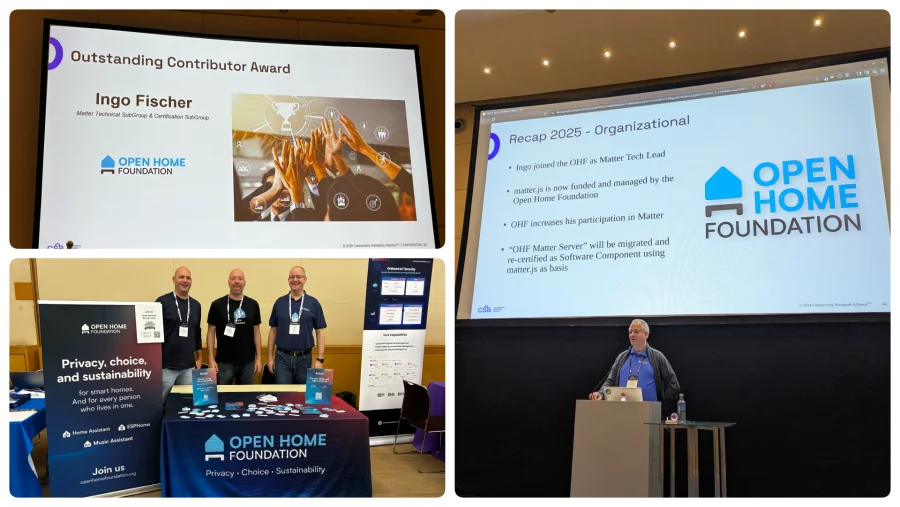
- Late 2025: The project creator joined the Open Home Foundation as Lead Developer, donating matter.js to the organization. In November 2025, the team presented its matter.js integration roadmap at the CSA Member Meeting.
- Early 2026: The Open Home Foundation and Home Assistant secured official Connectivity Standards Alliance certification for their implementations. The developer returned to the CSA Member Meeting in March 2026 to receive an Outstanding Contributor Award.
- Spring/Summer 2026: Following a four-month beta testing phase involving thousands of community members, Matter Server 9.0 was deployed globally as a drop-in replacement for existing installations.
Technical Enhancements and Specification Upgrades
The transition to matter.js brings substantial performance enhancements, addressing historical complaints regarding startup times, network instability, and device recovery failures. Because the new server is built natively on an asynchronous TypeScript framework, execution loops are streamlined, resulting in significantly faster device reconnection times after power outages or router reboots.
Furthermore, the update integrates the Matter 1.5.1 specification, paving the way for upcoming compatibility with the forthcoming Matter 1.6 standard. This specification bump expands native support for advanced device categories, including high-bandwidth security cameras, smart video doorbells, and complex motorized door closures. Coupled with an updated OpenThread Border Router (OTBR) application designed to support Thread 1.4, the platform ensures robust mesh networking capabilities.
Security protocols have also been tightened within Matter Server 9.0. To mitigate the risk of unauthorized or rogue hardware entering a local network, the server now enforces strict cryptographic validation during the commissioning phase. Uncertified devices utilizing generic development or test certificates are blocked from joining out-of-the-box, and real-time certificate revocation checks are performed during setup to protect users against compromised hardware.
Advanced Network Visualization Tools
One of the most praised additions in the latest Matter Server release is a comprehensive network visualization dashboard embedded directly within the web user interface. Managing complex Thread mesh topologies and Wi-Fi environments has historically been a challenge for average consumers due to the decentralized nature of mesh routing.
The new tool constructs a real-time graphical map using telemetry data gathered directly from commissioned nodes. Devices are rendered as interactive nodes accompanied by distinct iconography—such as crowns for network leaders, directional arrows for routers, and specialized icons for sleepy end nodes. Connection links are dynamically color-coded to denote signal strength:
- Green: Strong, reliable connection.
- Orange: Medium signal quality with potential latency.
- Red: Weak connection requiring intervention or repeater placement.
- Gray: Unreachable or offline status.
For Thread networks, where data packets frequently traverse multiple intermediary hops before reaching a border router, this visualization provides unprecedented diagnostic clarity. It allows power users and novices alike to optimize device placement, resolve bottlenecks, and ensure resilient smart home automation pathways.
Expert Reactions and Community Response
The open-source community and industry observers have responded enthusiastically to the launch of Matter Server 9.0, highlighting its impact on usability and developer engagement.
Ward Zhou, a prominent smart home journalist, noted that the platform has evolved past its early experimental phases. "The new Matter Server has evolved into the ultimate Matter controller and troubleshooting tool for power users, backed by an open community that continues to push the standard forward," Zhou stated during a review of the beta phase.
End-users echoing sentiments on community forums have praised the accessibility of the development pipeline. Contributions from non-programmers during the beta testing cycle demonstrated the efficacy of the Open Home Foundation’s collaborative model. Beta testers highlighted that the inclusion of the Thread mesh view eliminated the guesswork traditionally associated with troubleshooting low-power wireless mesh topologies.
Implications for the Smart Home Industry
The widespread deployment of matter.js within Home Assistant signals a broader shift in the smart home industry. By lowering the technical barriers to entry for local, interoperable device communication, the Open Home Foundation is proving that open-source alternatives can match—and frequently exceed—the reliability of closed ecosystems managed by multinational technology conglomerates.
With 38 percent of Home Assistant deployments now utilizing Matter, the protocol is transitioning from an enthusiast novelty into the primary connective tissue for modern automated households. As the industry looks toward the widespread adoption of Matter 1.6 and deeper integration of AI-driven automation routines, the establishment of a fast, secure, and transparent server architecture ensures that local control remains viable, scalable, and future-proof. Users seeking to participate in the ongoing development of the ecosystem can review the Open Home Foundation roadmap to contribute feedback, test upcoming features, and help shape the next chapter of open smart home technology.