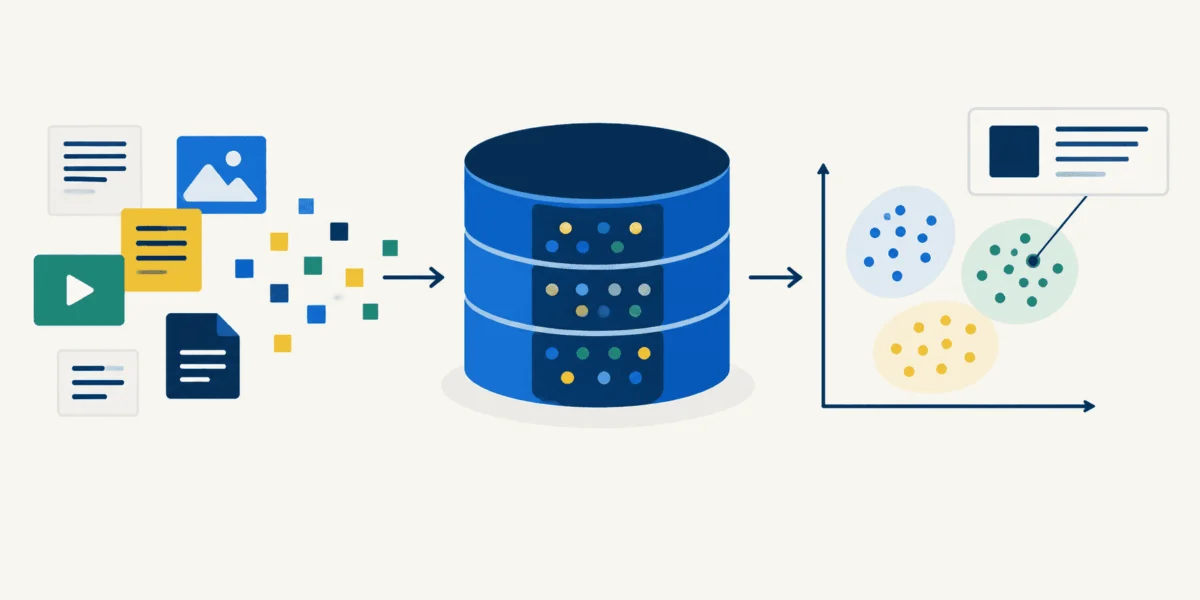
The modern landscape of artificial intelligence and machine learning relies heavily on efficient information retrieval systems, chief among them being the vector database. Unlike traditional relational databases or keyword-based search engines that query data using exact string matches, boolean logic, or inverted indices, vector databases operate by conceptualizing meaning. By transforming unstructured data—such as text documents, images, or audio files—into high-dimensional numerical vectors, these systems facilitate semantic search, enabling applications to retrieve information based on context, conceptual proximity, and semantic intent.
To demystify the underlying mechanics of these specialized systems, developers and data scientists can construct a functional, lightweight vector database from the ground up using only Python and NumPy. This hands-on implementation requires no specialized hardware accelerators like graphics processing units (GPUs), nor does it depend on proprietary cloud application programming interface (API) keys. By relying entirely on fundamental linear algebra principles and standard open-source libraries, engineers can gain a comprehensive, under-the-hood perspective on how enterprise-grade vector search engines index, query, scale, and manage massive repositories of high-dimensional data.
Understanding the Core Architecture of Vector Search
At its mathematical core, a vector database performs similarity searches by calculating the distance or directional alignment between high-dimensional numerical arrays. When a document is ingested, it passes through an embedding model—such as those provided by the sentence-transformers library—which converts natural language text into a dense vector, typically consisting of 384 dimensions. Each dimension represents a latent semantic feature learned during the model’s pre-training phase.
When a user submits a natural language query, the system transforms that query into a vector of identical dimensionality. By normalizing these vectors to a length of one, the mathematical operation required to measure semantic similarity simplifies to a straightforward dot product, which is equivalent to cosine similarity. Ranking an entire corpus of documents then reduces to a single, highly optimized matrix multiplication.
To execute this ten-step educational implementation, developers begin by establishing a clean workspace containing three fundamental components: a core database class file, a corpus of simulated documents equipped with metadata topic tags, and a test suite designed to verify operational integrity. Installing the primary dependencies, NumPy and sentence-transformers, sets the stage for the progressive construction of the database index, search routines, metadata filtering mechanisms, and serialization protocols.
Step-by-Step Implementation: From Setup to Scalability
The development process is structured into ten discrete, atomic phases. In the initial setup phase, developers initialize the environment and implement display helper functions to format search outputs cleanly, printing relevance scores, topic metadata, and truncated document snippets. The second step involves building the search index. Initializing the VectorDB class downloads the chosen embedding model, and invoking the addition method encodes the baseline corpus of 25 simulated documents. Notably, the memory footprint of the resulting index is independent of document length; whether a record consists of a six-word sentence or a multi-page essay, it maps uniformly to a fixed-size vector of 384 floating-point values, occupying precisely 1,536 bytes of raw storage.
In subsequent steps, the database demonstrates its core capabilities through empirical queries. When tasked with retrieving documents related to cellular energy supplies, the database successfully surfaces relevant passages concerning biological mitochondria. Crucially, subsequent searches demonstrate the power of semantic retrieval by processing queries that share zero overlapping words with the target documents—such as searching for baking phenomena using queries about sourdough fermentation or querying superhero concepts using character traits without explicitly naming the subjects. The retrieval engine matches intent and meaning rather than lexical strings.
As the tutorial progresses into intermediate operations, handling search scores becomes paramount. Vector search engines invariably return a predefined number of results, denoted as $k$, even when the underlying corpus contains no genuinely relevant information. Consequently, engineers must implement score thresholds or semantic floors in production environments to filter out low-confidence matches. Furthermore, metadata filtering mechanisms are introduced to narrow search results based on structured attributes, such as specific topic tags. This architecture prevents semantic false positives—such as retrieving a comic book reference regarding muscular biology when the user requested strict scientific literature.
Guard rails and error handling form another critical phase of the implementation. Robust database classes must enforce strict structural alignment between incoming text documents, their corresponding metadata dictionaries, and generated embedding vectors, raising descriptive exceptions when data arrays fall out of synchronization. Serialization is achieved through lightweight file input and output operations, storing numerical embeddings in compact binary .npy files for rapid loading while retaining human-readable metadata in standard JSON structures.
Analyzing Performance and Computational Scaling
The final phase of the development lifecycle addresses the critical question of computational scalability. While a baseline corpus of 25 documents allows for instantaneous query execution, evaluating performance against synthetically generated datasets reveals how vector databases behave under heavier enterprise loads. When scaling the index size from one thousand to one hundred thousand high-dimensional vectors, the linear scan time for matrix multiplication scales predictably.
Empirical benchmarks demonstrate that searching through one hundred thousand 384-dimensional vectors requires only a few milliseconds of compute time on standard central processing units, highlighting the raw efficiency of NumPy’s underlying vectorized operations. However, as datasets scale into millions or tens of millions of records, exhaustive linear scans become computationally prohibitive, necessitating advanced approximate nearest neighbor (ANN) indexing structures such as Hierarchical Navigable Small World (HNSW) graphs or inverted file indexes (IVF).
Broader Implications and Industry Impact
The educational exercise of building a vector database from scratch illuminates a fundamental reality of modern data infrastructure: the core algorithmic design principles remain largely consistent whether a system manages twenty-five documents or twenty-five million records. The primary differences lie in the underlying indexing structures, memory management strategies, and distributed computing frameworks utilized to accelerate search times at scale.
For software engineers, enterprise architects, and machine learning practitioners, understanding these foundational mechanics demystifies the commercial offerings currently dominating the artificial intelligence marketplace. By grasping how embedding normalization, dot-product similarity, metadata filtering, and matrix multiplication interact, technical teams are better equipped to evaluate, optimize, and deploy vector search solutions tailored to their specific operational requirements. As generative artificial intelligence, retrieval-augmented generation (RAG), and semantic search systems continue to proliferate across enterprise software stacks, mastering the mechanics of vector databases transitions from an academic curiosity to a core competency in modern software engineering.