

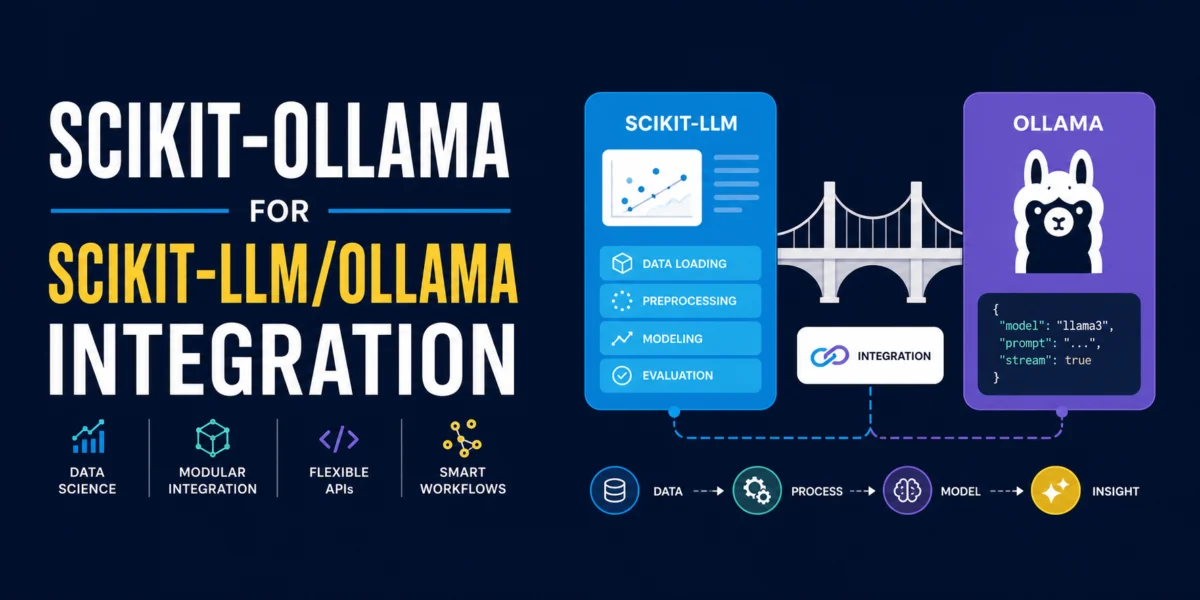







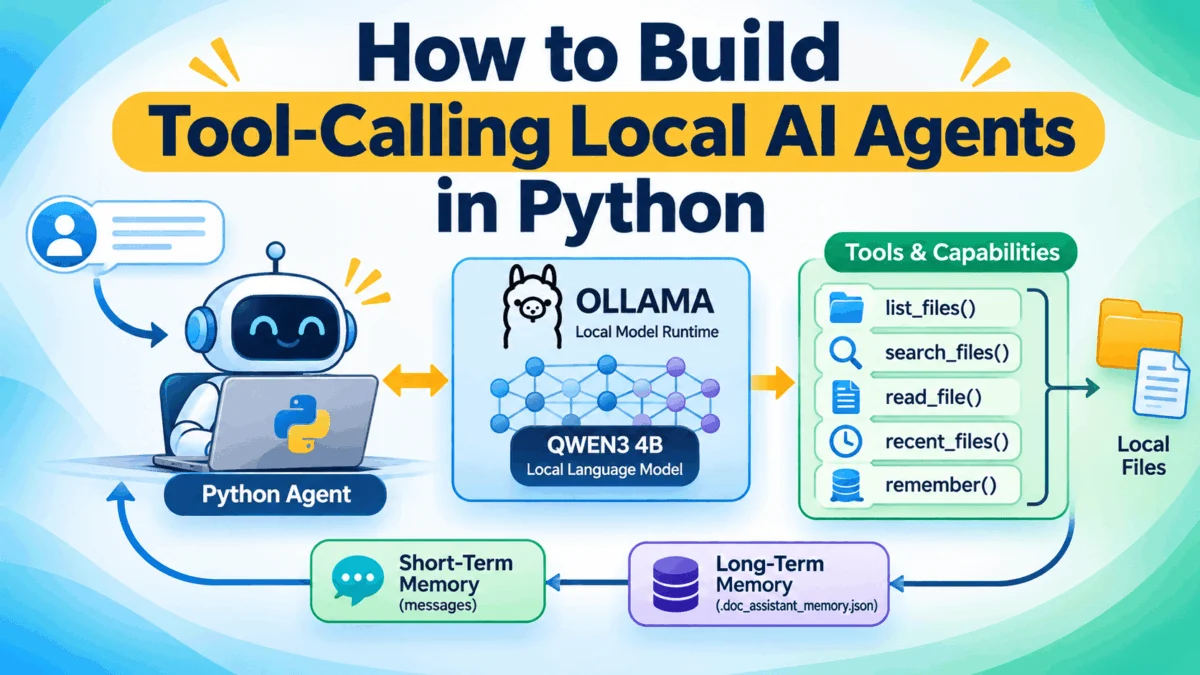
The integration of artificial intelligence into local development environments has reached a significant milestone with the popularization of open-weight large language models capable of executing structured tool calls. Traditional language models operate within isolated text-generation sandboxes, limiting their utility for practical software engineering tasks that require direct file system interaction. By leveraging local runtime frameworks such as Ollama and specialized compact models like Qwen3, developers can now construct autonomous, privacy-preserving AI agents capable of searching directories, parsing documents, and maintaining persistent memory entirely on local hardware without incurring cloud computing costs or relying on external API keys.
The Architecture of Local Tool-Calling Agents
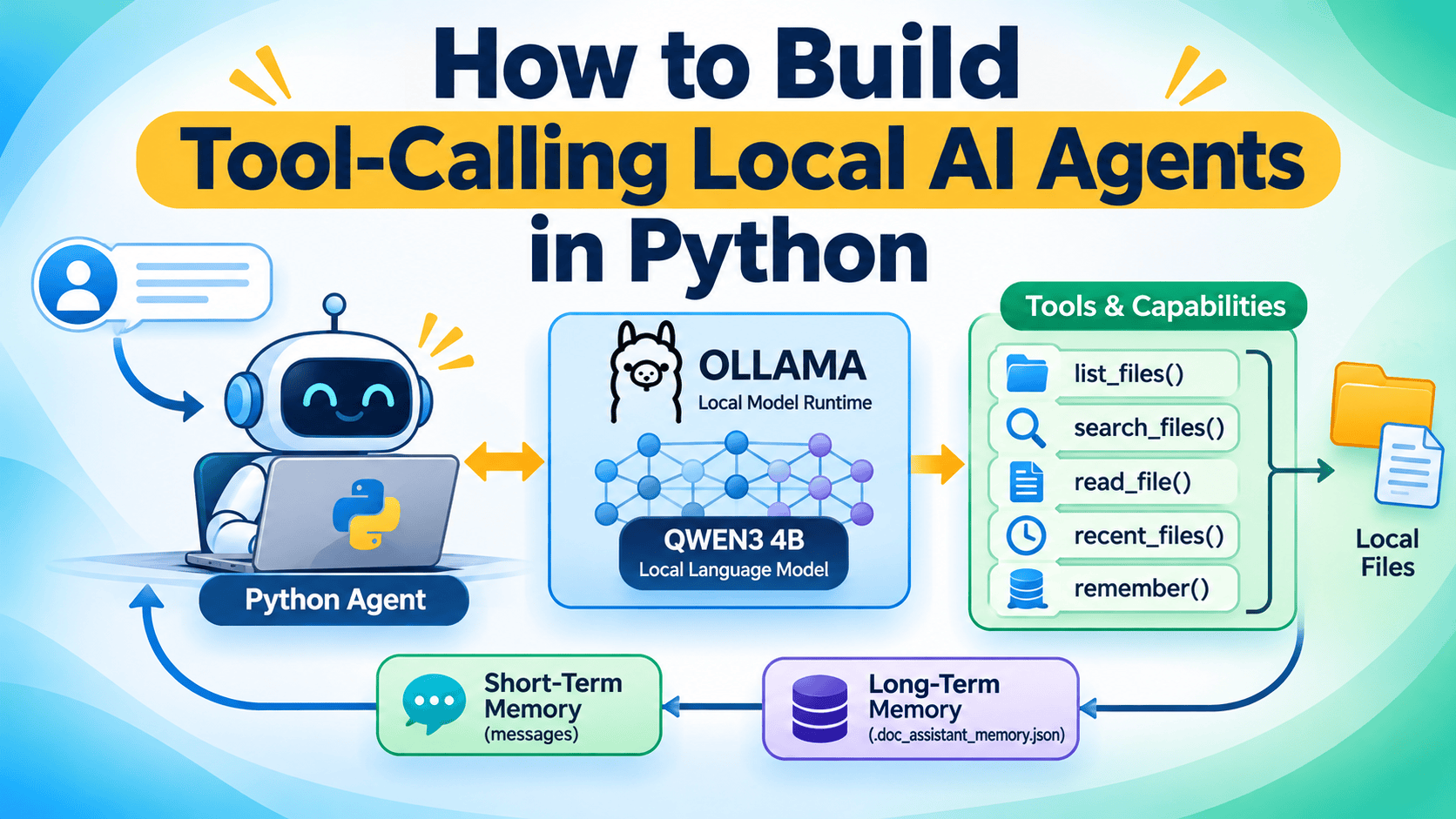
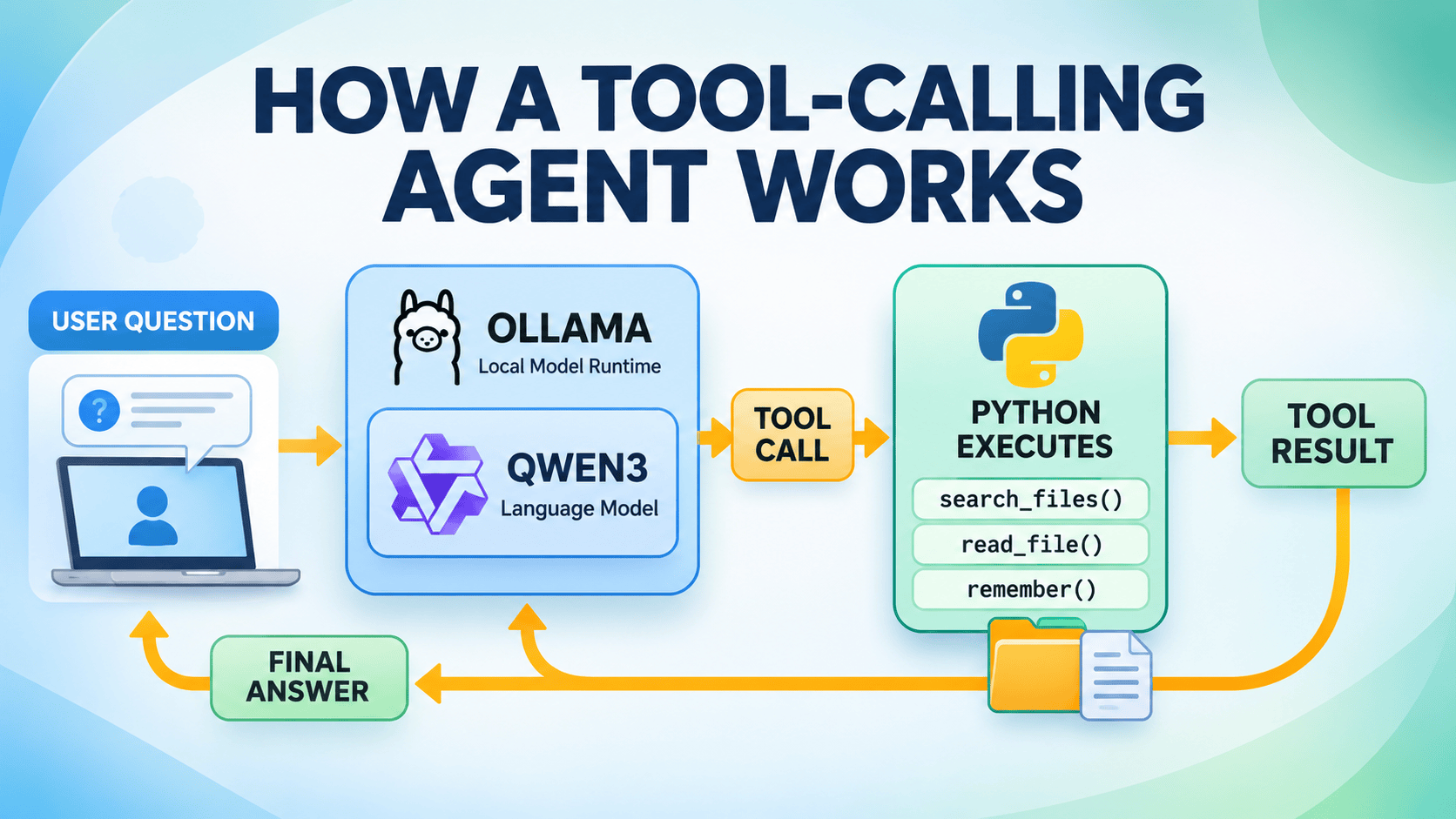
At the core of any modern AI agent lies the capability known as tool calling. While large language models excel at reasoning, linguistic synthesis, and instruction following, they lack native mechanisms to execute system-level operations. Tool calling bridges this gap by allowing the model to emit a structured JSON payload specifying a function name and corresponding arguments. The host application intercepts this request, executes the underlying Python function, and feeds the resulting output back into the conversation history as a specialized tool message.
This iterative exchange transforms a standard chat interface into an autonomous loop. The model can request a file search, evaluate the output, read specific lines from a targeted document, execute secondary searches based on prior findings, and finally synthesize a comprehensive response for the user. Maintaining this architecture locally requires careful orchestration of context windows, security boundaries, and memory management strategies.
Setting Up the Local Development Environment
Deploying a local tool-calling agent requires a modern Python runtime—ideally Python 3.10 or newer—alongside the Ollama desktop application or command-line server. The operational pipeline relies on the Qwen3 model, specifically the 4-billion-parameter variant, which is optimized for instruction-following and structured function calling while remaining lightweight enough to run efficiently on consumer-grade graphics hardware with approximately 2.5 GB of storage space.
Following the installation of Ollama and the acquisition of the model weights, developers establish an isolated virtual environment to manage project dependencies. The primary programmatic interface is provided by the official Python ollama client library, which communicates with the local server running by default on port 11434.
A critical parameter in local agent design is the context length. Because tool definitions, historical conversational turns, and extensive file search outputs accumulate rapidly within the context window, hardware memory limitations dictate maximum token limits. Developers frequently configure server startup parameters to allocate extended context windows—such as 32,000 tokens—while employing strict output truncation rules to ensure the underlying hardware offloads processing tasks efficiently to the GPU.
Designing Secure and Constrained Tools
Allowing an autonomous model to interact with a local file system introduces inherent security challenges. Left unconstrained, a language model might attempt to read sensitive system files or traverse directory paths outside the intended project scope. Robust local agent architecture implements strict functional boundaries through dedicated sanitization utilities.
To maintain system integrity, production-grade local agents rely on read-only operational paradigms for all functions except explicit memory storage. Path resolution helpers ensure that any relative path supplied by the model is programmatically joined to a defined root directory, resolved to absolute form, and validated to confirm it remains a legitimate descendant of the project folder. Any attempt to traverse upward using relative syntax or absolute system paths triggers a controlled exception, returning a descriptive error string to the model and allowing it to self-correct in subsequent iterations.
The functional toolset typically comprises five core capabilities:
- File Listing: Enumerating direct child directories and readable text files alongside byte-size metrics.
- Global Search: Performing case-insensitive substring matches across project files to locate specific keywords, returning formatted string outputs containing file paths, line numbers, and truncated text snippets.
- Targeted Reading: Extracting specific line ranges from identified files with structural metadata indicating overall document length.
- Temporal Auditing: Identifying recently modified files within a specified time horizon to assist with workflow tracking.
- Persistent Fact Storage: Appending verified user preferences or project facts to an isolated JSON-based memory file located outside the immediate project workspace.
Managing Short-Term and Long-Term Memory
Local language models possess no native persistence between distinct execution turns. Consequently, effective agent design necessitates a dual-tiered memory architecture encompassing short-term conversational history and long-term factual storage.
Short-term memory is managed via the message sequence array passed to the model during each chat invocation. Because this array expands continuously, unchecked growth leads to context exhaustion. Developers implement sliding-window trimming mechanisms that preserve the foundational system prompt and a defined number of recent user-assistant turns—typically the last six exchanges—while ensuring that tool requests and their corresponding outputs are never decoupled mid-exchange.
Long-term memory is achieved by reading external JSON storage files at startup and injecting stored facts directly into the system prompt. This methodology ensures that critical user instructions, testing protocols, and environmental configurations persist across distinct terminal sessions, providing the model with immediate contextual awareness from the first prompt onward.
Implications and Future Outlook for Local AI Engineering
The proliferation of local, tool-enabled AI agents marks a paradigm shift in software development workflows. By shifting complex text processing and project navigation from centralized cloud servers to local machines, enterprises and independent developers gain unprecedented data privacy, zero latency dependencies, and complete operational independence.
Industry analysts note that while local models currently exhibit higher error rates in complex tool selection compared to massive cloud-hosted proprietary systems, rapid advancements in open-weight architecture continue to narrow this performance gap. As hardware acceleration improves and compact models become increasingly proficient at structured argument generation, local AI agents are poised to become standard fixtures in modern integrated development environments, fundamentally transforming how engineers interact with local codebases.