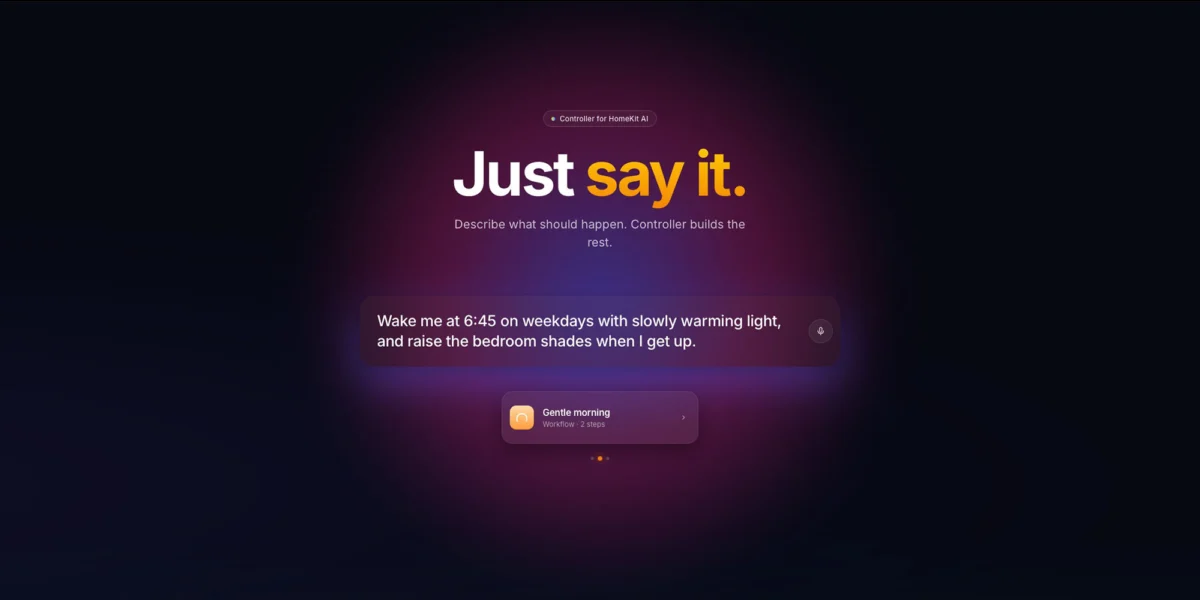
The professional smart home management ecosystem has reached a significant milestone with the latest update to Controller for HomeKit, introducing a sophisticated artificial intelligence integration designed to streamline the creation of complex home automations. Marketed under the tagline "Just say it," this new feature leverages natural language processing (NLP) to bridge the gap between user intent and technical execution. By allowing users to describe their desired smart home behaviors in plain English, the app automatically generates the necessary scenes, workflows, and conditional automations that would typically require extensive manual configuration within Apple’s native Home architecture.
The Evolution of Smart Home Configuration
The integration of artificial intelligence into the Controller for HomeKit app represents a shift from menu-driven interfaces to intent-based interaction. Traditionally, setting up a smart home automation involves a multi-step process: selecting a trigger (such as time of day or a sensor state), defining conditions (only if someone is home or if it is after sunset), and finally assigning specific actions to various devices. For users with dozens of smart lights, plugs, and sensors, this process can become cumbersome and error-prone.
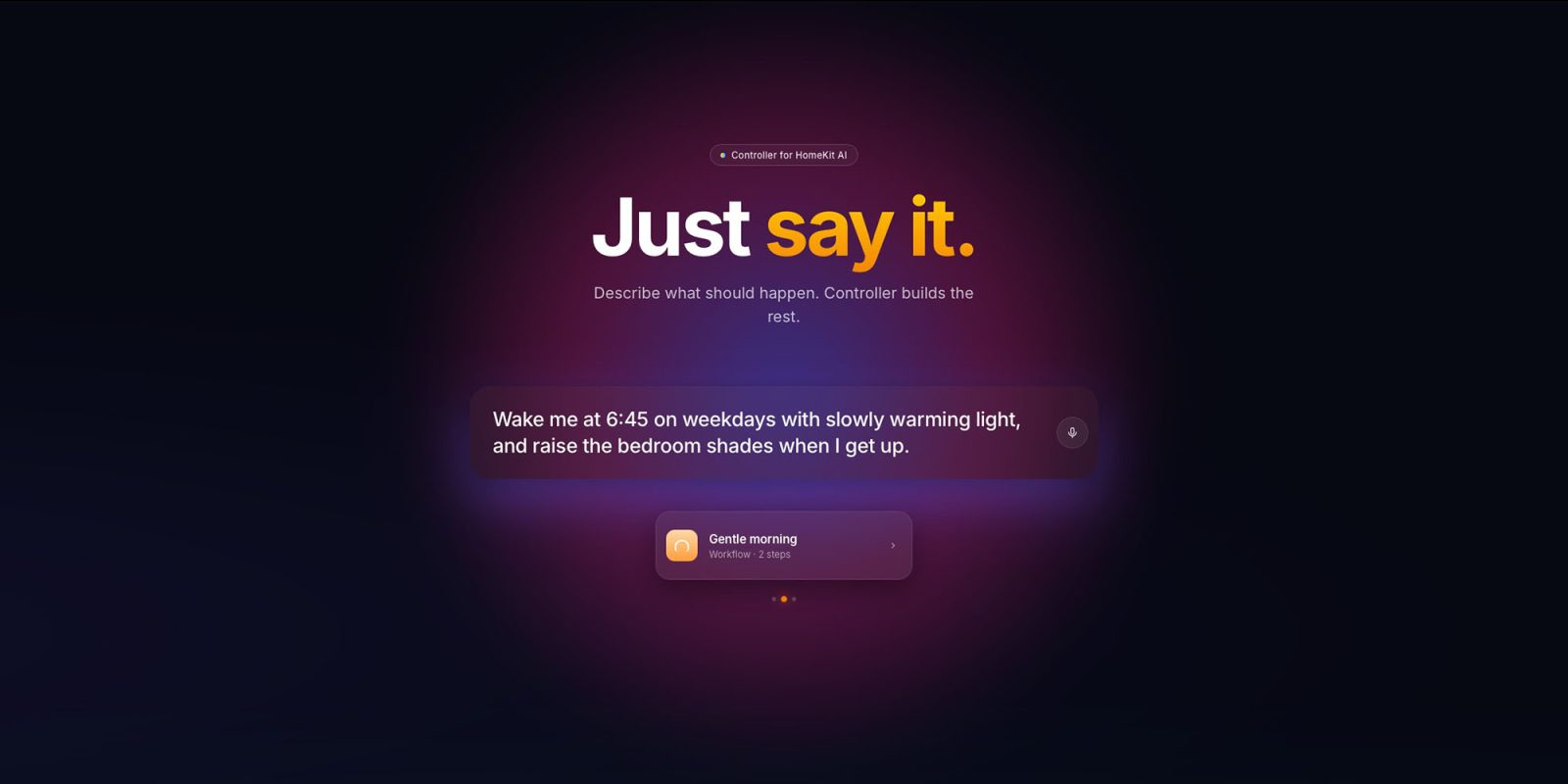
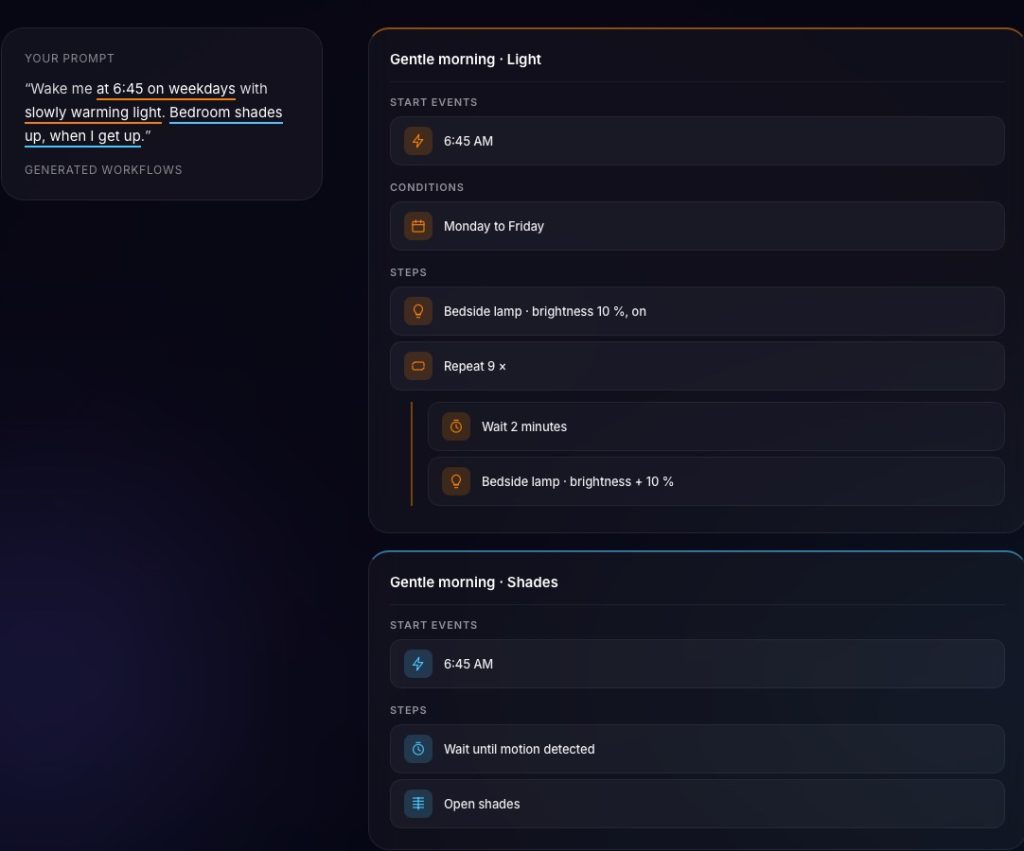
The "Just say it" feature aims to eliminate these friction points. According to the developer, the AI is trained to understand the nuances of home management, recognizing the relationships between different device categories and time-based triggers. When a user inputs a command like "Wake me at 6:45 on weekdays with slowly warming light, and raise the bedroom shades when I get up," the AI parses the sentence to identify the specific days (Monday through Friday), the precise time (06:45), the action (dimming and color temperature adjustment), and the subsequent trigger (motion detection or a secondary time delay for the shades).

Technical Breakdown and Capabilities
The new AI engine within Controller for HomeKit does not merely execute simple commands; it builds the underlying infrastructure of the HomeKit environment. This includes the creation of "Scenes"—pre-set states for groups of devices—and "Automations," which are the logic-based rules that govern those scenes.
Three primary use cases highlighted by the developer demonstrate the breadth of the AI’s logic:
- Complex Scheduling: "Wake me at 6:45 on weekdays with slowly warming light, and raise the bedroom shades when I get up." This command requires the AI to interface with lighting controllers and motorized window coverings while applying a temporal filter (weekdays).
- Atmospheric Scenes: "Movie night: dim the living room lights to 20% and close the curtains." This is a classic scene-creation task where the AI must identify all devices located in the "Living Room" zone and assign them specific states simultaneously.
- Conditional Security and Convenience: "If someone comes home after midnight, turn only the hallway light to 15%." This illustrates the AI’s ability to handle conditional logic, specifically "if-then" statements based on time constraints and occupancy sensors.
Preliminary testing of the feature indicates a high degree of accuracy. Even in environments with minimal hardware—such as a single smart plug and a few lights—the AI successfully mapped natural language requests to functional automations. For instance, a request to link a bedroom fan to the state of living room lights was processed correctly, creating a reactive automation that monitored the power state of one device to trigger another.
Market Context and the Smart Home Industry
The introduction of AI-driven configuration tools comes at a time when the smart home industry is grappling with complexity. While the Matter standard has improved interoperability between brands like Apple, Google, and Amazon, the actual "intelligence" of the smart home remains largely manual.
Data from industry analysts suggest that while over 60 million households in the United States utilize smart home devices, only a fraction of those users utilize advanced automations. Most consumers limit their usage to voice commands ("Siri, turn on the lights") or simple schedules. The barrier to entry for complex, "set-and-forget" logic has historically been the user interface. By moving toward a natural language model, Controller for HomeKit is positioning itself as a "Pro" tool that is accessible to a broader demographic.
Furthermore, this update precedes anticipated AI enhancements from Apple itself. With the announcement of "Apple Intelligence" and the overhaul of Siri, the tech giant is expected to bring similar natural language capabilities to the native Home app. However, third-party developers like those behind Controller for HomeKit often move faster, offering deeper customization options and power-user features—such as automation backups and advanced logging—that Apple has yet to implement.
Chronology of Controller for HomeKit Updates
The "Just say it" feature is the latest in a series of aggressive updates designed to make Controller for HomeKit the primary interface for Apple power users.
- Initial Launch: The app originally served as a tool for backing up HomeKit configurations, a feature notably absent from Apple’s own ecosystem.
- Advanced Logging: Later versions introduced a logging feature that allowed users to see exactly when and why an automation triggered, helping to troubleshoot "ghost" activations.
- Custom Icons and Workflows: The developer added the ability to create more visually organized dashboards and workflows that exceeded the grid-based limitations of the standard iOS Home app.
- AI Integration (Current): The latest update represents the transition from a management tool to a creation tool, using LLMs (Large Language Models) to interpret user desires.
Pricing Structure and Availability
Controller for HomeKit operates on a subscription-based model, which has become the industry standard for apps requiring ongoing server-side processing for AI features. The app offers two primary tiers:
- Essentials Tier: Priced at $40 per year, this tier includes basic AI features, backup capabilities, and advanced organization tools.
- Plus Tier: Priced at $80 per year, this tier is aimed at enthusiasts and professional installers, offering the full suite of AI automation building, extensive logging, and multi-home management.
A seven-day free trial is available for new users, allowing them to test the AI’s ability to interpret their specific home layouts before committing to a subscription.
Implications for Privacy and Data Security
As with any AI integration involving the home, privacy remains a paramount concern. Controller for HomeKit has historically emphasized local processing and data sovereignty. However, natural language processing of this complexity often requires off-device computation.
While the developer has not released a detailed white paper on the specific LLM used, typical implementations involve anonymizing the home’s metadata—device names and room labels—before sending the text prompt to a cloud-based model for parsing. The resulting logic is then sent back to the app to be written into the user’s local HomeKit database. This ensures that while the "intent" is processed in the cloud, the "execution" and the actual state of the home remain within Apple’s encrypted HomeKit framework.
Broader Impact on the Ecosystem
The success of "Just say it" could signal a new era for third-party HomeKit apps. For years, these apps have struggled to compete with the free, pre-installed Home app on iPhones and iPads. By offering a "smart" layer that Apple currently lacks, Controller for HomeKit provides a clear value proposition for the $40–$80 annual price tag.

If the AI feature proves reliable, it may force a shift in how smart home hardware is marketed. Instead of selling a "smart bulb," companies may begin focusing on the "experiences" that AI can build around those bulbs. The ability to generate a "Slowly warming morning" or a "Security-focused entryway" via a single sentence makes the hardware significantly more valuable to the end-user.
In the long term, this move by Controller for HomeKit is a harbinger of the "Autonomous Home." We are moving away from a world where users must be amateur programmers to enjoy a truly automated living space. As AI models become more adept at understanding the context of human life—knowing that "getting up" implies a certain sequence of events—the smart home will finally live up to its name, operating invisibly in the background based on simple, spoken directives.
For now, the "Just say it" feature stands as a powerful proof of concept and a functional tool for those looking to maximize their investment in the Apple Home ecosystem. As the developer continues to refine the AI’s understanding of complex home hierarchies, the gap between the average user and the power user is likely to narrow, driven by the simplicity of natural language.