The Open Home Foundation (OHF) has officially released a transformative update to the Matter integration within Home Assistant, marking a foundational shift in how the open-source smart home platform handles the industry’s most prominent interoperability standard. By transitioning the core engine of the Open Home Foundation Matter Server to matter.js—a high-performance TypeScript implementation—the developers have delivered a suite of improvements ranging from increased stability and faster reconnection speeds to advanced network visualization tools. This milestone represents the culmination of years of development, moving away from the traditional C++ software development kit (SDK) toward a solution tailored specifically for the agility of the open-source community.
The Strategic Shift to matter.js
The transition to matter.js is more than a simple software update; it is a strategic pivot for the Home Assistant ecosystem. Originally a passion project by Lead Developer Ingo Fischer, matter.js was designed to provide a more flexible, lightweight, and developer-friendly alternative to the official Matter SDK maintained by the Connectivity Standards Alliance (CSA). While the official C++ SDK served as a robust starting point for Matter’s initial launch in 2022, the Open Home Foundation identified a need for a codebase that could better serve the unique requirements of Home Assistant’s diverse user base.
In late 2024, Fischer joined the Open Home Foundation full-time and donated the matter.js project to the foundation. This move ensured that the project would remain an open-source asset, protected from commercial volatility. Over the last ten months, the development team focused on rebuilding the Matter Server—the software bridge between Matter-certified devices and the Home Assistant interface—on this new TypeScript foundation. The result, released as Matter Server version 9.0, is a drop-in replacement that offers significant performance gains and a more responsive user experience.
Chronology of Matter Integration in Home Assistant
The journey toward this upgrade has followed a rigorous timeline of development and certification:
- Late 2022: Within weeks of the official Matter 1.0 release by the CSA, Home Assistant introduced its first Matter integration, utilizing the Python-based server and the official C++ SDK.
- Early 2024: Ingo Fischer joined the Open Home Foundation. The foundation announced its intention to migrate the entire infrastructure to matter.js to gain better control over the development cycle.
- March 2025: Both Home Assistant and the Open Home Foundation Matter Server achieved official certification from the CSA, validating the platform as a reliable controller for the smart home.
- Late 2025 – Early 2026: A four-month intensive beta testing phase commenced. During this period, community members and power users contributed bug fixes and feature enhancements, refining the server for a general audience.
- June 2026: The official launch of Matter Server 9.0, incorporating Matter 1.5.1 specifications and advanced Thread 1.4 support.
Technical Enhancements and Performance Gains
The migration to matter.js addresses several long-standing pain points for smart home enthusiasts. The primary benefit is a noticeable reduction in latency during device reconnection and platform startup. Because the new server is optimized for the environments where Home Assistant typically runs—such as Raspberry Pi units and Home Assistant Green hardware—resource management is significantly improved.
Furthermore, the update brings Home Assistant into alignment with the Matter 1.5.1 specification. This is a critical step for the platform’s future, as it expands the range of supported device types. While early Matter versions focused on lighting, plugs, and basic sensors, Matter 1.5.1 and the upcoming 1.6 version include support for complex devices such as smart cameras, video doorbells, and advanced closures. The move to a TypeScript-based engine allows the OHF team to implement these new device classes with greater speed than was possible under the previous architecture.

Security has also been bolstered in this release. The Matter Server now performs more rigorous checks on Device Attestation Certificates (DACs). By default, uncertified devices or those using development-only certificates are restricted, preventing the inadvertent addition of potentially insecure hardware to a user’s local network. Additionally, the server now integrates certificate revocation data during the commissioning process, ensuring that devices with compromised security credentials cannot be added to the home environment.
Network Visualization and Troubleshooting
One of the most significant additions for power users is the new visualization tool within the Matter Server web interface. Smart home networks, particularly those utilizing the Thread protocol, have historically been "black boxes" where it was difficult to diagnose connectivity issues. Thread networks are mesh-based, meaning devices can "hop" through various routers to reach the main controller.
The new visualization feature maps these connections in real-time. Each device is represented as a node, with icons indicating its specific role:
- Leaders: Identified by a crown icon, these devices manage the network state.
- Routers: Shown with arrow icons, these act as intermediaries for data traffic.
- End Devices: Including "sleepy" battery-powered devices that only wake up to transmit data.
The system uses color-coded connection lines—green for strong signals, orange for medium, and red for weak—to provide an instant health check of the mesh network. For users with complex setups involving multiple Border Routers or access points, this transparency is invaluable for optimizing device placement and ensuring reliable local control.
Market Adoption and Industry Impact
The importance of this update is underscored by the rapid adoption of Matter within the Home Assistant community. According to current platform analytics, Matter is now active in approximately 38% of all Home Assistant instances. It currently ranks as the twelfth most popular integration out of thousands, a remarkable feat given that the standard has only been commercially available for a few years.
This high adoption rate reflects a broader industry trend toward local control and interoperability. By championing an open-source implementation like matter.js, the Open Home Foundation is positioning itself as a leader in the "Open Home" movement—an initiative that prioritizes privacy, choice, and durability over proprietary cloud-based ecosystems.
Industry experts have noted that Home Assistant’s success with Matter serves as a blueprint for other platforms. Ward Zhou, a prominent smart home journalist, observed that the new server has evolved into "the ultimate Matter controller and troubleshooting tool," highlighting the role of the open community in pushing the standard forward.
Official Responses and Community Contributions
The Open Home Foundation has emphasized that this project was a collaborative effort. Funding for the development was provided through Home Assistant Cloud subscriptions and the sale of official hardware, such as the Home Assistant SkyConnect. This model allows the foundation to hire full-time developers like Fischer to work on critical infrastructure that benefits the entire smart home industry.
"The launch of a new Matter experience in Home Assistant shows what’s possible with your support," the foundation stated, acknowledging the role of its user base. The beta program, in particular, was praised for its short feedback loops, allowing non-programmers to contribute by reporting real-world edge cases in diverse network environments.
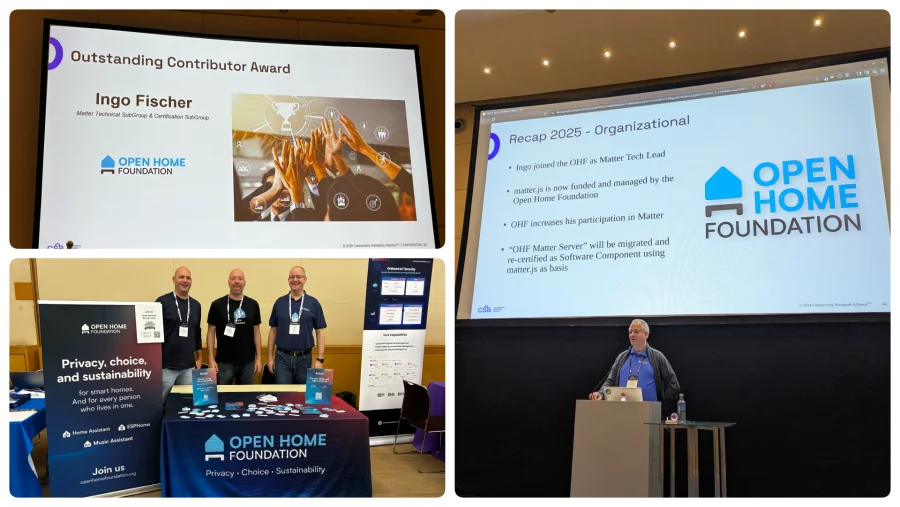
At the Connectivity Standards Alliance (CSA) Member Meeting in March 2026, Ingo Fischer was recognized with an Outstanding Contributor Award, signaling the industry’s respect for the work being done within the Home Assistant ecosystem. This recognition validates the idea that open-source contributions are essential to the long-term viability of global standards like Matter.
Looking Ahead: The Future of Matter 1.6 and Beyond
With the foundation now firmly established on matter.js, the Open Home Foundation is looking toward the next stages of the Matter roadmap. Support for Matter 1.6 is already in development, which is expected to further refine device management and energy monitoring capabilities.
The integration of Thread 1.4 via an updated OpenThread Border Router (OTBR) app also signals a move toward even more robust networking. Thread 1.4 introduces features that make it easier for border routers from different manufacturers to work together seamlessly, reducing the likelihood of "split" networks that have plagued early adopters of the technology.
As the smart home market continues to mature, the ability for users to visualize, secure, and rapidly update their Matter networks will be a key differentiator. With the release of Matter Server 9.0, Home Assistant has not only kept pace with the industry but has established a new benchmark for how open-source platforms can implement and enhance global technology standards. The Open Home Foundation invites users to follow their public roadmap as they continue to build toward a future where the smart home is accessible, private, and truly interoperable.