The financial and privacy toll of relying exclusively on cloud-based artificial intelligence APIs has become a pressing concern for software developers, students, and hobbyists alike. According to internal cost telemetry provided by Nous Research, a typical coding session utilizing commercial cloud AI infrastructure incurs costs ranging from $0.60 to $0.80 per run. For heavier, multi-step agentic automation workflows—such as recursive code refactoring, large-scale codebase analysis, and automated testing—these expenditures can rapidly escalate to between $5.00 and $20.00 per session. Beyond direct financial outlays, cloud-dependent architectures introduce a significant security trade-off: every proprietary file, sensitive codebase, intellectual property asset, and conversational prompt is transmitted across the internet and processed on external corporate servers.
To address these vulnerabilities, the open-source community has increasingly championed localized execution models. By integrating Nous Research’s Hermes Agent with Ollama’s open-weight model serving infrastructure, developers can construct a fully localized, zero-cost agentic workflow. This architecture guarantees that sensitive data, source code, and personal files never leave the host hardware.
The Architecture of Local Agentic AI
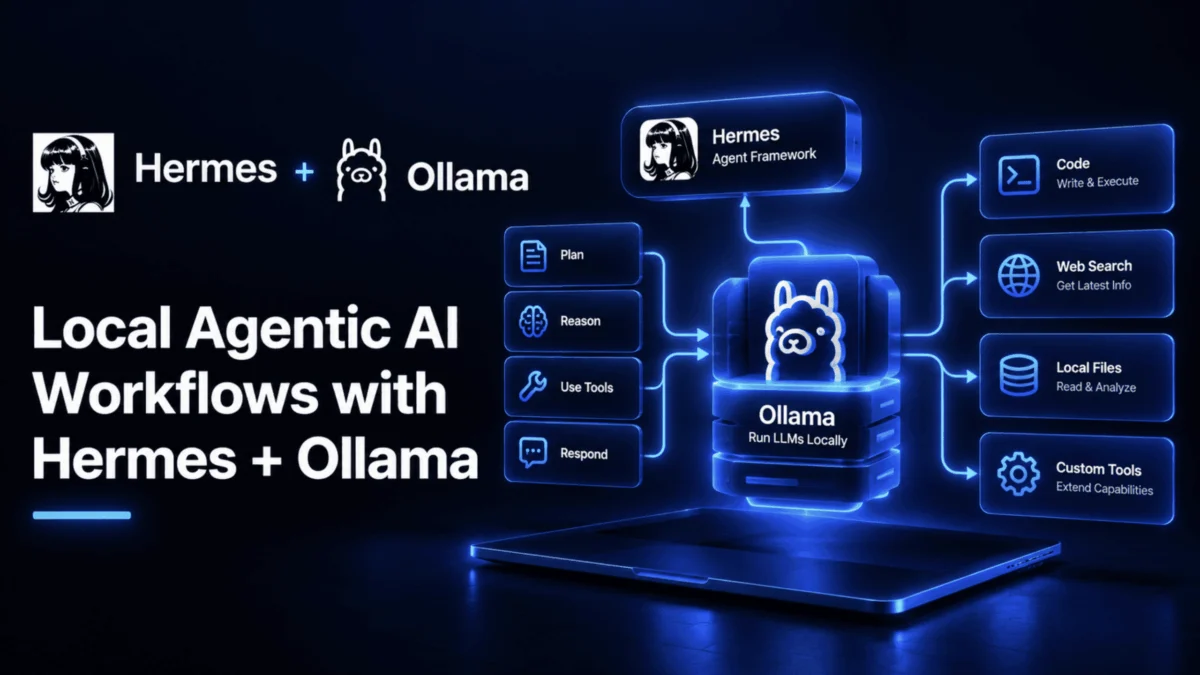
The deployment relies on a distinct division of labor between two primary software layers: the inference engine and the orchestration agent.
Ollama functions as the foundational serving layer. It automates the download, execution, and resource management of open-weight large language models directly on local hardware. Crucially, Ollama exposes an OpenAI-compatible API endpoint located at /v1/chat/completions. Because this local endpoint mirrors the JSON request-and-response schema of commercial cloud APIs, client software can communicate with a locally resident model using standard integration pathways, substituting localhost for a remote internet address.
Operating above Ollama is Hermes Agent, an open-source autonomous agent developed by Nous Research and distributed under the permissive MIT license. Unlike a basic chat interface, Hermes is engineered for genuine agentic execution. It possesses the capability to modify local files, execute terminal commands, browse the web, and delegate complex tasks to isolated sub-agents equipped with specialized toolsets.
The synergy between these two components creates a closed-loop system. Ollama’s sole responsibility is processing tensor computations and generating token completions, while Hermes acts as the operational brain—evaluating task requirements, determining when to invoke specific tools, interpreting execution outputs, and managing persistent project memory.
Core Capabilities and Operational Mechanics
Hermes Agent differentiates itself from standard command-line assistants through several advanced subsystems designed for persistent, multi-platform deployment.
Persistent Memory and Automated Skill Generation
Traditional AI interactions suffer from amnesia, requiring users to repeatedly supply context, coding standards, and architectural constraints at the start of every session. Hermes incorporates a persistent memory architecture that catalogs project histories over time. Crucially, the agent can auto-generate reusable "skills" based on how it successfully resolved historical problems. This prevents the system from starting from zero during subsequent development cycles, progressively tailoring its operational efficiency to the specific workflows of the user.
Comprehensive Sandboxing Backends
Because autonomous agents possess the authority to execute terminal commands and modify files, system security is paramount. Hermes features a robust sandboxing architecture supporting five distinct isolation backends: local execution, Docker containers, Secure Shell (SSH) connections, Singularity containers, and Modal cloud infrastructure. This ensures that potentially destructive shell commands or unverified scripts executed by the agent are safely sequestered away from the host operating system.
Unified Messaging Gateways
To extend utility beyond the local development environment, Hermes features a messaging gateway that bridges the agent’s core memory and toolset to external communication channels. Through this gateway, the identical agent instance can be accessed via Telegram, Discord, Slack, WhatsApp, and email, allowing users to delegate background automation tasks from mobile devices while away from their desks.
Hardware Requirements and Performance Scaling
Deploying large-weight models locally requires careful alignment between hardware specifications and workload demands. Performance scales directly with RAM bandwidth, processor core counts, and dedicated video random access memory (VRAM).
| Component | Minimum Specification | Recommended Specification |
|---|---|---|
| RAM | 8 GB (suitable for 3B parameter models) | 32 GB or higher (required for 27B+ models) |
| Storage | 5 GB free disk space | 30+ GB free space (for multi-model storage) |
| CPU | 4 processing cores | 8 or more processing cores |
| GPU | Not strictly required | NVIDIA GPU with 8+ GB VRAM |
Performance metrics vary significantly depending on the underlying hardware profile. CPU-only deployments remain fully functional but introduce notable latency. For instance, executing a 9-billion parameter model on a modern 8-core CPU typically yields an inference speed of approximately 10 tokens per second. Conversely, scaling up to a 31-billion parameter model on CPU hardware reduces throughput to between 2 and 5 tokens per second, resulting in response generation times of 30 to 120 seconds per query.
While acceptable for background data processing, such latencies can impede interactive development. The inclusion of an NVIDIA GPU with adequate VRAM dramatically accelerates token generation via partial or complete layer offloading.
Step-by-Step Implementation Guide
Establishing a local agentic workflow requires installing the serving backend, configuring an agent-compatible model, and initializing the Hermes environment.
Step 1: Installing and Verifying Ollama
Users initiate the deployment by installing the Ollama binary via the official installation script:
curl -fsSL https://ollama.com/install.sh | shOnce installation completes, verification confirms that the service daemon is active and listening for local requests:
ollama --version
curl http://localhost:11434/api/tags
A correct installation returns the installed version string followed by an empty JSON array ("models":[]), confirming that the server is operational but has not yet loaded any models.
Step 2: Selecting and Downloading a Tool-Capable Model
The single most critical decision in configuring an agentic workflow is model selection. Standard large language models capable of basic conversation are insufficient for autonomous agent operations; the model must support native tool calling to invoke file operations and execute terminal commands.
| Model Identifier | Size on Disk | Minimum RAM | Tool Calling Support | Primary Use Case |
|---|---|---|---|---|
gemma4:31b |
~20 GB | 24+ GB | Yes | Optimal reasoning, robust tool execution, and code manipulation |
gemma2:27b |
~16 GB | 20+ GB | No | Conversational queries and general knowledge retrieval |
gemma2:9b |
~5 GB | 8+ GB | No | Rapid chat responses and lightweight Q&A |
llama3.2:3b |
~2 GB | 4+ GB | No | Ultra-lightweight quick answers |
Because Hermes requires reliable tool invocation to function as an autonomous agent, models lacking native tool-call support are restricted to conversational chat. Consequently, deploying gemma4:31b serves as the baseline for file-organizing and web-searching workflows.
After pulling the model via Ollama, administrators verify endpoint functionality by submitting a test payload matching the OpenAI-compatible chat completion schema:
curl http://localhost:11434/v1/chat/completions
  -H "Content-Type: application/json"
  -d '
    "model": "gemma4:31b",
    "messages": ["role": "user", "content": "Say hello"],
    "max_tokens": 50
  '
Step 3: Configuring Hermes Agent
With Ollama serving the model locally, Hermes must be pointed toward the local endpoint. Configuration can be executed via the setup wizard by designating Custom Endpoint as the provider, entering http://localhost:11434/v1 as the base URL, leaving the authentication token blank, and assigning gemma4:31b as the active model.
Alternatively, users can manually configure ~/.hermes/config.yaml:
model:
  default: "gemma4:31b"
  provider: "custom"
  base_url: "http://localhost:11434/v1"
The provider: "custom" parameter instructs Hermes to utilize standard OpenAI-compatible integration patterns without seeking commercial API credentials.
Step 4: Optimizing Context Windows and Memory Persistence
Out of the box, Ollama defaults to a 2,048-token context window. This capacity is inadequate for agentic operations, which require handling extensive tool schemas, system prompts, and file contents simultaneously. Hermes requires a minimum context window of 64,000 tokens to perform reliably.
Administrators expand the context window by creating a custom Ollama Modelfile:
cat > /tmp/Modelfile << 'EOF'
FROM gemma4:31b
PARAMETER num_ctx 64000
EOF

ollama create gemma4-64k -f /tmp/Modelfile
To prevent Ollama from automatically unloading models after five minutes of inactivity—which introduces severe latency when processing asynchronous messages from messaging gateways—the keep-alive parameter should be extended:
curl http://localhost:11434/api/generate
  -d '"model": "gemma4:31b", "keep_alive": "24h"'
Expanding Capabilities: Telegram Gateway and Cloud Fallbacks
To maximize operational flexibility, developers can extend the local agent into a hybrid architecture by integrating external messaging platforms and conditional cloud fallbacks.
Telegram Gateway Integration
By acquiring a bot token through @BotFather on Telegram, users can interface with their local agent remotely. Updating the configuration file links the existing agent memory to the messaging platform:
model:
  default: "gemma4:31b"
  provider: "custom"
  base_url: "http://localhost:11434/v1"
platforms:
  telegram:
    enabled: true
    token: "YOUR_TELEGRAM_BOT_TOKEN"
Launching the Hermes gateway provides continuous, secure remote access to local files and system commands from any mobile device, entirely bypassing commercial server storage.
Hybrid Cloud Fallbacks
While local models handle the vast majority of routine automation tasks, highly complex reasoning challenges may occasionally exceed the capabilities of open-weight models. To mitigate this without abandoning the local-first paradigm, developers can configure conditional fallback providers:
model:
  default: "gemma4:31b"
  provider: "custom"
  base_url: "http://localhost:11434/v1"
fallback_providers:
  - provider: openrouter
    model: anthropic/claude-sonnet-4
This configuration ensures that the fallback provider is invoked exclusively when the primary local model encounters persistent execution failures or malformed outputs. The vast majority of everyday operations remain entirely local and free, while extraordinarily difficult problem sets receive support from commercial cloud infrastructure only when mathematically or logically necessary.
Broader Implications and Industry Impact
The maturation of local agentic frameworks like Hermes and Ollama represents a structural shift in software development and data security. Historically, organizations and individual developers faced a binary choice: sacrifice data privacy to leverage advanced cloud-based agentic workflows, or accept severe functional limitations by remaining entirely offline.
By demonstrating that large-weight, tool-capable models can be efficiently hosted on consumer-grade hardware and orchestrated via autonomous agents, this architecture democratizes advanced AI automation. It eliminates recurring operational expenses for hobbyists and students while providing enterprises with an airtight compliance mechanism that satisfies strict regulatory frameworks regarding data sovereignty and intellectual property protection. As open-weight models continue to narrow the performance gap with proprietary cloud endpoints, localized agentic workflows are positioned to become the default standard for secure, cost-effective software engineering.