The integration of large language models into traditional machine learning pipelines has rapidly transitioned from an experimental novelty to an enterprise necessity. As data scientists increasingly blend standard scikit-learn workflows with generative artificial intelligence capabilities, managing the lifecycle of these hybrid systems presents unique engineering challenges. Chief among these is reproducibility. Traditional machine learning asset management tools often fail when confronted with the dynamic, continuously updating backends of large language models. To bridge this gap, engineers are turning to a robust methodological combination: Scikit-LLM for seamless model integration and MLflow for comprehensive end-to-end lifecycle management.
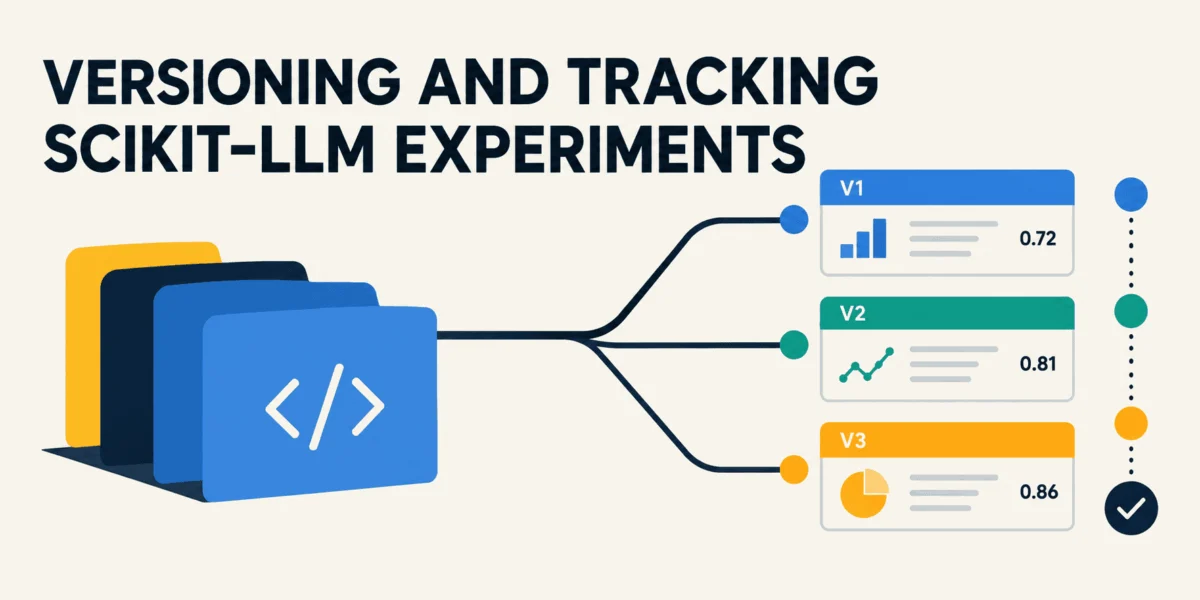
Building, tracking, comparing, and registering scikit-learn pipelines that incorporate large language models require a formalized protocol. Without strict version control, updates to underlying LLM backends can silently break production environments, alter classification outputs, or degrade predictive performance. By leveraging Scikit-LLM alongside an MLflow model registry backed by a persistent database, development teams can establish a rigorous framework that guarantees exact reproducibility, comprehensive parameter auditing, and seamless promotion of high-performing models to production stages.
The Evolution of Hybrid Machine Learning Architectures
The architectural paradigm of machine learning has shifted over the past several years. Historically, pipelines constructed using scikit-learn relied on static numerical transformations, linear models, and deterministic estimators. These components could be easily serialized using native Python pickling utilities, ensuring that a model trained on Tuesday would yield identical outputs when queried on Wednesday. However, the advent of large language models introduced a high degree of stochasticity and external dependency.
LLMs are rarely static. Whether hosted locally via lightweight open-source runtimes or accessed through external APIs, model weights, tokenizers, and underlying quantization files frequently undergo updates. Furthermore, integrating LLMs into scikit-learn pipelines means that text preprocessing, embedding generation, and zero-shot classification steps are now bound within a single execution graph. If an underlying model file—such as a GGUF or BIN format artifact—is modified or replaced without proper versioning, the entire pipeline’s integrity is compromised.
To mitigate these risks, the industry has adopted experiment tracking frameworks traditionally reserved for deep learning. MLflow provides the necessary infrastructure to log not just the final artifact, but every hyperparameter, dataset identifier, and environment configuration associated with a training run. When paired with Scikit-LLM—a library designed to bridge the gap between scikit-learn’s intuitive API and state-of-the-art language models—developers gain the ability to treat LLM-driven components with the same rigorous version control applied to traditional tabular models.
Setting Up the Development Environment for LLM Versioning
Implementing a production-grade experiment tracking workflow begins with proper environment initialization. Whether operating within a local development machine or a cloud-hosted notebook environment such as Google Colab, developers must install the correct dependencies to prevent version mismatches. The primary software stack relies on the scikit-learn ecosystem, mlflow, and the specialized scikit-llm package configured with local execution extras.
pip install "scikit-llm[gpt4all]" mlflowThe inclusion of the gpt4all extra is critical, as it enables the execution of lightweight, open-source language models locally without requiring external commercial API keys. In enterprise or secure research settings where data privacy is paramount, local execution ensures that sensitive training text never leaves the local infrastructure.
Following package installation, the environment configuration requires initializing dummy credentials for Scikit-LLM to satisfy its internal structural checks during local execution. Concurrently, the MLflow tracking URI must be pointed toward a persistent database backend, such as a SQLite database file, which serves as the foundation for the MLflow Model Registry. Setting up a dedicated experiment name—such as "Scikit-LLM-Versioning"—isolates the telemetry data, preventing clutter and ensuring that all subsequent pipeline iterations are systematically grouped for comparative analysis.
Constructing and Logging Baseline Pipelines
With the infrastructure established, the next phase involves building a baseline pipeline. In a typical zero-shot classification scenario, text data is fed directly into a language model configured to categorize inputs without prior task-specific fine-tuning. For initial testing, developers often deploy lightweight, highly efficient models to minimize latency and resource consumption.
Consider a baseline pipeline utilizing a compact Orca Mini model variant. By wrapping the ZeroShotGPTClassifier inside a standard scikit-learn Pipeline object, the text processing and classification logic are encapsulated into a single unified interface.
import mlflow
import mlflow.sklearn
from sklearn.pipeline import Pipeline
from skllm.config import SKLLMConfig
from skllm.models.gpt.classification.zero_shot import ZeroShotGPTClassifier

# Configure dummy keys for local execution
SKLLMConfig.set_openai_key("local-execution-key")
SKLLMConfig.set_openai_org("local-execution-org")

# Configure MLflow tracking backend and experiment
mlflow.set_tracking_uri("sqlite:///mlflow.db")
mlflow.set_experiment("Scikit-LLM-Versioning")

# Define sample dataset for zero-shot classification
X_train = [
    "The application crashed immediately.",
    "Absolutely wonderful support team!",
    "It works fine but is a bit slow."
]
y_train = ["bug", "praise", "feedback"]

LLM_V1 = "gpt4all::orca-mini-3k-71m-q4_0.gguf"
pipeline_v1 = Pipeline([
    ('llm_classifier', ZeroShotGPTClassifier(model=LLM_V1))
])

with mlflow.start_run(run_name="Baseline_Orca_Mini") as run_v1:
    mlflow.log_param("llm_backend", "gpt4all")
    mlflow.log_param("llm_model_file", LLM_V1)
    pipeline_v1.fit(X_train, y_train)

    # Log model using cloudpickle to support complex pipeline structures
    mlflow.sklearn.log_model(
        pipeline_v1,
        "model",
        serialization_format="cloudpickle"
    )
    print(f"V1 Logged - Run ID: run_v1.info.run_id")
During this logging phase, explicit parameter tracking is executed. Recording the llm_backend and the specific llm_model_file ensures complete traceability. Furthermore, overriding strict default type checking by specifying serialization_format="cloudpickle" is vital. Standard pickling utilities often struggle with the complex dependency trees and dynamic objects inherent to LLM wrappers; cloudpickle ensures that the entire scikit-learn pipeline object, along with its internal configurations, is accurately preserved as an MLflow artifact.
Simulating Backend Upgrades and Model Swapping
In real-world software engineering environments, models are rarely static. Performance bottlenecks, changing accuracy requirements, or hardware availability frequently necessitate upgrading the underlying LLM backend. To demonstrate MLflow’s capability in handling model iterations, developers can construct a secondary, upgraded pipeline utilizing a heavier, more capable architecture—such as a Falcon-based model variant.
LLM_V2 = "gpt4all::ggml-model-gpt4all-falcon-q4_0.bin"
pipeline_v2 = Pipeline([
    ('llm_classifier', ZeroShotGPTClassifier(model=LLM_V2))
])

with mlflow.start_run(run_name="Upgraded_Falcon") as run_v2:
    mlflow.log_param("llm_backend", "gpt4all")
    mlflow.log_param("llm_model_file", LLM_V2)
    pipeline_v2.fit(X_train, y_train)

    mlflow.sklearn.log_model(
        pipeline_v2,
        "model",
        serialization_format="cloudpickle"
    )
    print(f"V2 Logged - Run ID: run_v2.info.run_id")
Isolating this upgraded pipeline within a distinct MLflow run generates a unique run identifier, separating the telemetry of the new model architecture from the baseline. This isolation allows engineering teams to perform side-by-side evaluations of execution times, memory footprints, and classification accuracy without risking data contamination between experiments.
Auditing, Comparing, and Evaluating Experiment Runs
Once multiple pipeline iterations have been executed and logged, the focus shifts from creation to auditing. MLflow provides powerful search and retrieval APIs that allow data scientists to query the experiment database programmatically and structure the results into analytical data structures, such as pandas DataFrames.
experiment = mlflow.get_experiment_by_name("Scikit-LLM-Versioning")
runs_df = mlflow.search_runs(experiment.experiment_id)
comparison_df = runs_df[['run_id', 'tags.mlflow.runName', 'params.llm_model_file', 'status']]
print("Experiment Tracking Audit:")
display(comparison_df)
This auditing process is essential for maintaining governance over machine learning operations. In complex development cycles, preliminary runs often fail due to syntax errors, missing dependencies, or out-of-memory exceptions. An effective audit DataFrame displays not only successfully completed executions (FINISHED) but also aborted or failed attempts (FAILED). By reviewing this comprehensive log, engineering leadership can analyze historical trial-and-error patterns, ensuring that only stable, thoroughly vetted code paths are considered for production deployment.
Promoting Models to the MLflow Model Registry
The ultimate objective of experiment tracking is the transition from a rough draft to a governed production asset. Once an optimal pipeline has been identified—either through manual selection of a specific run name or via automated metric sorting—it must be promoted to the MLflow Model Registry.
The model registry acts as a centralized repository where versioned models are cataloged, staged, and managed throughout their operational lifecycle. Promoting a model involves referencing its specific run ID, constructing its artifact Uniform Resource Identifier (URI), and registering it under a standardized production name.
best_run_id = runs_df[runs_df['tags.mlflow.runName'] == 'Upgraded_Falcon'].iloc[0]['run_id']
model_uri = f"runs:/best_run_id/model"

registered_model = mlflow.register_model(
    model_uri=model_uri,
    name="Production_ZeroShot_Classifier"
)

print(f"Successfully registered model 'registered_model.name'")
print(f"Current Registry Version: registered_model.version")
For automated continuous integration and continuous deployment (CI/CD) pipelines, manual selection can be replaced by dynamic querying. By sorting historical runs based on quantitative performance metrics—such as validation accuracy, F1 score, or inference latency—systems can programmatically identify the absolute top performer and submit it to the registry without human intervention.
# Retrieving runs ordered by performance metrics
best_runs_df = mlflow.search_runs(
    experiment_ids=[experiment.experiment_id],
    order_by=["metrics.accuracy DESC"]
)

metric_winner_id = best_runs_df.iloc[0]['run_id']
print(f"Top performing run ID based on metrics: metric_winner_id")
Broader Implications and Enterprise Best Practices
The integration of Scikit-LLM and MLflow addresses a critical vulnerability in modern artificial intelligence deployment: the black-box nature of language model updates. As enterprises increasingly rely on hybrid architectures that combine structured tabular data processing with unstructured text comprehension, maintaining rigorous audit trails is no longer optional.
Failing to version LLM backends can lead to silent regressions, where an upstream provider update subtly alters tokenization or output formatting, causing downstream business logic to fail unexpectedly. By enforcing a structured two-step workflow—where rough drafts are logged and explored in an experimental tracking phase, and only verified champions are promoted to the formal model registry—organizations can prevent registry bloat and maintain strict quality control.
Ultimately, adopting this rigorous tracking methodology ensures that generative artificial intelligence initiatives remain stable, reproducible, and enterprise-ready. As the regulatory landscape surrounding automated decision-making tightens, the ability to trace every production prediction back to its exact pipeline configuration, code version, and underlying model file will remain a cornerstone of responsible AI engineering.