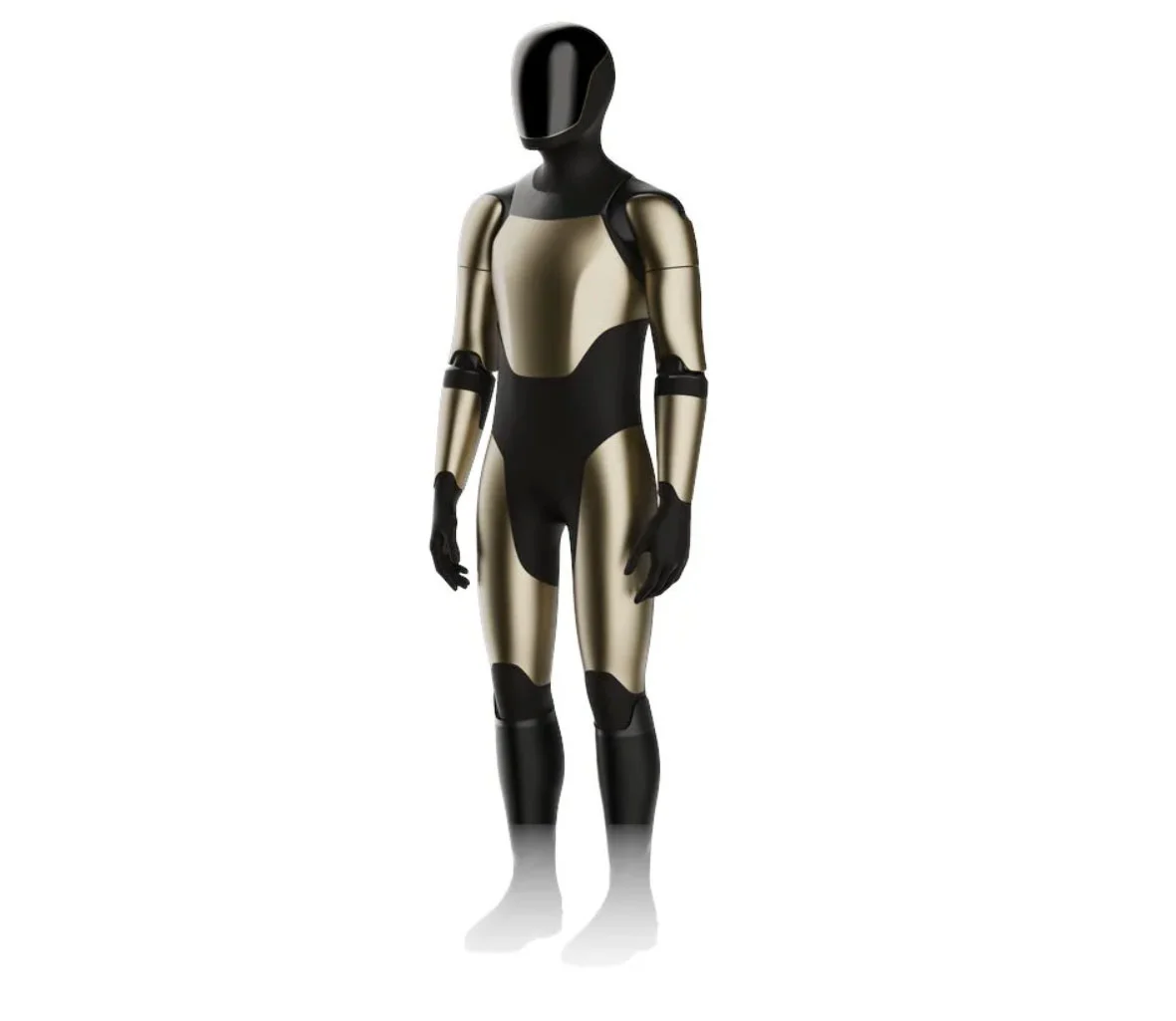
New visual assets discovered within Tesla’s official Android application have provided the public with its first look at the next iteration of the company’s humanoid robot program, designated as Optimus Gen 3. These images, which surfaced in late September 2026, showcase a significantly more polished aesthetic compared to the utilitarian, exposed-joint prototypes that characterized earlier iterations. The leaked files depict a robot featuring a sophisticated champagne-gold torso and sleek, matte-black protective plating covering the knee and shin assemblies. Perhaps most notably, the design incorporates enclosed hips, moving away from the skeletal, functional-first appearance of previous generations toward a form factor that closely resembles a finished consumer or industrial product.
The discovery of these images, cataloged in the application’s assets folder under filenames including robot_closeup_gen3.png and robot_home_full_body_gen3.png, has reignited discussions regarding Tesla’s timeline for transitioning its robotics division from a research and development initiative into a commercially viable manufacturing operation. While Tesla has maintained silence regarding the files, their presence in the application’s "assets/mock" directory suggests that the company is preparing its digital ecosystem for the public unveiling of this hardware.
The Evolution of the Optimus Program: A Chronology
Tesla’s journey into the humanoid robotics space began with an ambitious, albeit humble, start during the company’s inaugural AI Day in August 2021. At that time, the project was little more than a conceptual vision, famously introduced by a performer in a suit. By September 2022, Tesla presented the "Bumblebee" prototype, a device that could walk, albeit tentatively, and perform basic hand movements.
The trajectory of the project accelerated significantly through 2023 and 2024. The introduction of Gen 2 marked a departure from the earlier, clunky iterations, featuring enhanced dexterity, fluid motion, and integrated actuators designed by Tesla engineers. Throughout 2025, the company focused on refining the robot’s neural networks, utilizing the vast data gathered from its fleet of autonomous vehicles to train the robots in spatial awareness and object manipulation.
The most recent milestone occurred at the AWE 2026 conference in Shanghai, where Tesla representatives offered insights into the Gen 3 roadmap. During this event, personnel indicated that the primary objective for the Gen 3 platform is to move beyond the demo stage and into active, reliable deployment within Tesla’s own automotive production facilities. This shift represents a crucial pivot: the company is no longer interested merely in showing that a robot can walk or dance, but in proving that it can perform repetitive, high-precision tasks on a factory floor.
Design Philosophy and Technical Implications
The shift to a more "enclosed" aesthetic in the Gen 3 model serves a functional purpose that extends beyond mere vanity. In industrial environments, exposed joints, wiring, and sensitive sensors are prone to wear, contamination, and damage. By moving to a design that features covered hips and protected limb assemblies, Tesla is signaling that the Gen 3 is intended for the harsh, dust-filled, and high-motion reality of a vehicle assembly line.
Furthermore, the choice of a champagne-gold finish combined with matte-black components creates a distinct visual identity that differentiates the robot from traditional, industrial-looking factory machinery. This branding effort suggests that Tesla views the Optimus not just as a tool, but as a future consumer product—a device that will eventually find its way into households, logistics centers, and retail environments.
From an engineering perspective, the transition to Gen 3 is expected to involve significant upgrades to the robot’s torque density and energy efficiency. Previous generations were limited by battery life and the heat generated by intensive computation. If Gen 3 is indeed ready for large-scale production, it implies that Tesla has solved, or at least significantly mitigated, these thermal management and power-consumption bottlenecks. The use of custom-designed actuators, which Tesla has championed since the second generation, is likely a cornerstone of this new design, allowing for the thinner, more human-like limb profile seen in the leaked imagery.
Supporting Data and Production Scalability
Tesla’s ambition to produce humanoid robots at scale requires a manufacturing infrastructure that few companies possess. The company’s plans for its Gigafactory facilities in Texas and Fremont have reportedly been adjusted to accommodate dedicated lines for robotics assembly.
Market analysts have long speculated on the cost-to-utility ratio of the Optimus. While the initial units are expected to carry a price tag that reflects the high cost of R&D and specialized components, Tesla’s ultimate goal is to achieve economies of scale similar to those seen in its electric vehicle production. If the company can achieve a cost point below $20,000 per unit, it could potentially disrupt the labor market in industries ranging from automotive manufacturing to warehousing and home assistance.
However, the transition from a laboratory prototype to a reliable industrial worker is fraught with challenges. Historical data on robotics development shows that hardware reliability is the most significant hurdle. A robot that works 90% of the time is often useless in a factory setting where 99.9% uptime is required to maintain the cadence of a production line. Consequently, the Gen 3’s design, characterized by its protective covers, is likely a direct response to the reliability data gathered from Gen 2 units currently undergoing pilot testing in Tesla’s factories.
Official Responses and Industry Context
Tesla has consistently maintained a policy of not commenting on leaks or unannounced product details. The fact that these images were found within the "mock" folder of the company’s internal application software suggests that the assets are intended for future use, possibly as part of an upcoming interface update or an integrated remote-control feature for the robots.
Industry observers have noted that Tesla’s approach to robotics is uniquely positioned due to its existing ecosystem. By leveraging the same AI training infrastructure used for Full Self-Driving (FSD) software, Tesla is able to accelerate the "brain" development of its robots at a rate that traditional robotics companies, which often develop proprietary and isolated AI models, struggle to match.
The broader implications of the Gen 3 development are significant. If Tesla successfully deploys these units into its factories by the end of 2026, it will provide a massive proof-of-concept that will likely trigger a surge in competitive investment across the robotics sector. Other major players, such as Boston Dynamics, Figure AI, and various state-backed Chinese robotics initiatives, are all racing toward similar goals. Tesla’s ability to move from an app-based "leak" to actual factory-floor deployment will be the ultimate test of its vertical integration strategy.
Future Outlook: Beyond the Demo Stage
While the excitement surrounding the leaked images is palpable, it is essential to contextualize these findings with a degree of caution. Static images found in a software package do not equate to a finalized, mass-produced product. Tesla has famously adjusted its timelines in the past, and the company’s internal roadmaps are often subject to change based on supply chain availability and hardware performance testing.
The current consensus among those following the program is that while consumer sales of an Optimus unit might be theoretically possible by late 2027, the primary focus for the foreseeable future will remain internal. The "sidewalk timeline"—the idea of seeing a humanoid robot walking through a city—remains a distant prospect. Instead, the real-world application of the Gen 3 will be behind the closed doors of Tesla’s manufacturing facilities, where it will be tasked with the mundane, repetitive, and potentially dangerous work that currently occupies human workers.
Ultimately, the Gen 3 represents a critical milestone in the maturation of humanoid robotics. By shifting the focus from experimental laboratory curiosity to a refined, industrially-ready machine, Tesla is signaling that the era of the humanoid worker is approaching a pivotal inflection point. Whether the final shipping version of the Gen 3 mirrors the sleek, gold-and-black design found in the app files remains to be seen, but the intent behind the design is clear: Tesla is preparing for a future where robotics are a central pillar of its industrial and commercial operations. As the end of 2026 approaches, the industry will be watching closely to see if the company can transform these digital renders into a tangible, high-functioning reality that fundamentally changes how work is performed on a global scale.