










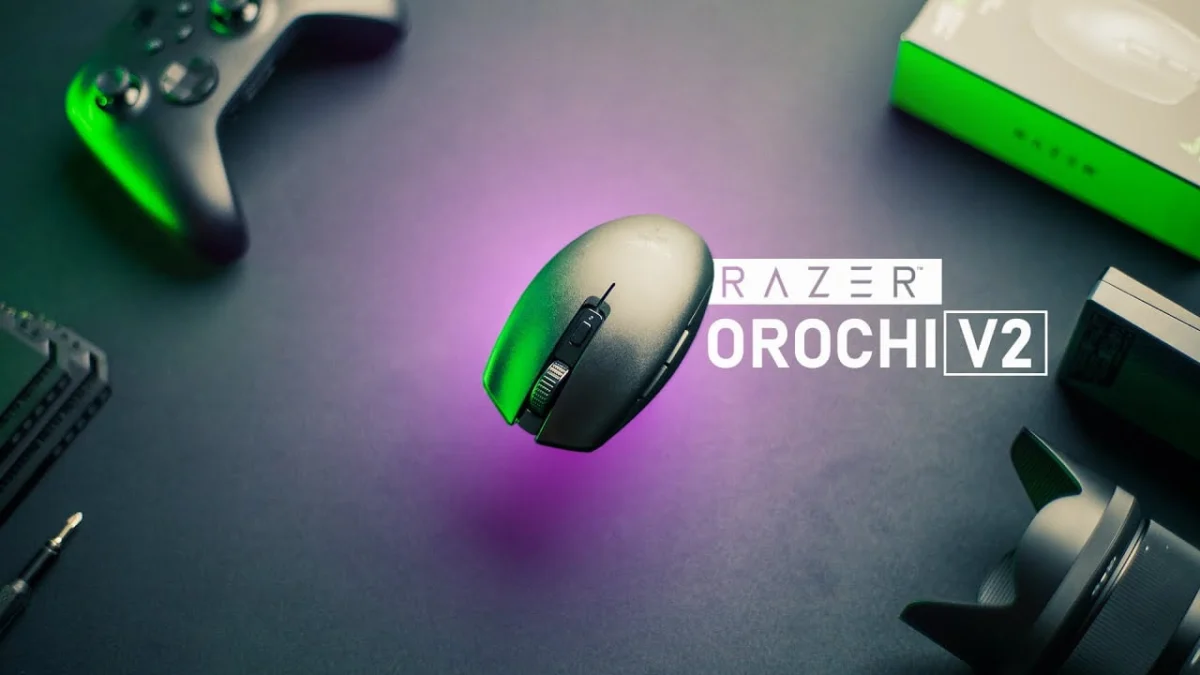
The modern peripheral market has long been defined by a constant tension between portability, battery efficiency, and uncompromising performance. For years, compact wireless mice intended for mobile professionals and on-the-go gamers often required significant compromises. Users frequently had to choose between heavy, lag-prone office peripherals or stripped-down gaming devices lacking modern dual-connectivity features. Into this competitive landscape steps the Razer Orochi V2, a compact, asymmetrical wireless mouse designed to challenge established category benchmarks like the Logitech G305 and SteelSeries Rival 3 Wireless. Priced competitively at $69 USD, the Orochi V2 arrives as a feature-rich, high-performance alternative aimed at users seeking long-term reliability and advanced sensor technology without the traditional financial or ergonomic penalties associated with miniaturized gaming hardware.
Design, Build Quality, and Ergonomic Philosophy
The structural integrity of compact peripherals has historically been a point of vulnerability, particularly as manufacturers race to reduce overall weight through perforated chassis and honeycomb shell designs. Razer has notably rejected the honeycomb trend with the Orochi V2, opting instead for a completely solid outer shell. Despite featuring a removable top plate designed to accommodate customizable aesthetics, the mouse exhibits zero structural creaking, flex, or loose tolerances along its seams.
Ergonomically, the Orochi V2 is tailored for fingertip and claw grip styles, featuring a pronounced rear hump that offers substantial palm support relative to its small footprint. A subtle thumb indentation on the left flank and a contoured right side accommodate the ring and pinky fingers securely, preventing fatigue during extended usage sessions. This shape marks a significant departure from ultra-small symmetrical alternatives like the Razer Viper Mini, providing a more filled-out hand feel that closely mirrors the beloved ergonomics of the Logitech G305, albeit with refined curves that enhance tracking stability across all four screen quadrants.
Dual Battery System and Advanced Weight Distribution
One of the most innovative engineering choices integrated into the Orochi V2 is its dual-battery compartment layout. Unlike traditional wireless mice restricted to a single battery type, the Orochi V2 features a uniquely angled internal bay capable of accepting either a standard AA or a smaller AAA battery. This flexibility allows users to actively modify the peripheral’s weight profile and center of gravity according to their personal preferences.
Without batteries, the chassis weighs a mere 58 grams. Inserting the default AA lithium battery brings the total operating weight to approximately 73 grams, whereas utilizing a lighter AAA cell yields a 69-gram total. For comparative context, the Logitech G305 outfitted with a standard AA lithium battery weighs roughly 89 grams, while competitors such as the SteelSeries Aerox 3 Wireless and Glorious Model O Wireless sit at 68 and 71 grams, respectively. Independent testing indicates that the default AA configuration provides the most centralized weight distribution, preventing the rear-heavy bias occasionally introduced by smaller cells.
Connectivity, Multi-Device Support, and Software Integration
Connectivity is handled via a dual-mode wireless architecture offering both Bluetooth and proprietary 2.4GHz Razer HyperSpeed wireless via a storable USB dongle. The 2.4GHz connection delivers ultra-low latency suitable for competitive esports titles, while Bluetooth mode maximizes energy efficiency for office environments and notebook pairing.
A notable technological inclusion is Razer’s multi-device pairing support, which allows multiple compatible Razer peripherals—such as a wireless keyboard and the Orochi V2—to connect simultaneously to a single USB dongle. While this feature successfully conserves precious USB ports on modern ultrabooks and desktop rigs, technical evaluations suggest it can occasionally introduce minor signal interference or input stutter in congested 2.4GHz environments. Consequently, competitive gamers are advised to maintain dedicated dongles for tournament-level play, though the feature represents a significant step forward in peripheral standardization.
Through the Razer Synapse software suite, users can also customize the mouse’s sensor parameters. The peripheral utilizes the Razer 5G Advanced Optical Sensor, capable of tracking up to 18,000 DPI. Software-level adjustments allow users to modify the lift-off distance from a default 2.4mm down to a precise 1mm, accommodating rapid flick movements and repositioning habits common among low-sensitivity players.
Switches, Power Management, and Longevity
To achieve optimal power efficiency, Razer departed from the optical switches found in its flagship desktop mice, choosing instead second-generation Razer mechanical switches produced in collaboration with Kailh (Kailh GM 4.0). Rated for up to 60 million clicks, these green mechanical switches provide a distinctly crisp tactile feedback loop and a pronounced acoustic profile, avoiding the mushy feel often associated with ultra-low-power microswitches.
Power efficiency remains a defining characteristic of the hardware. While official packaging metrics cite up to 950 hours of continuous operation in Bluetooth mode, real-world utilization under the 2.4GHz HyperSpeed protocol yields approximately 425 hours of battery life using a standard lithium AA cell. Synapse software provides a four-stage battery level indicator and customizable low-voltage warning alerts, ensuring users have adequate time to execute battery swaps before unexpected power loss occurs.
Market Implications and Broad Industry Impact
The launch of the Razer Orochi V2 underscores a broader industry shift toward high-performance, cost-effective peripherals that do not sacrifice build quality for weight reduction. By bridging the gap between mobile productivity devices and high-end gaming mice, Razer has provided a compelling alternative for consumers previously locked into the entry-level wireless ecosystems dominated by legacy competitors.
Furthermore, ancillary product expansions—such as Razer’s universal grip tapes, priced at $10 and designed for cross-device application—signal an increasing emphasis on user-driven customization and tactile enhancement. As remote work environments merge increasingly with competitive gaming spaces, hardware that successfully balances multi-device versatility, exceptional battery endurance, and competitive pricing establishes a new benchmark for future peripheral development. The Orochi V2 ultimately demonstrates that premium features can be successfully scaled down into affordable, highly durable form factors without compromising on structural or technical integrity.