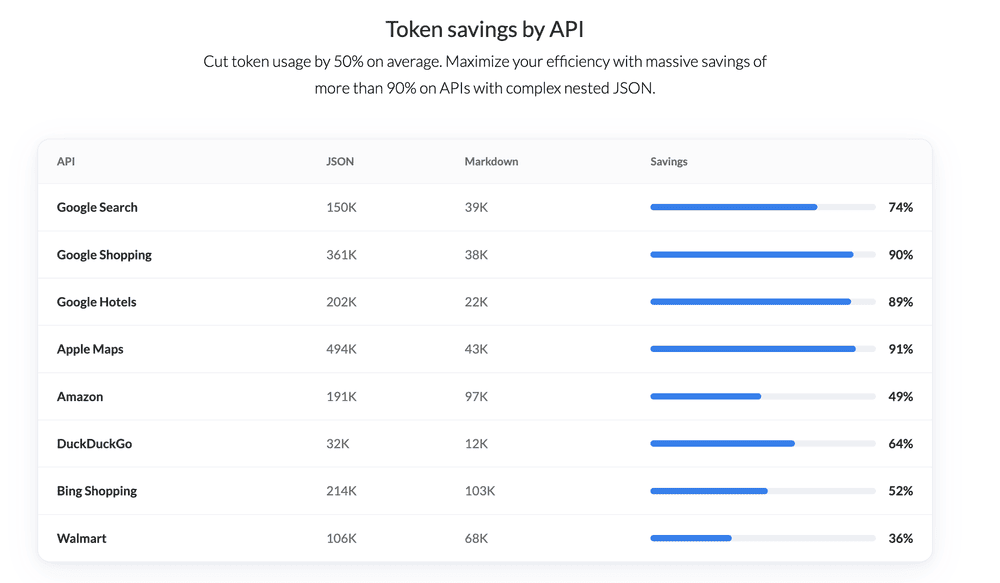
As the artificial intelligence industry continues its rapid evolution from static chatbot interactions to dynamic, multi-step autonomous agents, developers and enterprise architects are confronting a hidden operational bottleneck: token bloat. Modern AI agents tasked with complex research, automated file retrieval, and iterative web searches consume millions of tokens not just through core reasoning, but by digesting massive payloads of unstructured web data. A routine search query executed by an autonomous agent frequently pulls in dozens of full-length HTML documents, server logs, comment blocks, and deeply nested object trees containing tracking links and metadata. Much of this auxiliary data is entirely superfluous to the underlying language model, yet organizations continue to incur financial costs for every single token processed. Furthermore, this data bloat constrains the available context window, degrades retrieval-augmented generation (RAG) performance, and increases latency. Addressing this structural inefficiency, SerpApi has introduced a native Markdown output feature designed to strip away superfluous code, reduce token consumption by up to 74 percent, and fundamentally reshape how search data is delivered to large language models.
The Economic and Technical Burden of Token Bloat in Agentic Workflows
To understand the magnitude of the problem, one must examine the operational mechanics of contemporary AI agents. When an agent is deployed to perform market research, aggregate news, or conduct competitor analysis, it relies heavily on recursive loops. It submits a query, reviews the results, refines its parameters, and executes secondary searches. Each iteration brings a fresh payload of search engine results pages (SERPs). Traditionally, these results have been delivered in JavaScript Object Notation (JSON), a format optimized for web applications, databases, and programmatic parsers rather than neural networks.
JSON responses inherently carry significant structural overhead. Keys, brackets, quotation marks, nested objects, and extensive metadata—such as tracking parameters, internal identifiers, and styling cues—are crucial for a web browser or a backend pricing engine. However, they provide zero semantic value to a large language model attempting to comprehend user intent or summarize textual information. When an agent processes a query like "look up coffee shops," standard JSON payloads routinely balloon to tens of thousands of tokens. The model spends computational cycles and financial capital parsing structural syntax rather than reasoning over core content. Consequently, development teams face escalating API expenditures, restricted context windows that trigger premature memory pruning, and sluggish response times that hinder real-time user experiences.
The Mechanics of SerpApi’s Markdown Integration
Recognizing the friction between traditional data serialization and modern LLM requirements, SerpApi rolled out its native Markdown output feature to streamline data ingestion across its suite of more than 100 search APIs. By converting search results from verbose JSON into clean, structured Markdown, the service preserves essential informational content while ruthlessly eliminating formatting noise.
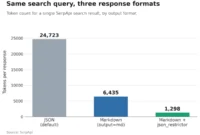
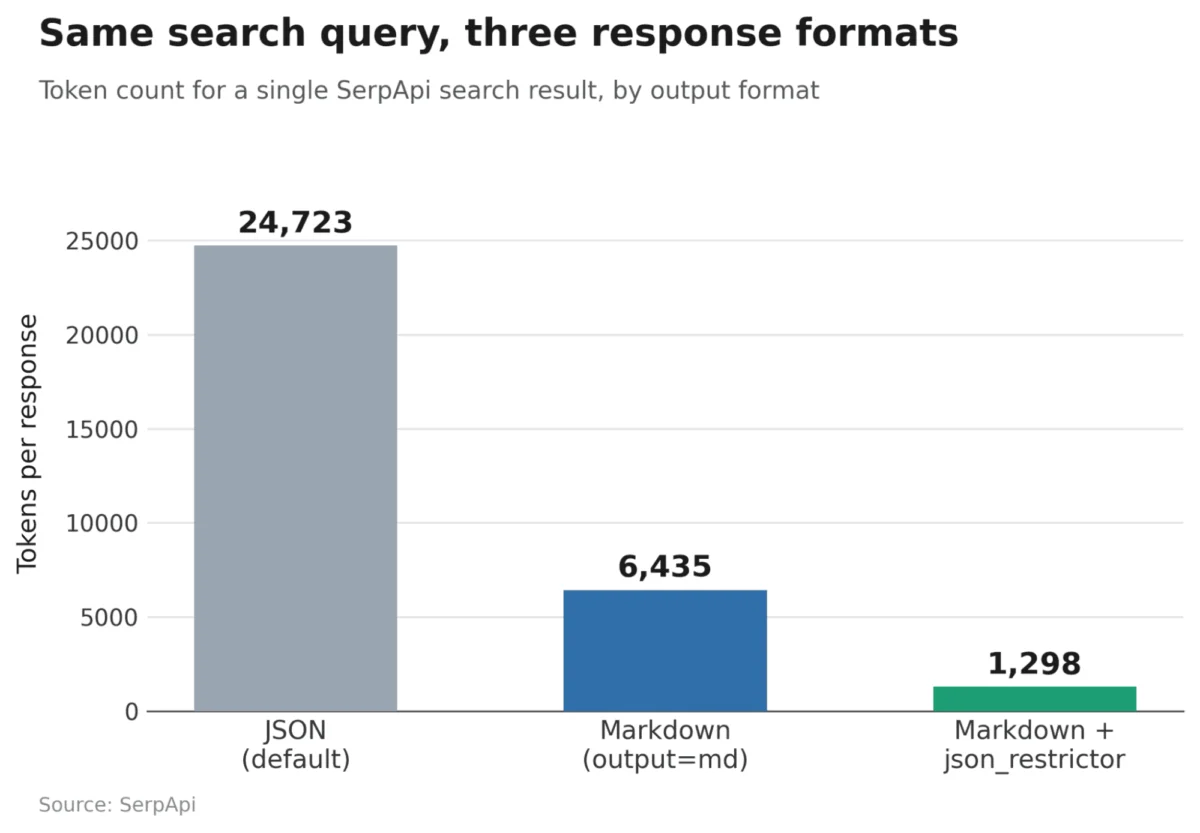
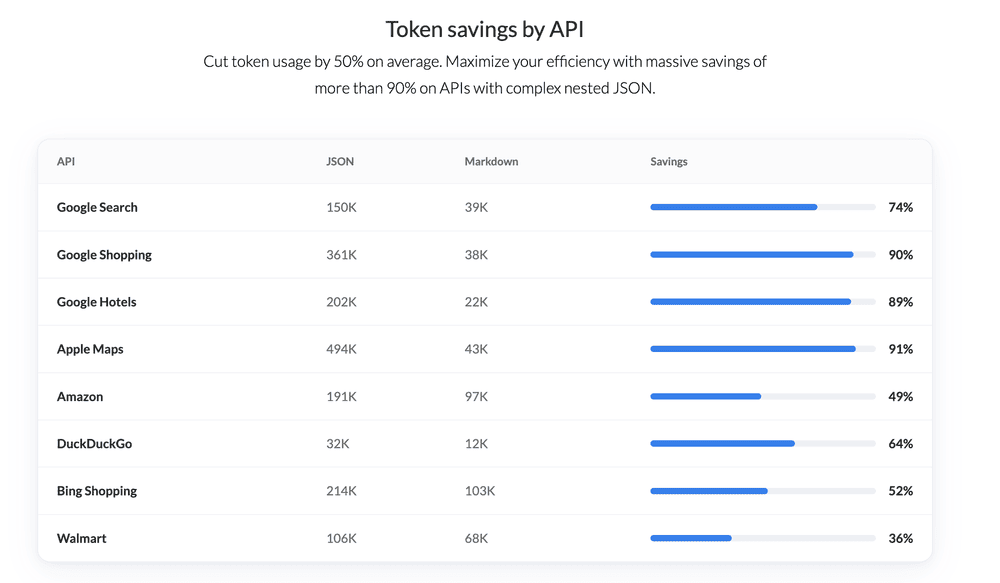
Empirical testing provided by SerpApi highlights the dramatic efficiency gains of this approach. A baseline search for the keyword "coffee" executed via conventional JSON yielded a response requiring 24,723 tokens. When the exact same query was executed using SerpApi’s Markdown output, the token count plummeted to 6,435 tokens—representing an immediate 74 percent reduction. Furthermore, when developers implemented supplementary server-side filtering, the token footprint for a more restricted view dropped to a mere 1,298 tokens.
This compression is achieved by transforming how data is represented. Elements designed exclusively for code parsing or user interface rendering are stripped or reshaped. YAML frontmatter, clean tables, and native inline links replace complex nested arrays and redundant key-value pairs. Crucially, internal tracking URLs, duplicate fields, and algorithmic noise that inflate payload sizes without contributing to model comprehension are systematically excised before the data ever crosses the network boundary.
Strategic Differentiation: When to Choose Markdown Versus JSON
Despite the overwhelming efficiency advantages of Markdown in agentic workflows, industry analysts and software architects emphasize that JSON remains an indispensable tool for specific enterprise applications. The choice between Markdown and JSON ultimately depends on the consumer of the data: a neural network or a downstream computational pipeline.
Markdown is explicitly optimized for large language models and autonomous agents. Its semantic structure—utilizing headers, bullet points, and inline links—maps cleanly onto the training distributions of modern transformer models, allowing agents to ingest, summarize, and synthesize web data with minimal computational overhead.
Conversely, JSON remains the mandatory format for deterministic systems that require strict data typing. If an enterprise data pipeline depends on precise numeric integer pricing, geographic coordinates formatted as specific floats, exact ratings, or structured arrays for quantitative analytics and pricing engines, Markdown is inadequate. A Naver Shopping result, for instance, exposes dedicated fields such as price, old_price, coupon_price, rating, reviews, and stores as typed variables. For a quantitative pricing algorithm, these typed fields are essential. However, for an AI agent tasked merely with generating a qualitative summary of top-performing products, those programmatic fields represent costly overkill. SerpApi accommodates both use cases by allowing developers to toggle output formats dynamically, ensuring that systems utilize the right shape of data for the specific task at hand.
Implementation and Developer Integration
Deploying SerpApi’s Markdown output requires minimal engineering friction. The feature is integrated directly into the existing API infrastructure, requiring no additional subscription tiers or supplementary costs. Developers can request Markdown formatting through a straightforward query parameter, a dedicated route extension, or a custom request header.
To achieve even greater precision, developers can combine SerpApi’s Markdown formatting with the platform’s json_restrictor tool—or the --fields parameter in the command-line interface. This capability allows engineering teams to specify exact keys server-side, ensuring that only relevant data points are transmitted across the network. By pruning unnecessary fields at the source rather than within the client application, organizations achieve compound bandwidth savings alongside token reductions.
Industry Implications for Autonomous Agent Architecture
The introduction of format-optimized search APIs points to a broader maturation phase in the deployment of generative AI. As enterprises transition from proof-of-concept chatbots to mission-critical autonomous agents operating at scale, operational efficiency has emerged as a primary competitive differentiator.
In agentic systems, minor inefficiencies do not remain isolated; they compound exponentially. A redundant payload of 15,000 tokens per search query multiplies rapidly when an agent executes dozens of recursive loops across hundreds of daily user sessions. This silent accumulation of token bloat inflates cloud infrastructure budgets and throttles operational velocity.
By rethinking data serialization through the lens of machine consumption rather than human or browser consumption, services like SerpApi are establishing a new architectural standard for API design. The ability to dynamically reshape data payloads reduces overhead, preserves critical context window real estate, and enhances the reliability of complex multi-agent workflows.
As the ecosystem continues to evolve, developers are encouraged to audit their existing data pipelines, benchmark their specific query workloads using native format toggles, and evaluate the tangible return on investment offered by token-optimized data delivery. In an era where AI performance is inextricably linked to context availability, optimizing the shape of data is no longer merely an optimization exercise—it is a fundamental requirement for scalable enterprise AI deployment.