The field of humanoid and general-purpose robotics has long been hindered by a critical scarcity of high-quality, diverse interaction data. While Large Language Models (LLMs) have benefited from the vast expanses of the internet’s text, robots require physical demonstrations to learn how to navigate and manipulate the world. Xiaomi’s robotics division has recently unveiled Xiaomi-Robotics-1, a foundation model specifically engineered to bridge this "data gap." By utilizing an innovative data collection method involving handheld grippers rather than full-scale robots, Xiaomi has amassed a dataset of unprecedented scale, allowing their model to perform complex tasks in unfamiliar environments with minimal additional training.
The Robotics Data Bottleneck and the Shift to Handheld Collection
In the development of artificial intelligence, the "scaling law" suggests that performance improves predictably as model size, compute power, and data volume increase. However, in robotics, the data component has remained the most expensive and slowest to scale. Traditionally, researchers have relied on teleoperation—where a human operator controls a multi-million dollar robot via a VR headset or specialized controllers—to record movements. This method is geographically limited to laboratories and restricted by the number of physical robots available.

To circumvent these limitations, the Xiaomi team pivoted away from real robots during the primary data collection phase. Instead, they utilized portable, handheld grippers equipped with integrated cameras. These devices, known in the research community as Universal Manipulation Interfaces (UMI), allow human collectors to simply pick up the tool and perform tasks manually. This approach decoupled data collection from the robot’s physical presence, enabling the team to record manipulation tasks in a vast array of real-world settings, including private kitchens, busy offices, retail stores, industrial factory floors, and unpredictable outdoor spaces.
The result of this decentralized effort was a pretraining dataset comprising over 100,000 hours of motion recordings. This dataset spans more than 1,700 different environments and includes 2.4 million individual episodes covering over 260 distinct tasks. The sheer variety of the data—capturing different lighting conditions, object textures, and spatial layouts—provides the foundation for a model that does not just memorize movements but understands the underlying physics of manipulation.
Automated Labeling and the Transition to Physical Hardware
Amassing 100,000 hours of video and motion data presents a secondary challenge: annotation. For a machine learning model to understand the relationship between a command and an action, each segment of the data must be accurately described. Manual labeling of such a massive corpus would have taken years of human labor. Xiaomi addressed this by deploying a secondary AI model designed to analyze the motion segments and generate text descriptions automatically. By leveraging high-performance Vision-Language Models (VLMs), the team was able to label the entire 100,000-hour dataset in approximately two weeks, a feat that sets a new benchmark for efficiency in robotics research.

Once the model was pretrained on this "human-gripper" data, the researchers faced the "embodiment gap"—the physical difference between a handheld gripper held by a human and the mechanical arm of a robot. To bridge this, Xiaomi employed a post-training phase where the model was fine-tuned using a smaller, high-quality dataset of actual robot recordings. This included data from Xiaomi’s own wheeled mobile manipulators and dual-arm systems, as well as open-source robotics datasets. This multi-stage training process allows the model to transfer the "common sense" manipulation skills learned from the handheld grippers to the specific kinematics of various robotic platforms.
Redefining Scaling Laws: Data Volume Over Model Size
One of the most significant findings from the Xiaomi-Robotics-1 project involves the relative importance of data versus compute. In the world of LLMs, the Chinchilla scaling laws suggest that model size and data volume should grow in tandem to optimize performance. However, Xiaomi’s research indicates that for Vision-Language-Action (VLA) models, data volume is the dominant factor in performance gains.
In rigorous testing, Xiaomi observed that while increasing the model’s parameter count (from 2 billion to 10 billion) did yield improvements, the gains were eclipsed by those achieved through increasing the volume of training data. When the amount of pretraining data was scaled from 12.5% to 100% of the total dataset, the model’s success rate in zero-shot tasks—tasks in environments it had never seen before—surged from 25% to 75%.

The researchers noted that they have yet to reach a point of diminishing returns; as more data is added, the model continues to show improved accuracy and better generalization. This suggests that the future of robotics AI may depend less on building "massive" models and more on the industrialization of diverse data collection.
Benchmarking Performance and Real-World Versatility
Xiaomi-Robotics-1 has demonstrated superior performance across several industry-standard benchmarks. On the RoboCasa365 leaderboard, which focuses on useful household tasks, the model secured the top position by a wide margin, particularly in "unseen composite tasks" that require a sequence of different actions. It also led the RoboDojo benchmark, scoring approximately 58% higher than the closest competitor, despite the inherent difficulty of the tasks involved.
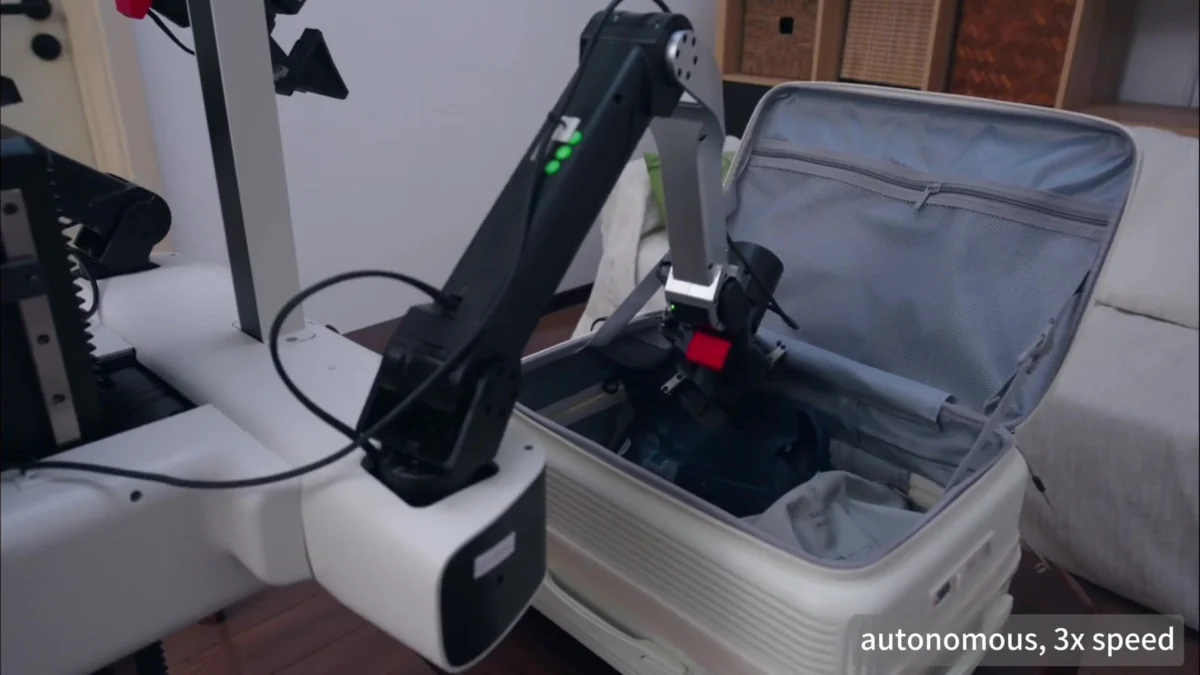
In practical demonstrations, the model’s capabilities were put to the test in long-horizon tasks. In one notable example, a robot was tasked with packing a suitcase—a process that required it to identify items, navigate across a room, and arrange objects within the suitcase. The task took over ten minutes of continuous, autonomous operation without human intervention.

The model also showed remarkable proficiency in handling "deformable" or soft materials. Many current robotic systems struggle with objects that do not have a fixed shape, such as clothing or paper. Xiaomi-Robotics-1, however, successfully demonstrated tasks such as loading laundry into a washing machine and feeding individual sheets of paper into a printer. With less than ten hours of specific task-related training data, the model achieved a 75% success rate on these complex activities, significantly outperforming rival models like Physical Intelligence’s pi0.5, which managed only 40% under the same conditions.
Comparative Landscape: Xiaomi vs. Nvidia and BAAI
The release of Xiaomi-Robotics-1 places the company at the center of a global debate regarding the best path forward for robotics. Different organizations are pursuing varied strategies to solve the data problem:
- Nvidia and Synthetic Data: Nvidia’s Project GR00T and the ENPIRE project focus on turning the data problem into a compute problem. They use AI coding agents to autonomously teach robots in simulated environments, generating synthetic data that is then transferred to the real world.
- BAAI and Label-Free Learning: China’s Beijing Academy of Artificial Intelligence (BAAI) has introduced the Orca world model. Unlike Xiaomi’s approach, Orca learns from 125,000 hours of video without any action labels, attempting to understand the world through observation alone.
- Physical Intelligence and Generalization: The U.S.-based startup Physical Intelligence has focused on models like pi0.7, which aim for LLM-like generalization. However, they have faced scrutiny over whether their models are truly generalizing or simply recalling specific training examples.
Xiaomi’s approach sits in the middle: it uses real-world "human" data (unlike Nvidia), but applies automated labeling (unlike BAAI) to ensure the model has a clear understanding of the intent behind every motion.

Strategic Implications and Future Availability
The development of Xiaomi-Robotics-1 is a continuation of Xiaomi’s aggressive expansion into the robotics sector. This journey began publicly with the introduction of the CyberDog quadruped and the CyberOne humanoid. In March, the company introduced its MiMo-V2 models, signaling an intent to create a unified AI brain capable of controlling agents, mobile devices, and industrial robots.
By releasing the model and its code on GitHub and Hugging Face, Xiaomi is positioning itself as a leader in the "Open Robotics" movement. This follows the recent release of Xiaomi-Robotics-0, a version of the model optimized for fast, real-time edge computing. By providing the community with a high-performing foundation model, Xiaomi likely hopes to accelerate the development of third-party applications, much like the impact Meta’s Llama models had on the LLM ecosystem.
The broader implications for industry are profound. If a foundation model can reach a 75% success rate in new tasks with only ten hours of fine-tuning, the barrier to deploying robots in small-scale manufacturing or specialized service roles drops significantly. The transition from "fixed-function" industrial robots to "general-purpose" assistants appears to be moving out of the realm of research and into the territory of scalable engineering. As Xiaomi continues to refine its hardware and scale its data collection, the focus will likely shift to the long-term reliability and safety of these systems in unsupervised environments.