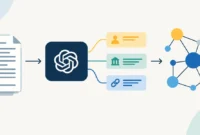
In the rapidly evolving landscape of Retrieval-Augmented Generation (RAG), the integrity of the data pipeline often hinges on a single, silent point of failure: document parsing. While classic Optical Character Recognition (OCR) tools like EasyOCR are efficient at recovering raw text, they frequently discard the underlying structural context of a document, such as table borders and cell relationships. This leads to a phenomenon where a system generates a "plausible-looking nonsense" answer—one that reads fluently but is factually incorrect because the model interpreted a flattened table as a continuous sentence. To combat this, a new philosophy of "adaptive parsing" has emerged, prioritizing a multi-stage escalation cascade that balances computational cost with the precision required for enterprise-grade intelligence.

The Economic and Technical Tension of Document Parsing
The fundamental challenge in building enterprise RAG systems is the massive disparity in performance and cost between various parsing methods. On one end of the spectrum, tools like PyMuPDF (fitz) can process a PDF page in approximately five milliseconds at effectively zero cost. On the other end, advanced Vision Large Language Models (LLMs) or specialized layout analyzers like Azure Document Intelligence can cost ten thousand times more per page and require up to ten seconds of processing time.
For an enterprise corpus containing millions of documents, running the most expensive parser on every page is economically unviable. Conversely, relying solely on the cheapest parser is technically irresponsible. When an answer is buried in a complex table or an intricate diagram, a basic parser returns a fragmented mess. The LLM, designed to be helpful and confident, will then attempt to "hallucinate" the missing structure, leading to errors that are difficult for the end-user to detect without manual verification of the original source.

The solution is a feedback loop that utilizes a "start cheap, escalate when necessary" strategy. This adaptive approach relies on a series of deterministic and probabilistic checks to flag when a cheap parse has failed, only then triggering a more robust, structure-aware tool.
The Eight-Point Escalation Cascade
The reliability of an enterprise RAG system is built upon a sequence of evaluations, each more sophisticated than the last. This cascade asks a simple but vital question at every stage: "Did the parser produce enough information to answer the user’s query?"

The first six checks are typically deterministic or retrieval-based, focusing on character density, table fingerprints, and chunk integrity. However, the final lines of defense—Checks 7 and 8—occur during and after the generation phase. Check 7 involves the LLM’s own self-evaluation, where the model is asked to flag if the context provided appears structurally compromised. Check 8 is a post-generation groundedness check, where a separate LLM or a Natural Language Inference (NLI) model verifies the final answer against the source chunks to ensure no fabrications occurred.
Case Study A: Resolving Table Flattening via Azure Layout
To illustrate the necessity of this escalation, researchers analyzed Table 3 of the seminal "Attention is All You Need" paper (Vaswani et al., 2017). The question posed was specific: "What is the value of ‘h’ for the base model in the Table of Variations?"

In the initial pass using PyMuPDF, the table was flattened. The column headers and row values were returned as a sequence of independent lines. While a powerful model like GPT-4 can sometimes "guess" the correct cell by counting the lines, it recognizes the structural fragility. In this instance, the model produced the correct answer, "8," but triggered a context_structured=False flag. This flag served as a signal to the orchestrator that the layout was too complex for a flat text parser.
The system then escalated the page to Azure Document Intelligence. Unlike the basic parser, Azure recovered the table as a markdown grid, anchoring the data with pipes (|). When the LLM processed this structured input, it could unambiguously map the "h" header to the "8" value. The cost of this escalation was approximately $0.003 and four seconds of latency—a small price to pay for a "structurally trusted" result that could be permanently cached for future queries.

Case Study B: Figure Escalation and Vision-Language Models
A different failure mode occurs when information is stored in diagrams rather than text. When asked about the "architecture of the Transformer," the most comprehensive answer resides in Figure 1 of the Vaswani paper—a complex flowchart of encoders and decoders.
A standard text parser sees only an image placeholder or a few stray text fragments from the diagram’s labels. During the first generation pass, the LLM noted that "Figure 1 is referenced in the prose but its content is absent." This triggered an escalation to a Vision LLM. By feeding the specific image coordinates to a vision-capable model, the system generated a detailed text description of the architecture, including residual connections and layer normalization placements that were not fully detailed in the surrounding prose. This description was then appended to the document’s data model, allowing the final generation to be both highly confident and factually complete.

Data-Driven Stress Testing: The Unreliability of Self-Evaluation
While the "self-evaluation" flag (Check 7) is a critical component of the cascade, recent stress tests reveal that it cannot be the only line of defense. In a matrix of 18 test runs involving different models (GPT-4o, GPT-4o-mini, and GPT-4 Turbo) and various parsing qualities, researchers found that weaker models often fail to recognize when they are hallucinating.
In several instances where the parser misaligned columns, the models fabricated an answer and confidently asserted that context_structured=True. The tests showed a 60% false-alarm rate when using a continuous 0.0-1.0 scoring system for structural integrity. The findings suggest that the LLM’s structural verdict is "bimodal disguised as continuous"—the model either thinks it’s perfect or it’s broken, with very little nuance in between.

This highlights the necessity of Check 8: the post-generation groundedness check. By using a "fresh judge"—a separate LLM instance that did not generate the original answer—the system can catch fabrications that the generating model was too confident to see. The judge has no incentive to defend the previous generation, making it a more objective arbiter of truth.
Operational Strategy: Lazy vs. Eager Parsing
For enterprise leaders, the choice between "lazy" and "eager" parsing is a matter of query volume and budget. Lazy parsing—the "escalate on demand" model—is the most efficient for typical enterprise corpora where many documents may never be queried.

However, eager parsing (processing everything with high-quality tools at the start) is preferable in two specific scenarios:
- High-Value/Low-Volume Collections: If a corpus contains only a few thousand mission-critical documents, the overhead of advanced parsing is negligible compared to the risk of a single wrong answer.
- High Query Density: If a document is expected to be queried hundreds of times, the cumulative latency of multiple escalations outweighs the one-time cost of a deep initial parse.
The beauty of the adaptive data model is that it treats the database as a cache. Once a page is escalated and parsed via a high-quality method, that result is stored with a parsing_method metadata tag. Future queries hitting that page will automatically use the high-quality version, allowing the system to "learn" and improve its own data quality based on actual user demand.

Broader Implications for Artificial Intelligence in Business
The move toward adaptive parsing signifies a shift in AI development from "model-centric" to "data-centric" engineering. It acknowledges that even the most advanced LLM is only as good as the data it can actually "see." By building pipelines that can self-correct and escalate, organizations can mitigate the risks of "silent failures" in OCR and layout analysis.
Furthermore, this approach provides a robust audit trail. By highlighting the exact bounding boxes of the source PDF used to generate an answer, enterprises can provide human reviewers with the tools to verify AI claims in seconds. This transparency is vital for sectors like legal, finance, and healthcare, where the cost of a factual error can be catastrophic.

As parsing technologies like Docling and Table Transformer continue to mature, the cost of "heavy" parsing will likely decrease. However, the need for a multi-layered check system will remain. The ultimate goal of Enterprise Document Intelligence is to amplify human expertise, not replace it with "confident nonsense." Through adaptive parsing and the escalation cascade, the industry is moving closer to a future where RAG systems are not just fast, but fundamentally trustworthy.