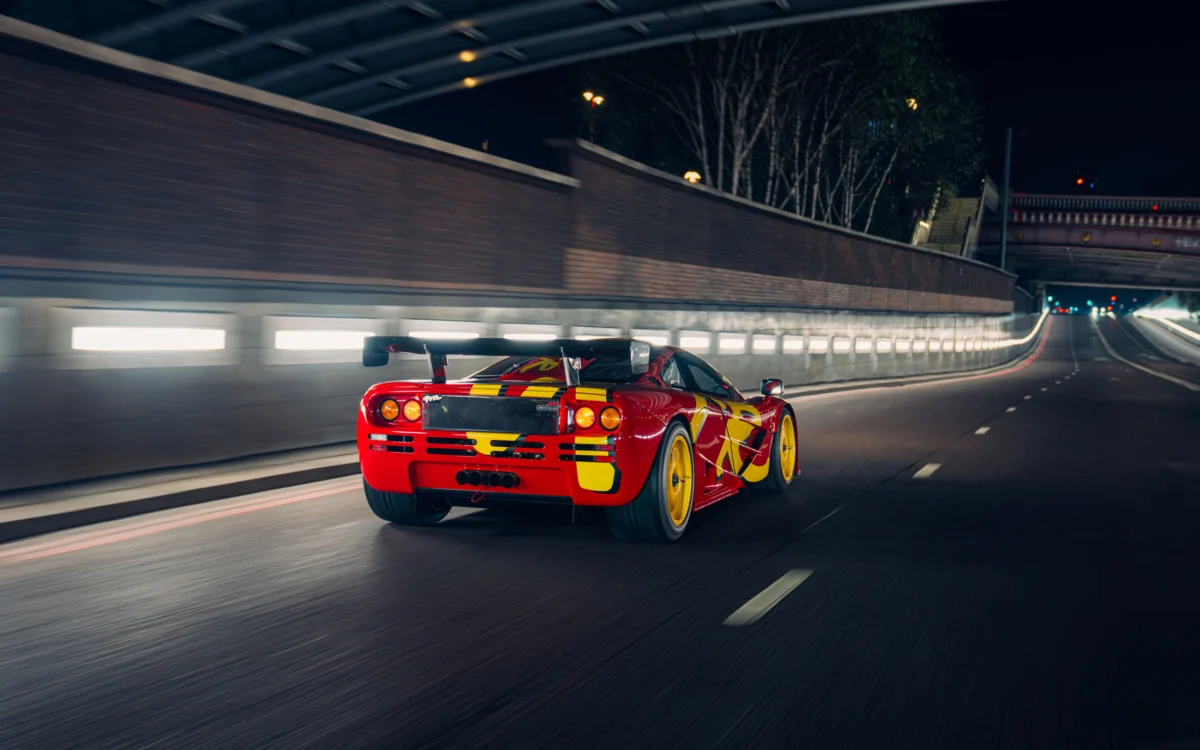
The global collector car market is preparing for a landmark event as RM Sotheby’s announces the consignment of one of the most significant McLaren F1 variants in existence. The 1996 McLaren F1 GTR, specifically chassis 10R, is scheduled to cross the auction block with an estimated value exceeding $35 million. This specific vehicle represents a rare intersection of racing pedigree, engineering development, and high-profile ownership, making it one of the most anticipated automotive sales of the decade. As a road-legal conversion of a factory prototype, chassis 10R carries a history that spans from the secret testing grounds of the Woking-based manufacturer to the private collection of one of the world’s most renowned automotive enthusiasts.
The Engineering Genesis of the McLaren F1 GTR
To understand the significance of chassis 10R, one must look back to the original mission of the McLaren F1. Conceived by designer Gordon Murray, the F1 was intended to be the ultimate road car, with no initial plans for a factory racing program. However, the car’s inherent performance capabilities—driven by its carbon-fiber monocoque, central driving position, and the bespoke BMW S70/2 V12 engine—inevitably drew the attention of privateer racing teams.
By 1995, McLaren responded to this demand by developing the GTR. The transition from road car to racer was remarkably seamless, a testament to Murray’s original design. The 1995 GTR went on to win the 24 Hours of Le Mans on its debut, cementing the F1’s status in motorsport history. Following this success, McLaren refined the design for the 1996 season. The 1996 specification, to which chassis 10R belongs, featured extensive modifications designed to keep the F1 competitive against burgeoning factory efforts from Porsche and Ferrari. These updates included a more aggressive aerodynamic package, a lightened gearbox, and a reduction in overall weight, bringing the car down to approximately 1,000 kilograms.
Chassis 10R: The "Pop Art" Prototype
Chassis 10R holds a unique position within the production run as one of only two "Short-Tail" GTR prototypes built. While the other prototype famously achieved victory at Le Mans in 1995, 10R served as a critical development vehicle for the 1996 specification. It was the first GTR to be built for the 1996 season and was retained by the factory for testing and promotional purposes.
The car earned the nickname "Pop Art F1" due to its striking scarlet and yellow livery. This aesthetic was not merely for show; it became one of the most recognizable color schemes in the history of the model, appearing in numerous contemporary automotive publications and marketing materials. Underneath the vibrant exterior, 10R housed the peak evolution of the Short-Tail GTR. The 1996 spec cars are widely regarded by drivers and collectors as the fastest and most visceral of the GTR variants, predating the "Long-Tail" versions that were introduced in 1997 to meet new GT1 regulations.
Ownership and Provenance: The Nick Mason Era
The provenance of chassis 10R is further enhanced by its long-term ownership. After its duties as a factory development and promotional car were completed, the vehicle was sold to Nick Mason, the drummer for Pink Floyd and a legendary figure in the car collecting world. Mason is known for his discerning taste and his willingness to drive his collection, which includes a Ferrari 250 GTO.
Mason owned and maintained chassis 10R for 25 years. During his stewardship, the car was a frequent sight at prestigious events such as the Goodwood Festival of Speed. Unlike many GTRs that were retired to static displays or private museums, 10R remained an active participant in the automotive community. This continuous history of care and operation is a critical factor in its high valuation, as it suggests a level of mechanical maintenance often missing from long-dormant race cars.
The Road-Legal Conversion and Technical Specifications
One of the most compelling aspects of chassis 10R is its street-legal status. Converting a purpose-built racing car for road use is a complex engineering feat, typically handled by specialists such as Lanzante Motorsports in the United Kingdom. Lanzante, which operated the 1995 Le Mans-winning team, has become the gold standard for McLaren F1 GTR road conversions.

The conversion process involves installing handbrakes, modifying the cooling systems to handle idling in traffic, adjusting the ride height, and ensuring the vehicle meets emission and lighting standards for public roads. Despite these concessions to civility, the core of the 10R remains a pure racing machine. It retains the 6.1-liter BMW V12, which produces approximately 600 horsepower (restricted for racing regulations, though often de-restricted for road use). The central seating position remains, flanked by two passenger seats slightly aft of the driver, providing the unique "3-seater" experience that defined the F1.
Market Context and the $35 Million Valuation
The $35 million estimate provided by RM Sotheby’s reflects the current trajectory of the ultra-high-end collector market. The McLaren F1 has seen a meteoric rise in value over the last decade, transitioning from a $10 million car to a $20 million car, and now potentially exceeding the $35 million mark.
Several factors contribute to this valuation:
- Rarity: Only 106 McLaren F1s were built in total, including prototypes, road cars, and racing variants. Only 28 GTRs were produced.
- Versatility: The ability to drive a Le Mans-spec prototype on the street is a rare privilege that appeals to the world’s most elite collectors.
- Performance: Even by modern standards, the F1 GTR’s performance is staggering. Its power-to-weight ratio remains competitive with modern hypercars like the McLaren P1 or the Ferrari LaFerrari.
- Historical Significance: As a factory prototype once owned by a cultural icon like Nick Mason, 10R possesses a "story" that adds intangible value beyond its mechanical components.
Comparatively, a "standard" McLaren F1 road car (chassis 029) sold for over $20 million in 2021. Given that GTRs are rarer and 10R is a prototype with significant provenance, the $35 million figure is viewed by analysts as a realistic, albeit ambitious, target.
Timeline of Chassis 10R
- 1996: Manufactured as the first of nine GTRs built to 1996 specifications. Serves as the factory development and press car.
- 1996-1997: Utilized for high-speed testing and promotional photography, wearing its signature scarlet and yellow livery.
- Late 1990s: Retired from factory duties and prepared for private sale.
- Early 2000s: Acquired by Nick Mason.
- 2000s-2020s: Regularly maintained and occasionally demonstrated at high-profile events. Undergoes a professional road-legal conversion.
- 2024: Consigned to RM Sotheby’s for the Monterey auction event.
Broader Implications for the Collector Market
The sale of chassis 10R is expected to serve as a bellwether for the health of the high-end automotive market. While the broader economy has faced headwinds, the "blue-chip" segment of the car market—comprising models like the Ferrari 250 GTO, the Mercedes-Benz 300 SLR, and the McLaren F1—has historically remained resilient.
This auction also highlights the growing demand for "analog" supercars. In an era of hybrid powertrains and electronic driver aids, the McLaren F1 GTR represents the pinnacle of mechanical purity. It features a naturally aspirated engine, a manual sequential gearbox, and no traction or stability control. For many collectors, this represents the "Golden Era" of automotive engineering.
Furthermore, the sale emphasizes the importance of the Monterey Car Week as the premier venue for such transactions. RM Sotheby’s choice to feature 10R at this venue ensures maximum visibility among the world’s most prolific collectors.
Official Sentiment and Industry Reaction
While official statements from the auction house remain focused on the technical merits and history of the car, industry insiders suggest that the offering of 10R is a "once-in-a-generation" opportunity. "The McLaren F1 GTR is often cited as the greatest racing car of its era," noted one market analyst. "When you add the layer of it being a street-legal prototype with Nick Mason’s name on the logbook, you are looking at a perfect storm of collectability."
The auction of the 1996 McLaren F1 GTR 10R is more than just a sale; it is a celebration of one of the most daring periods in automotive history. Whether it reaches or exceeds its $35 million estimate, the event will undoubtedly be recorded as a pivotal moment in the legacy of the McLaren F1. As the automotive world moves toward electrification, the roar of the BMW V12 in chassis 10R serves as a potent reminder of the heights achieved by internal combustion and carbon-fiber engineering in the late 20th century.