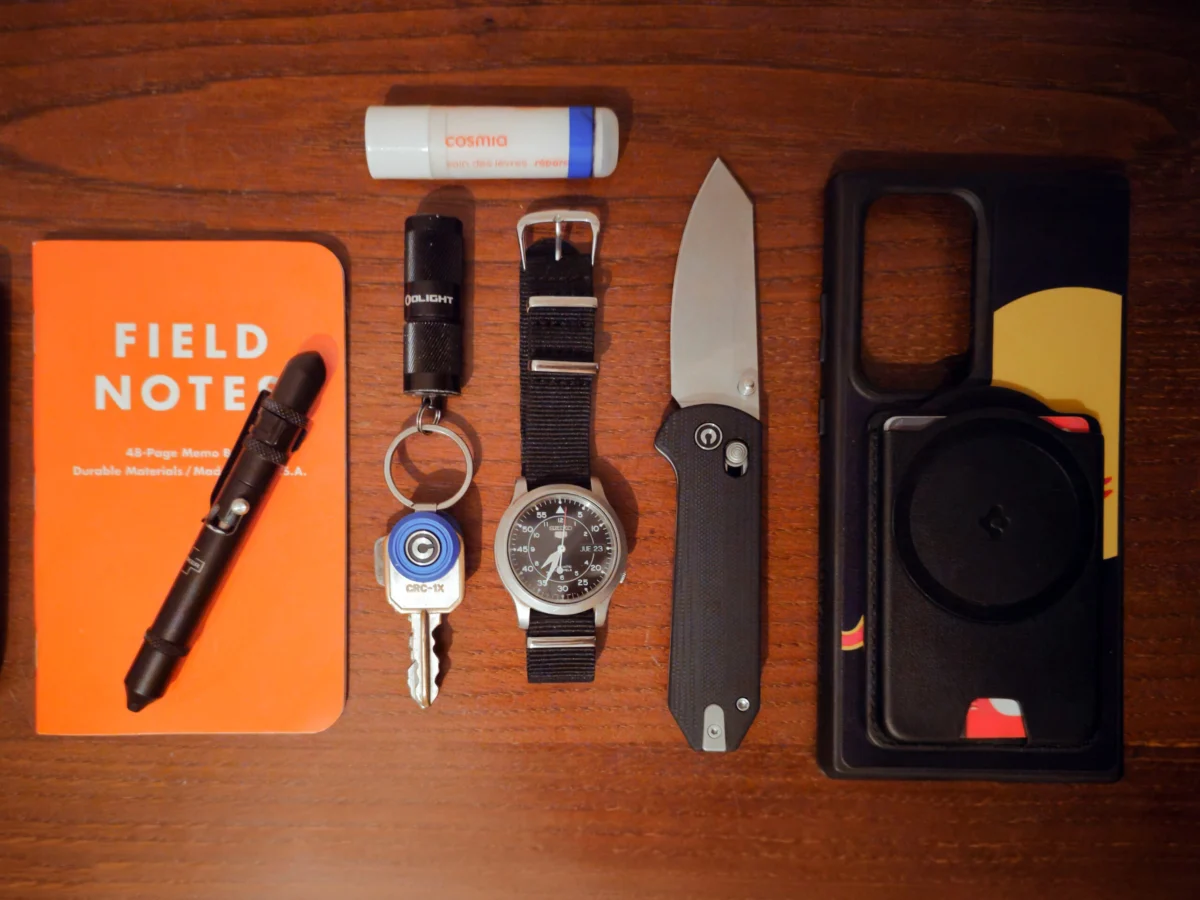
The contemporary professional landscape is undergoing a subtle but significant shift in how individuals curate their daily essential gear, a phenomenon known as Everyday Carry (EDC). Recent insights from aeronautical automation operators in Portugal, specifically the carry configuration of Ruben Caeiro, highlight the growing trend toward high-value, minimalist, and functional toolsets. This trend emphasizes the integration of durable, multi-purpose items that streamline productivity while maintaining a professional aesthetic. As global supply chains and manufacturing standards in the knife and stationery industries continue to evolve, the selection of gear—such as the award-winning CIVIVI Yonder—serves as a case study for the intersection of industrial design, consumer preference, and professional utility.
The Anatomy of a Modern Professional EDC
At the core of the modern EDC movement is the principle of "utility-to-footprint ratio." Professionals operating in technical fields, such as aeronautical automation, require tools that are unobtrusive yet readily available for diagnostic, logistical, or administrative tasks. Caeiro’s current rotation, which includes a magnetic wallet integrated with a smartphone, a compact key organizer, and a mini bolt-action pen, illustrates a deliberate move away from bulky, traditional accessories.
The inclusion of a Field Notes pocket notebook marks a return to tactile note-taking, a practice that remains relevant even in highly automated environments. Despite the prevalence of digital management systems, manual documentation serves as a critical fail-safe for field operators. When paired with high-performance cutting tools like the CIVIVI Yonder, the kit represents a balanced approach to the dual demands of office-based analytical work and field-level troubleshooting.
Chronology of the CIVIVI Yonder and Design Impact
The CIVIVI Yonder, a central component of this specific kit, represents a significant milestone in knife design for 2024. Designed by Zac Whitmore, an alumnus of the prominent gear review site Blade HQ, the Yonder was specifically engineered to address the market’s demand for high-quality, crossbar-locked folding knives at an accessible price point.
- 2024 (Early Q1): Initial prototypes of the Yonder undergo rigorous field testing, focusing on ergonomics and locking mechanism reliability.
- 2024 (Blade Show): The knife officially gains industry recognition, securing the "Best Buy of the Year" accolade. This award serves as a bellwether for the shift toward high-value manufacturing, where consumers prioritize functional engineering over decorative materials.
- 2024 (Late Q3): Public release and widespread adoption among EDC enthusiasts, solidifying its place as a standard-bearer for the "budget-premium" category.
The success of the Yonder is indicative of a broader trend: manufacturers are increasingly moving away from overly complex, exotic-material knives in favor of refined, utilitarian designs that appeal to both the casual user and the seasoned collector.
Economic and Industrial Context of EDC Gear
The broader EDC market has seen exponential growth over the last decade. Data indicates that the global pocket knife market is projected to expand significantly, driven by an increasing interest in outdoor activities and the "preparedness" subculture. However, the professional segment—characterized by individuals like Caeiro—prioritizes different metrics than the survivalist segment.
For the professional, value is defined by the following:
- Reliability: The ability of a tool to function without failure under repeated use.
- Scalability: The ability to swap items based on the environment (e.g., transitioning from a work-ready knife to a "dressier" option like the Kizer Feist).
- Ergonomics: The physical impact of carrying gear daily, which dictates the shift toward titanium components and low-profile designs.
The Kizer Feist, mentioned as a potential alternative, is another hallmark of this design philosophy. Featuring a front-flipper mechanism and a sleek, minimalist profile, it has become a staple for professionals who operate in environments where a more aggressive-looking knife might be perceived as unprofessional.
The Role of Timepieces in Professional Minimalism
The mention of the Casio Edifice with a Tiffany dial as a preferred "dress" option underscores the importance of horology within the EDC ecosystem. In the world of minimalist carry, the watch is often the only piece of "jewelry" a professional wears, making it a focal point for personal expression.
The Casio Edifice line specifically addresses the gap between luxury watch aesthetics and industrial-grade durability. By utilizing features such as sapphire crystal and 100M water resistance, these watches offer the performance required for technical work without the prohibitive cost of high-end Swiss horology. This aligns with the overall strategy of the modern professional: achieving maximum aesthetic and functional return on investment.
Implications for Workplace Productivity and Efficiency
While critics might view the focus on pocket tools as trivial, human factors engineering suggests that curated toolsets directly correlate with increased efficiency. The "Cognitive Load Theory" applies here: by streamlining one’s physical kit, an individual reduces the time spent searching for tools, managing bulk in pockets, or dealing with equipment failure.
In environments like aeronautical automation, where precision is paramount, the discipline required to maintain a standardized EDC kit often translates into better organizational habits. The shift toward magnetic wallets and ultra-compact organizers represents a move toward "frictionless" workflows, where the tools are seamlessly integrated into the user’s attire.
Expert Analysis: The Future of Curated Carries
Industry analysts observing the rise of curated EDC suggest that the trend is shifting toward "modularity." Rather than having a static kit, professionals are beginning to curate "modules" for different scenarios. As evidenced by Caeiro’s approach, there is an acknowledgment that gear requirements change based on whether one is on duty or in a social setting.
The "dressier" duo of the Kizer Feist and the Casio Edifice provides a clear example of this modularity. By maintaining a core set of utilitarian tools for daily operations and a secondary, refined set for non-work hours, the user manages to stay prepared without compromising on social norms or workplace aesthetics.
Conclusion: The Synthesis of Utility and Style
The everyday carry of an aeronautical automation operator is more than a collection of gadgets; it is a manifestation of modern professional values. It prioritizes durability, high-value engineering, and understated design. As the market continues to offer more sophisticated options, the ability to discern quality from marketing hype becomes a valuable skill for the modern professional.
Whether it is the crossbar-locking mechanism of a CIVIVI Yonder or the robust performance of a Casio Edifice, the items in these kits are selected with an eye toward longevity. As we look toward the future, the EDC landscape will likely continue to favor items that are not only functional but also adaptable to the diverse, fast-paced demands of 21st-century life. The feedback loop between users, like those in the EDC community, and manufacturers remains the primary driver of this innovation, ensuring that the tools we carry every day continue to evolve alongside our needs.
This evolution serves as a testament to the fact that even in an increasingly digitized world, the physical objects we choose to carry remain vital extensions of our professional identity and functional capacity. By balancing the rigors of technical work with the requirements of personal style, individuals like Ruben Caeiro are setting a standard for what it means to be prepared, professional, and refined in the modern age.