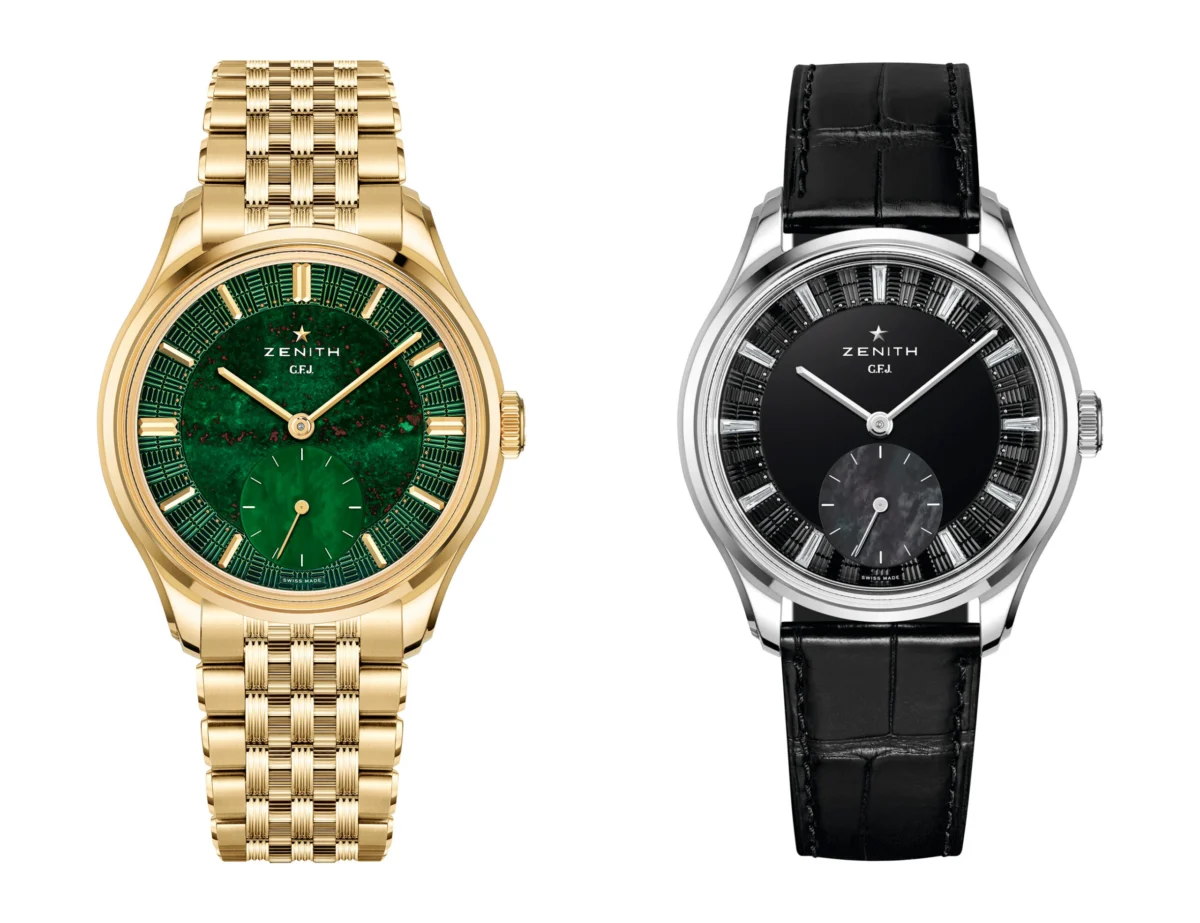
Zenith has officially unveiled two high-complication additions to its prestigious Georges Favre-Jacot (G.F.J.) collection, marking a significant milestone in the brand’s ongoing efforts to fuse historical horological excellence with avant-garde material science. The new timepieces, housed in 39.5mm cases, utilize rare and demanding materials—specifically tantalum and 18-carat yellow gold—to frame dials of black onyx and bloodstone. These releases are not merely aesthetic exercises; they represent a technical homage to the Calibre 135, one of the most decorated movements in the history of Swiss chronometry. By integrating a re-engineered version of this legendary engine, Zenith positions these models at the intersection of vintage soul and contemporary luxury, catering to a niche of collectors who value both provenance and physical durability.
The first of the two models features a case crafted from tantalum, a rare, blue-gray luster metal known for its extreme density and resistance to corrosion. Tantalum is notoriously difficult to machine due to its hardness and high melting point, requiring specialized tooling and a significantly slower fabrication process compared to traditional steel or gold. Zenith has paired this industrial-strength exterior with a dial of deep black onyx, accented by a small seconds counter finished in iridescent grey mother-of-pearl. The luxury quotient is further elevated by the inclusion of baguette-cut diamond indexes and polished white gold hands, creating a monochromatic yet high-contrast aesthetic.
The second model offers a warmer, more classical alternative in 18-carat yellow gold. This version features a central disc made of bloodstone—a variety of dark green jasper flecked with red inclusions of iron oxide. Like its tantalum counterpart, it utilizes a mother-of-pearl small seconds sub-dial. However, in a nod to traditional elegance, the diamond indexes are replaced with applied gold markers. Both watches retail between $51,900 and $83,400, reflecting the intensive labor required to work these materials and the exclusivity of the movements within.
The Technical Mastery of Tantalum and Rare Earth Minerals
The choice of tantalum for the G.F.J. collection underscores Zenith’s commitment to "Future of Tradition." Tantalum is a refractory metal, meaning it is highly resistant to heat and wear. In the watch industry, it is prized for its weight—similar to that of 18k gold—and its unique, slightly darker hue than titanium or steel. However, its high ductility and hardness mean that the milling process generates significant heat, which can damage standard tools. Zenith’s engineers have optimized the 39.5mm case design to maximize the metal’s biocompatibility and hypoallergenic properties, making it as comfortable on the skin as it is visually striking.
On the dial side, the use of onyx and bloodstone represents a return to "metiers d’art" or artistic crafts. Working with stone dials is a high-risk endeavor; the minerals must be sliced into wafers often less than 0.5mm thick. Any internal fissure in the stone can cause the dial to shatter during the cutting or polishing phase. The bloodstone used in the yellow gold model is particularly significant in horological history, often associated with strength and vitality in ancient cultures. By pairing these stones with mother-of-pearl—a biological-organic composite—Zenith creates a play of light and texture that ensures no two watches in the collection are exactly alike.
The Legacy of the Calibre 135: A Chronometric Titan
At the heart of these new G.F.J. models lies the updated Calibre 135. To understand the significance of this movement, one must look back to the mid-20th century, an era often referred to as the "Golden Age" of Swiss chronometry. Originally developed by Ephrem Jobin in 1948, the Calibre 135 was designed specifically to compete in the prestigious Neuchâtel Observatory trials. It was a movement built for one purpose: absolute precision.
The original Calibre 135 featured a distinctive architecture, including an oversized balance wheel and a large barrel to ensure a steady flow of energy. These design choices were radical for the time, as they forced a complete rethink of the gear train’s layout. The movement went on to win an unprecedented five consecutive Neuchâtel Observatory chronometry prizes from 1950 to 1954, and over 230 honors in total throughout its production life.
The modern iteration found in the tantalum and yellow gold G.F.J. models has been re-engineered for the 21st century. While it retains the spirit of the original "O" (Observatory) variant, it now incorporates modern materials and manufacturing tolerances that were impossible in the 1950s. The balance wheel has been further enlarged to improve inertia and stability, while the gear train has been optimized to reduce friction. This results in a robust 72-hour power reserve, allowing the watch to maintain its accuracy even after a weekend off the wrist.

Chronology of the Zenith Georges Favre-Jacot Collection
The evolution of the G.F.J. line is a testament to Zenith’s ability to mine its own history for modern relevance. The timeline of this specific lineage shows a clear trajectory toward high-end, low-volume artisanal pieces:
- 1865: Georges Favre-Jacot founds the Zenith manufacture in Le Locle, Switzerland, pioneering the concept of a vertically integrated watch factory.
- 1948: Ephrem Jobin develops the Calibre 135, setting a new standard for manual-wind movements.
- 1950–1954: The Calibre 135 dominates the observatory trials, cementing Zenith’s reputation as a leader in precision.
- 2022: Zenith collaborates with master watchmaker Kari Voutilainen and Phillips in Association with Bacs & Russo to restore and case original Calibre 135-O movements, sparking a renewed global interest in the caliber.
- 2024–2025: Zenith integrates the G.F.J. collection as a permanent fixture for its "High Craft" offerings, focusing on movement finishing and rare materials.
- 2026: The release of the Tantalum and Yellow Gold G.F.J. models, featuring the fully re-engineered and modernized version of the movement.
Market Analysis and Industry Implications
The release of these timepieces comes at a time when the luxury watch market is seeing a bifurcation between "hype" steel sports watches and "connoisseur" pieces that emphasize movement history and rare materials. By pricing these models between $51,900 and $83,400, Zenith is positioning itself to compete with independent "haute horlogerie" brands and top-tier established houses like Patek Philippe or Vacheron Constantin.
Industry analysts suggest that Zenith’s use of tantalum is a strategic move to appeal to collectors who find gold too traditional and steel too common. "Tantalum has a ‘stealth wealth’ appeal," notes one industry consultant. "It is more expensive and difficult to produce than titanium, and its weight gives it a luxury feel that modern enthusiasts crave. When you combine that with a movement as historically significant as the Calibre 135, you have a product that appeals to both the head and the heart."
Furthermore, the decision to use a 39.5mm case reflects a broader industry trend toward "new vintage" sizing. After decades of oversized watches, the market has shifted back toward sub-40mm diameters, which offer better proportions for formal wear while remaining substantial enough for daily use.
Official Responses and Craftsmanship Standards
While Zenith has not released a formal press statement regarding the specific production numbers, sources close to the manufacture indicate that these pieces will be produced in limited quantities due to the difficulty of sourcing high-quality bloodstone and the slow machining time for the tantalum cases.
A representative from Zenith’s technical department commented on the re-engineering of the movement, stating, "The challenge was not just to make the Calibre 135 run again, but to make it a movement that meets 2026 standards for durability and aesthetics. We have decorated every bridge and plate to a level that Georges Favre-Jacot himself would have demanded, using hand-chamfering and perlage that is visible through the sapphire crystal caseback."
The inclusion of the grey mother-of-pearl small seconds counter is also seen as a technical feat. Matching the luster of the mother-of-pearl with the deep, light-absorbing qualities of onyx or the matte texture of bloodstone requires a keen eye for color theory and material harmony.
Broader Impact on the Zenith Brand
The expansion of the G.F.J. collection serves as a halo for the rest of Zenith’s catalog. While the Chronomaster and Defy lines drive the brand’s volume, the G.F.J. models establish its credentials in the world of high-end watchmaking. By successfully reviving the Calibre 135 in a modern context, Zenith reinforces its claim as the "Master of Chronographs and Chronometry."
As these models reach boutiques and authorized retailers, they are expected to draw a new demographic of buyers—those who are looking for an alternative to the ubiquitous luxury brands and who appreciate the narrative of a movement that was once the undisputed king of the Swiss observatory trials. With the Tantalum and Yellow Gold G.F.J. models, Zenith has not just released new watches; it has reaffirmed its place in the pantheon of great Swiss watchmakers, bridging a century of innovation into a single, wearable object of art.