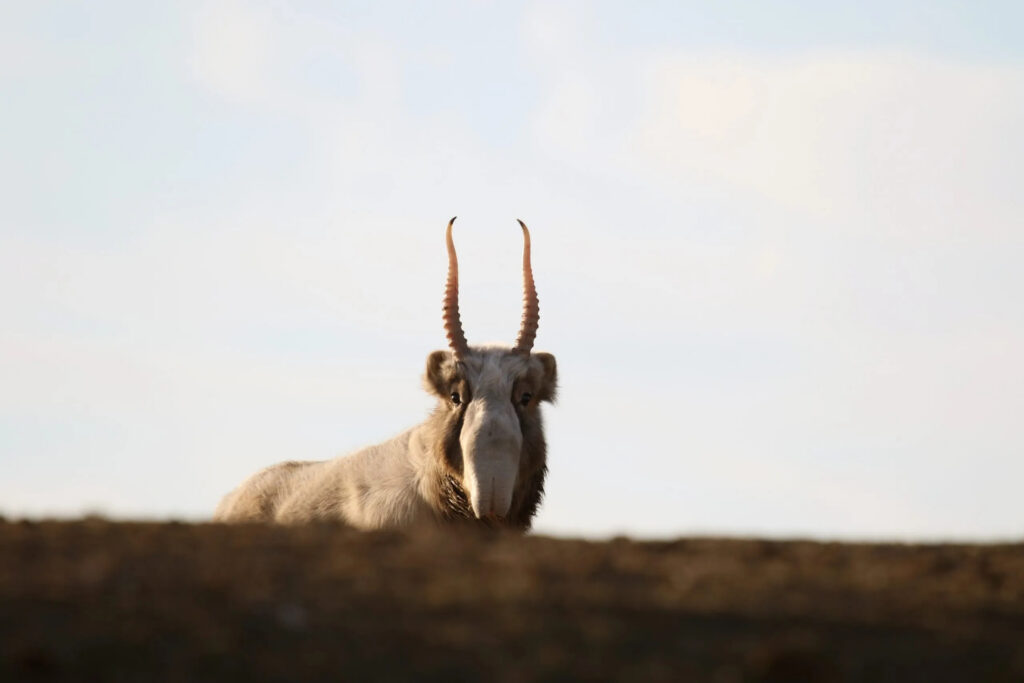
The rugged expanses of the Eurasian steppe serve as the backdrop for one of the most remarkable wildlife monitoring efforts in modern conservation. Deep within the remote frontiers of Kazakhstan, researchers from the Association for the Conservation of Biodiversity of Kazakhstan (ACBK) track the movements of the saiga antelope (Saiga tatarica). This prehistoric ungulate, characterized by its distinctive, bulbous trunk-like nose, represents a living link to the Pleistocene epoch. As seasonal rains transform the semi-arid grasslands into treacherous sludge, field biologists navigate the mud tracks of western Kazakhstan to monitor the annual rutting season—a critical period that dictates the survival and genetic health of these resilient nomadic herds.
Historical Context and Evolutionary Resilience
The saiga antelope is a survivor of an era that witnessed the extinction of woolly mammoths, saber-toothed cats, and giant deer with twelve-foot antlers. For hundreds of thousands of years, these animals have traversed the treeless plains of Central Asia, relying on expansive migrations to secure grazing lands and escape harsh weather patterns. Historically, indigenous human populations viewed the saigas as navigational guides across an unforgiving landscape, utilizing the animals’ established migration corridors to chart safe passages.
This deep-rooted tradition of mobility is mirrored in the history of the region’s human inhabitants. The term "Kazakh" is etymologically linked to Turkic roots signifying "wanderer" or "vagabond." For millennia, pastoral nomads practiced seasonal migrations, moving herds to higher altitudes during the summer and returning to sheltered river valleys before the onset of winter. These transit routes ultimately laid the foundation for portions of the historic Great Silk Road. The fertile banks of the Ural River, serving as the natural boundary between Europe and Asia, became a vital transcontinental crossroads where weary caravans found respite at strategic settlements and caravanserai.
However, twentieth-century geopolitical shifts profoundly altered this landscape. The rise of the Soviet Union brought mandatory sedentarization policies, forcing nomadic human populations into agricultural settlements and halting centuries-old migration patterns. While human mobility was largely restricted to urban centers and agricultural plots, the saigas continued their ancient nomadic traditions, setting the stage for inevitable conflicts with modern infrastructure.
Chronology of Modern Threats and Fragmentation
In contemporary times, the saigas face an existential crisis driven by rapid industrialization, the proliferation of linear infrastructure, and border security measures. While historical threats primarily involved regulated or illegal hunting, the modern era has introduced structural barriers that disrupt ecological connectivity.
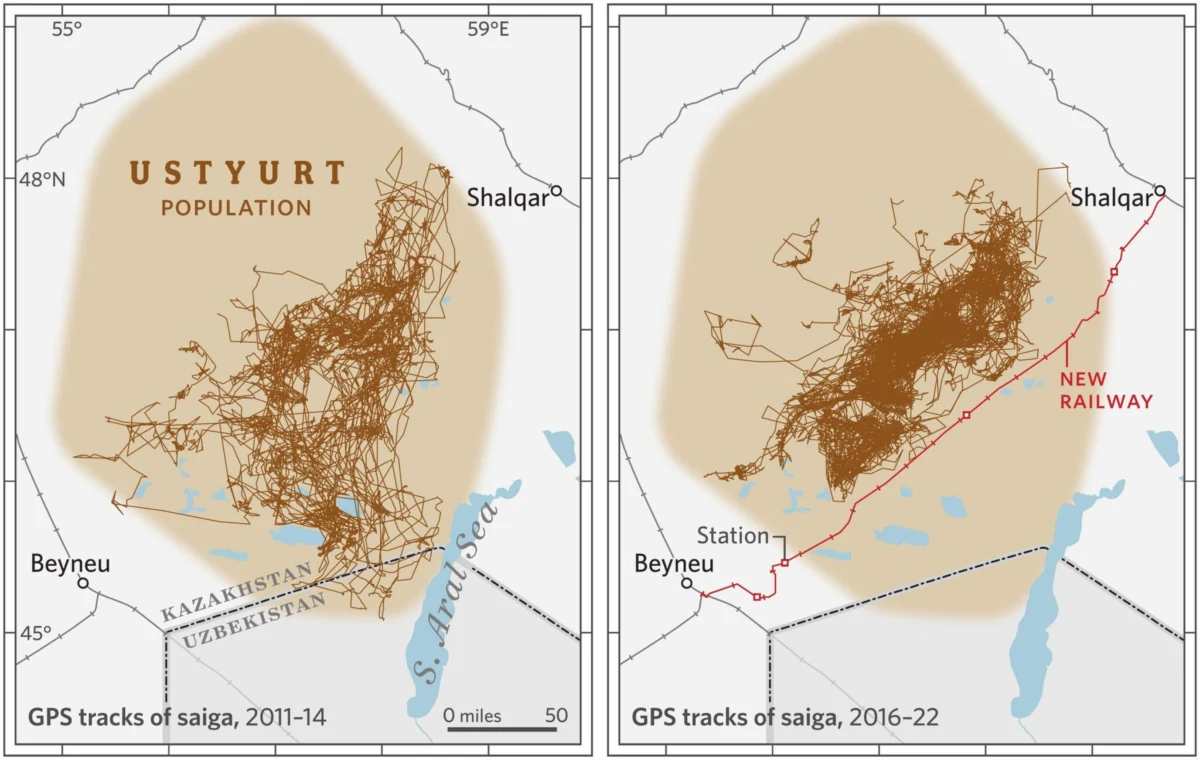
- Pre-2014: GPS-collared saiga populations routinely executed extensive migrations, crossing international borders from the Eurasian steppe deep into Uzbekistan in search of seasonal forage and water resources.
- 2014: The construction of a major trans-continental railway line bisected traditional migration corridors. Subsequent telemetry data revealed that collared herds were blocked by the new rail infrastructure, resulting in disoriented animals trapped on the northern side of the tracks while vital habitats to the south withered.
- Recent Years: The establishment of new wildlife sanctuaries informed by ACBK tracking data marked a shift toward targeted habitat protection. However, ongoing road and rail expansions continue to fracture historical ranges into isolated pockets.
Environmental historians and conservation scientists note that the interruption of these migratory routes leads to a profound loss of spatial knowledge among younger generations of animals. Similar to the cultural erasure experienced by human populations forced into sedentarization, young saigas acquire survival behaviors, such as optimal foraging routes and hazard avoidance, through observational learning within the herd. When physical barriers partition the landscape, entire stretches of ecological knowledge fade from collective memory.
Supporting Data and Ecological Mechanics
The biology of the saiga is intricately adapted to the extremes of the continental climate. The species’ signature elongated snout functions as a vital physiological tool: it filters out dust during arid summer months and warms frigid winter air before it enters the lungs. During the annual winter rut, male saigas engage in high-energy territorial displays and headbutting to signal physical dominance to females.
Historically, these populations numbered in the millions across a vast range spanning from the Caucasus Mountains to Mongolia. However, severe population bottlenecks—including a catastrophic epizootic disease event in 2015 that wiped out over 200,000 individuals in a matter of weeks—have left the species vulnerable to stochastic environmental pressures.
Modern conservation relies heavily on advanced telemetry. Because the Eurasian steppe lacks vertical obstructions, GPS collars provide reliable, high-resolution data streams regarding herd movements. This spatial analysis allows conservationists to identify critical bottleneck zones where human development intersects with wildlife corridors.
Official Responses and Mitigation Strategies
In response to habitat fragmentation, ACBK has partnered closely with the government of Kazakhstan and neighboring nations to implement structural solutions designed to restore ecological connectivity.
Conservation engineers have designed specialized, saiga-friendly crossing points along railway lines. These features incorporate slightly sloping dirt ramps that match the elevation of the tracks, creating the visual illusion of a natural gap in the barrier. Additionally, strategically placed cattle-guard fences installed at safe distances from the crossings prevent direct collisions between trains and the skittish ungulates.
International cooperation has also yielded modifications to border security infrastructure. Along the Kazakhstan-Uzbekistan border, traditional barbed-wire fencing—which frequently trapped or injured migrating wildlife—has been systematically replaced with X-shaped barricades. These redesigned structures successfully deter unauthorized vehicular traffic while leaving sufficient ground clearance for saigas to resume their cross-border migrations.
Broader Impact and Implications
The ongoing efforts to preserve the saiga antelope carry implications that extend far beyond wildlife management. Ecologists emphasize that large herbivores are essential ecosystem engineers, maintaining grassland health through grazing and nutrient cycling across vast expanses of the steppe.
Furthermore, the plight of the saiga serves as a bellwether for infrastructure development across Central Asia. As nations modernize their economies through expanded transportation networks, balancing economic connectivity with ecological preservation remains a critical policy challenge. The integration of wildlife-inclusive engineering in rail and border projects demonstrates a growing recognition that ecological corridors are as vital to regional stability as commercial supply lines.
Ultimately, the survival of the saiga antelope depends on institutional commitments to maintain the permeability of the steppe. By bridging the gap between modern infrastructure and ancient migratory pathways, conservationists aim to secure a future where these resilient nomads can continue to traverse the landscapes that have defined Central Asia for millennia.