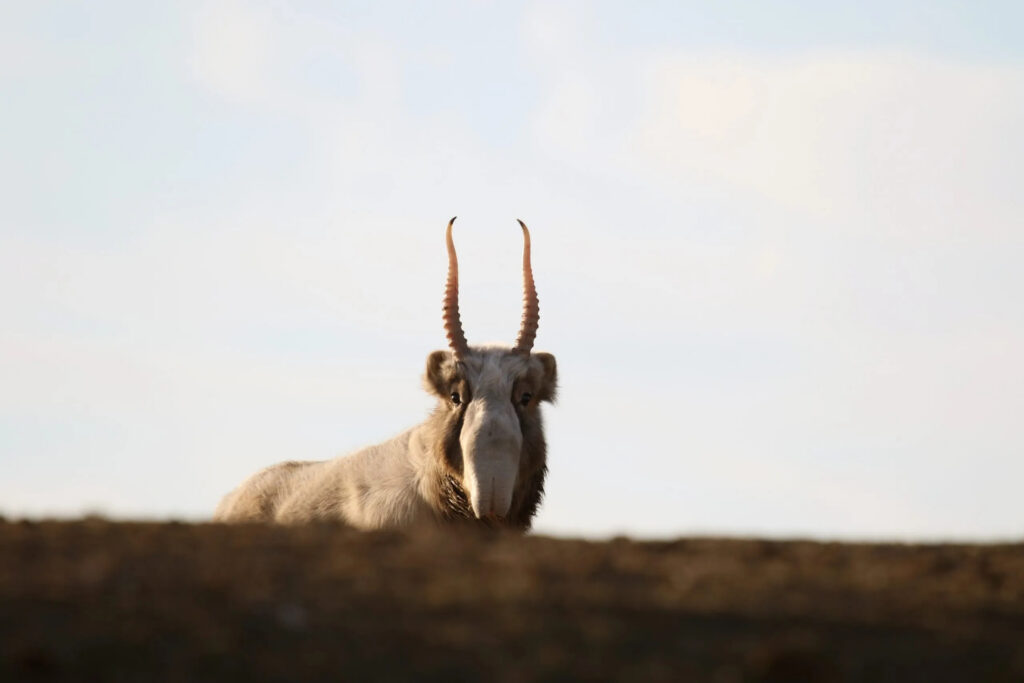
The rugged terrain of western Kazakhstan presents a landscape where boundaries blur and ancient history intersects with modern ecological challenges. Skidding off the main paved arteries onto mud paths maintained solely by persistent tire treads reveals a network of parallel tracks, forking and merging across the desolate plain. In the distance, howling Siberian winds drive sweeping snow across the horizon, framing a scene that has remained largely unchanged since the Pleistocene epoch. Through binoculars, hundreds of nomadic saiga antelope pierce the frigid air, their distinctive, ringed horns and elongated snouts propelling them swiftly across the treeless steppe.
This remote corner of Central Asia serves as the backdrop for field audits conducted by conservationists from the Association for the Conservation of Biodiversity of Kazakhstan (ACBK). Experienced researchers Alexandr and Albert navigate the unpredictable terrain during the crucial rutting season, monitoring a species that has outlived woolly mammoths, saber-toothed cats, and giant deer. As modern infrastructure encroaches upon these historic migration routes, the survival of the saiga hangs in the balance, prompting international conservation efforts to restore connectivity across the Eurasian landscape.
Historical Context and the Nomadic Heritage of the Steppe
The saiga antelope has traversed the Central Asian steppes for millennia, long before human civilizations established permanent settlements. Historical and archaeological analyses indicate that saigas served as natural guides for early human caravans navigating the unforgiving terrain. Cave paintings dating back to the seventh century BCE depict the antelope with mythical reverence, capturing their resilience and elusive nature in an extreme environment.
This region shares a deep historical connection with nomadism, a tradition originating at least as early as the Early Iron Age. The term "Kazakh" is widely believed to derive from the Turkic word "qaz," meaning "wanderer" or "vagabond." For centuries, small human groups migrated seasonally between high-altitude summer pastures and sheltered winter valleys, periodically congregating for cultural festivals and athletic gatherings. These time-honed transit corridors eventually formed the foundation of the Great Silk Road, a transcontinental network of pathways linking Europe and Asia across the fertile banks of the Ural River.
The lifestyle of continuous movement persisted until the 20th century, when the Soviet Union instituted mandatory sedentarization policies. These initiatives forced nomadic populations into agricultural practices and permanent settlements, effectively dismantling a cultural framework that had thrived for thousands of years. While framed as modernization, this transition severed human connections to traditional migratory routes, mirroring the modern disruptions currently faced by wildlife populations.
The Biology and Behavior of the Saiga Antelope
The annual rutting season represents a critical phase in the saiga lifecycle, requiring immense physical endurance. During this period, males congregate in massive single-file lines before engaging in competitive headbutting and mating displays. The intensity of these rituals is often so extreme that many males succumb to physical exhaustion and starvation.
Females carefully select mates based on physical fitness, paying particular attention to the male’s enlarged, floppy nose. The saiga’s specialized proboscis is an evolutionary adaptation essential for filtering out dust across semidesert plains and warming frigid winter air before it reaches the lungs. Consequently, a larger nose signifies superior virility among competing males.
Historically, saigas roamed in massive herds stretching from the Caucasus Mountains to Mongolia. Their preference for open, treeless landscapes makes them prime candidates for satellite tracking. Modern GPS collars provide conservationists with reliable location data, eliminating the historical challenge of locating nomadic herds across boundless horizons.
Infrastructure Expansion and the Fragmentation of Migration Routes
Despite their evolutionary resilience, saigas face unprecedented threats from rapid human development. Following the collapse of the Soviet Union and subsequent economic shifts, the expansion of paved roads, agricultural plots, and particularly linear infrastructure such as railways has severely fragmented the Eurasian steppe.
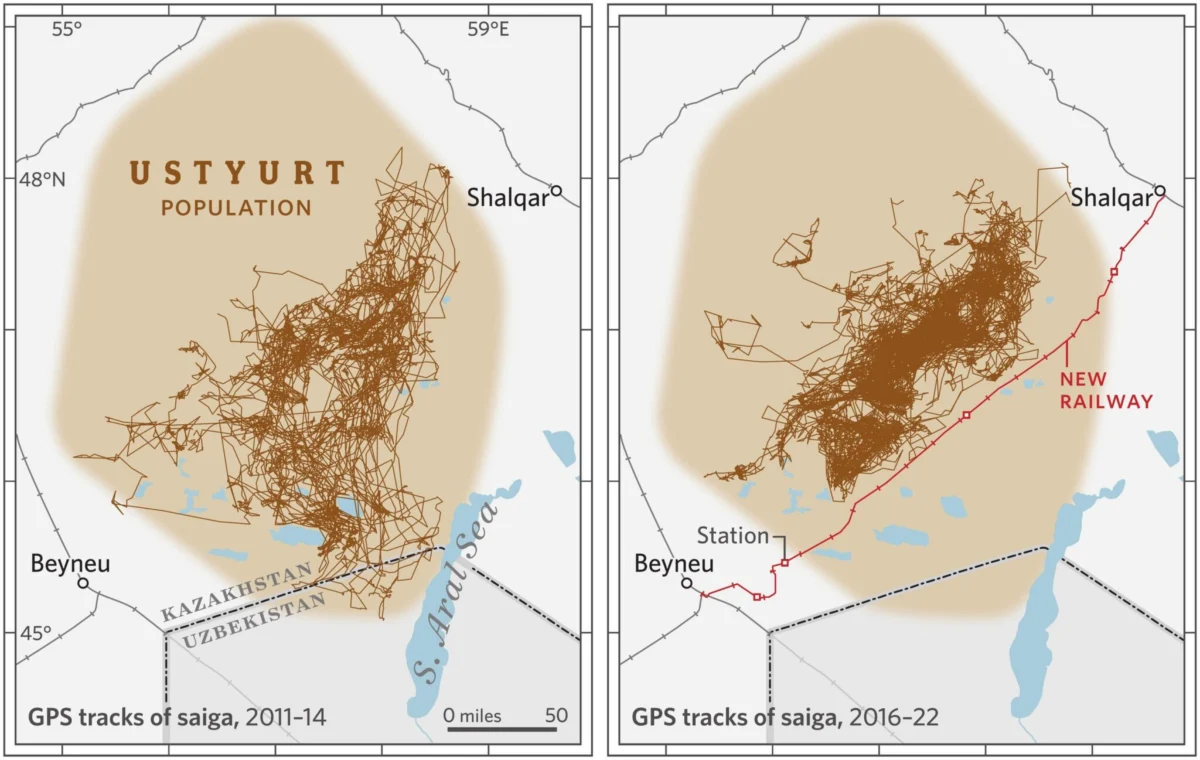
Conservation data highlights the immediate impact of these barriers. GPS tracking records analyzed by ACBK researchers demonstrate how populations of saigas that once routinely migrated deep into Uzbekistan were abruptly blocked by the construction of a rail line in 2014. Post-construction data reveals herds milling despondently on the northern side of the tracks, unable to reach traditional southern feeding grounds and water sources.
This physical obstruction triggers a broader ecological crisis: the loss of spatial knowledge. Similar to how displaced human populations gradually lose connection to ancestral navigation routes, young saigas learn migration pathways, foraging sites, and shelter locations through observation and active participation. When barriers divide the landscape, entire cultural traditions of navigation are erased from memory, leading to population declines and localized extinctions.
Conservation Strategies and Cross-Border Collaboration
To reverse habitat fragmentation, ACBK has partnered with the Kazakh and Uzbek governments to implement targeted mitigation measures. Along railway corridors in Kazakhstan, conservationists have collaborated to construct dozens of saiga-friendly crossing points. These structures feature gently sloping dirt ramps matching the height of the train tracks, creating the illusion of a natural gap in the infrastructure. Additionally, strategically placed cattle-guard fences keep trains and ungulates safely separated.
International cooperation has yielded similar interventions along the Kazakhstan-Uzbekistan border. Authorities modified traditional barbed-wire fencing into X-shaped barricades that prevent vehicular access while leaving precise clearances for saigas to pass through. These design adjustments aim to rebuild the migratory trust necessary for the antelope to reclaim historical plateaus.
Broader Implications for Steppe Ecosystems
The plight of the saiga antelope underscores the complex balance between economic development and biodiversity conservation in Central Asia. As linear infrastructure continues to expand to support regional trade and resource extraction, the long-term viability of migratory species depends on proactive landscape management.
Data from wildlife sanctuaries and government agencies indicate that targeted conservation policies can yield positive outcomes when informed by empirical tracking data. However, experts emphasize that maintaining ecological corridors is essential not only for the survival of the saiga but for the overall health of the Eurasian steppe ecosystem. Preserving these ancient migratory pathways ensures that the landscape retains its ecological integrity, safeguarding a natural heritage that has endured for hundreds of thousands of years.