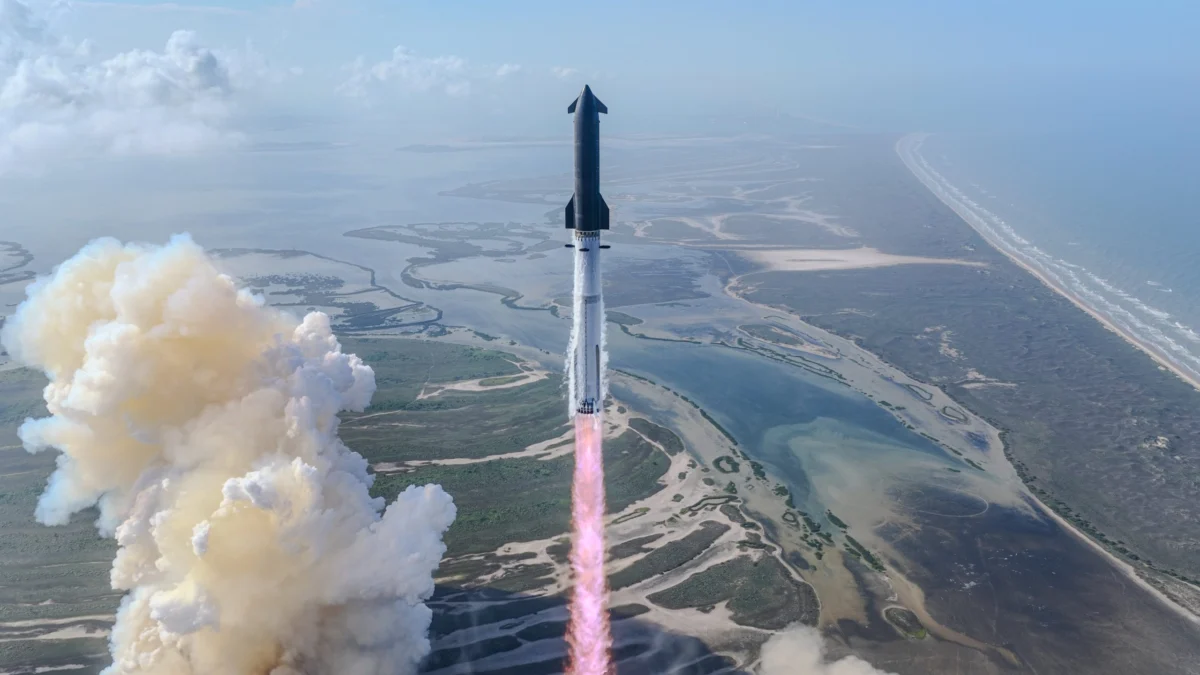
SpaceX is targeting Monday, July 20, 2026, for the thirteenth test flight of its Starship program, with the launch window scheduled to open at 6:45 p.m. ET/5:45 p.m. CT. This revised target follows an abort of the planned launch the previous evening, which was called off due to engine issues on the Super Heavy booster. The company’s CEO, Elon Musk, confirmed that the abort was triggered by a failure of several Raptor engines to ignite during the startup sequence, necessitating the replacement of two engines.
Starship Flight 13 Aborted Due to Engine Malfunctions
The highly anticipated Starship Flight 13 experienced an abrupt end just moments before its scheduled liftoff on Thursday, July 17, 2026. The launch attempt, which had proceeded smoothly through much of its countdown, was automatically scrubbed at T-zero when four of the Super Heavy booster’s 33 Raptor 3 engines failed to ignite. This critical failure in the engine startup sequence triggered an immediate abort, preventing the massive rocket from leaving the launchpad at SpaceX’s Starbase facility in Boca Chica, Texas.
The 90-minute launch window had opened at 6:45 p.m. EDT. Throughout the day, SpaceX engineers had meticulously loaded over 11.5 million pounds of liquid methane and liquid oxygen propellant into the rocket. The automated abort system, designed to ensure crew and vehicle safety, intervened precisely at the moment of ignition, averting a potentially more serious incident. Following the abort, SpaceX’s launch directors confirmed the stand-down via X (formerly Twitter), and the live broadcast of the event was concluded.

Elon Musk Explains the Cause and Sets New Timeline
Elon Musk, SpaceX’s founder and CEO, provided immediate insight into the cause of the abort, directly addressing the issue on X. He stated, "Some of the engines didn’t start, triggering an automatic launch abort." This candid explanation highlighted a common challenge in complex rocket launches, where the ignition of numerous powerful engines must be precisely synchronized.
To ensure a successful flight, Musk announced that two of the affected Raptor engines would be removed and replaced. This process requires careful inspection, repair, and reinstallation, followed by rigorous testing. Based on these necessary repairs and preparations, Musk indicated that the "most probable launch timing is early next week." This statement pointed towards a potential re-flight attempt on or around Monday, July 20, 2026, pending the completion of the engine work and a return to operational status for the launch vehicle. SpaceX officially announced the new launch window on the morning of July 18th, confirming the Monday target.
Evolution of Starship Testing and New Mission Objectives
Starship Flight 13 was designed to incorporate several significant advancements and mission objectives, building upon the lessons learned from the previous twelve test flights. Unlike some earlier attempts where SpaceX aimed to catch the Super Heavy booster with its launch tower, the company stated that it would not be attempting a booster catch during this mission. This suggests a continued focus on proving the booster’s core capabilities and recovery mechanisms independently before integrating more complex capture maneuvers.
For the Starship Upper Stage, the mission planned to assess adjustments aimed at enhancing engine reusability. These modifications would be evaluated during the ascent phase. A key payload for Flight 13 was the deployment of 20 operational Starlink V3 satellites, marking the first time Starship has been tasked with delivering an operational payload of this scale. Notably, six of these satellites were equipped with external cameras. The purpose of these cameras was to capture detailed imagery of Starship’s heat shield during its atmospheric reentry, providing SpaceX with an unprecedented self-inspection capability. This data is crucial for refining the heat shield’s design and performance for future missions, especially those involving higher-velocity reentries.

Furthermore, SpaceX intended to conduct a critical in-space relight of a single Raptor engine on the Starship Upper Stage. This maneuver is a vital demonstration for enabling future orbital deorbit burns, in-space refueling operations, and deep space exploration missions. The successful execution of such a relight is a cornerstone for establishing Starship’s capability as a versatile spacecraft for interplanetary travel and sustained orbital operations.
The mission profile for Flight 13 concluded with Starship performing a controlled splashdown in the Indian Ocean. This recovery method allows SpaceX to gather valuable data on the vehicle’s performance during reentry and descent, even without a propulsive landing.
Increased Scrutiny Following SpaceX’s Public Offering
The aborted launch of Starship Flight 13 occurred against a backdrop of heightened public and investor attention. SpaceX recently completed its Initial Public Offering (IPO) in June 2026, listing on the stock market under the ticker SPCX at an opening price of $135 per share. This marked a significant milestone for the company, transforming it into a publicly traded entity with a substantial investor base now closely monitoring every aspect of its operations, particularly the progress of the Starship program.
A launch abort, especially one occurring at the final moments before liftoff, carries greater visibility and potential market impact than previous test flights conducted while SpaceX was privately held. Public investors are now keenly observing the success and failures of Starship, recognizing its pivotal role in the company’s future growth and its ambitious long-term vision, which includes enabling a Mars civilization and providing global satellite internet services.
Lessons Learned from Previous Flights
The Starship program, characterized by rapid iteration and learning, has seen its share of challenges and successes. Flight 12, which took place in May 2026, also encountered engine-related issues. During its boostback burn, the Super Heavy booster deviated significantly from its intended trajectory when five of its engines failed to reignite. While the Starship Upper Stage successfully separated and reached orbit, the booster’s off-nominal flight path resulted in a less controlled landing. This experience underscored the importance of consistent engine performance and the need for robust control systems.
The decision to skip the in-space relight demonstration on Flight 12, following the engine issues during ascent, further emphasized the critical nature of engine reliability for Starship’s operational capabilities. Flight 13 was designed, in part, to address these lingering questions about engine performance and control in the demanding environment of space.
Broader Implications for SpaceX and Space Exploration
The continuous testing and development of Starship are fundamental to SpaceX’s overarching strategy. The program aims to achieve full reusability of both the Super Heavy booster and the Starship Upper Stage, a goal that is paramount for significantly reducing the cost of space access. This reusability is not only key to facilitating the deployment of future Starlink constellations but also central to enabling ambitious deep-space missions.
SpaceX’s Starship is slated to play a crucial role in NASA’s Artemis program, serving as the lunar lander for the Artemis III mission, which aims to return humans to the Moon for the first time since the Apollo era. The success of Starship’s development directly impacts the timeline and feasibility of these historic lunar endeavors. Beyond lunar missions, Starship is envisioned as the primary vehicle for transporting cargo and eventually humans to Mars, representing a paradigm shift in interplanetary exploration.

A Glimpse into Elon Musk’s Vision: The Texas Ranch Gallery
In related news, Elon Musk recently announced plans to establish a "product gallery" at his ranch in Texas. This initiative aims to showcase the lifelong body of work and inventions that have defined his career. The announcement came in response to a resurfaced comparison of Musk to Albert Einstein, made by JPMorgan CEO Jamie Dimon in early 2025.
The gallery is expected to feature a comprehensive timeline of Musk’s technological contributions, starting with his first programmed game, Blastar, at age 12. The collection will span his entrepreneurial journey, including Zip2 (1995), X.com (which merged to become PayPal, acquired by eBay in 2002), SpaceX (2002), Tesla (2003), SolarCity (2006), The Boring Company (2016), Neuralink (2016), and his involvement with OpenAI (co-founded 2015). More recent ventures such as the acquisition of X (2022), xAI (2023), Optimus (2024), and the Cybercab (2026) are also anticipated. Artifacts that blur the lines between product and cultural phenomena, such as The Boring Company’s "Not-a-Flamethrower," Tesla’s Short Shorts, and "Burnt Hair" perfume, are likely to be included.
Land acquisition records suggest that entities tied to Musk have accumulated a significant acreage in Bastrop County, east of Austin, Texas, managed by his longtime associate Jared Birchall. While the exact location, opening date, and public accessibility of the gallery remain unconfirmed, the project signifies a moment of reflection on Musk’s profound impact on technology and industry, especially in the wake of SpaceX’s successful IPO. The gallery serves as a testament to a career marked by ambitious innovation and a persistent drive to push the boundaries of what is possible.