











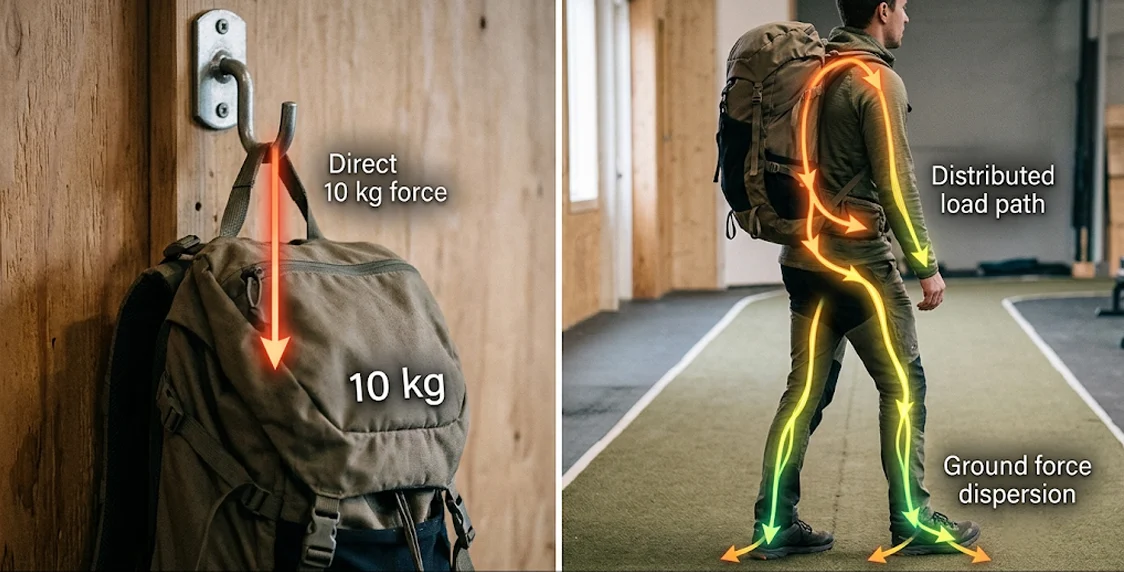
When an individual hoists a 10-kilogram weight, the physical reality of that action extends far beyond the static number registered on a scale. While a mechanical scale simply records downward gravitational pull, the human body experiences that same weight as a dynamic, complex distribution of forces. Depending on the method of transport, weight dispersion shifts radically, transforming a simple lifting task into a sophisticated biomechanical challenge. To understand why a poorly designed pack feels profoundly heavier than its actual weight, researchers in ergonomics and kinesiology examine what is known as a "load path"—the precise trajectory that external weight travels through an object and into the human skeletal structure.
The mechanics of this phenomenon can be easily visualized. If a 10-kilogram load is suspended from a rigid steel hook, the hook absorbs the entire 10 kilograms of force statically. However, when that same 10-kilogram load is placed onto a human body, the force does not merely park itself on the shoulders. Instead, the kinetic energy and gravitational pull travel downward through the fabric and frame of a backpack, pressing into the shoulders and hips, traversing the trunk and pelvis, moving down the legs, passing through the feet, and finally dissipating into the ground. Carrying, at its core, is an uninterrupted load path.
Within this biomechanical pathway, the exact positioning of the load relative to the human center of mass dictates the level of physical exertion required. For instance, holding a 10-kilogram weight tightly against the chest requires significantly less muscular stabilization than holding that exact same weight at arm’s length. While the mass remains identical, the biomechanical demand escalates dramatically due to torque. The further a load is positioned from the body’s natural center of gravity, the greater the torque exerted on the spine and core muscles, forcing muscles to work exponentially harder to maintain balance and control.
Ideally, human biomechanics function most efficiently when the skeleton and joints—rather than perpetually fatigued muscles—transmit the bulk of the load through the structural framework of the body. This structural efficiency explains why traditional load-carrying techniques, such as carrying heavy burdens atop the head, have endured across various cultures for centuries. By aligning the weight directly over the body’s vertical axis, carriers minimize the muscular torque required to keep the load stable, thereby conserving metabolic energy over long distances.
Evolutionary Context and Historical Development of Load Carriage
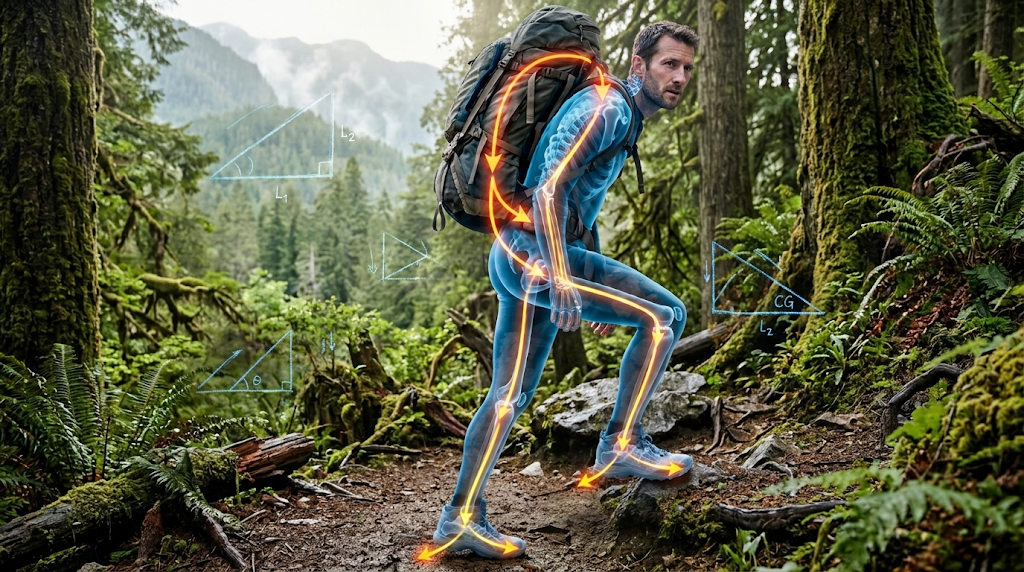
Human survival throughout history has been inextricably linked to the ability to transport resources, tools, and provisions across vast landscapes. Anthropological studies indicate that early humans developed specialized anatomical adaptations—including elongated legs, arched feet, a stabilized pelvis, and an S-curved spine—specifically optimized for bipedal endurance walking while bearing external loads.
For millennia, this transportation relied primarily on tumplines (straps worn across the forehead or chest), baskets, and direct overhead balancing. It was not until the late 19th and mid-20th centuries that modern industrial design began systematically addressing the mechanical interaction between manufactured luggage and human anatomy. The introduction of external aluminum frames in the 1950s, followed by the widespread adoption of internal frames, hip belts, and adjustable load-lifter straps in subsequent decades, marked a revolution in outdoor and tactical gear. These interventions were engineered specifically to manipulate the load path, shifting the burden away from vulnerable cervical and thoracic regions and redirecting it toward the robust skeletal structure of the pelvis and lower limbs.
Modern Ergonomic Innovations and Mechanical Interventions
Contemporary backpack design relies heavily on hardware innovations designed to optimize the load path and reduce fatigue. Chief among these are padded hip belts and adjustable load lifters. A properly fitted hip belt acts as a structural bridge, intercepting a significant percentage of the downward force and transferring it directly into the pelvic girdle. From the pelvis, the load is safely transmitted into the large, dense bones of the lower extremities and into the earth, bypassing the delicate vertebrae of the upper spine.
Similarly, load-lifter straps—the webbing anchored above the shoulders and attached to the upper frame of a backpack—serve a crucial geometric function. By drawing the top of the pack inward toward the wearer’s back, these straps minimize the backward-pulling leverage that often forces hikers and commuters to hunch forward. Additional components, such as sternum straps and compression panels, work in tandem to stabilize the entire system, preventing the contents from shifting unpredictably during movement.
Biomechanical Implications and Energy Expenditure
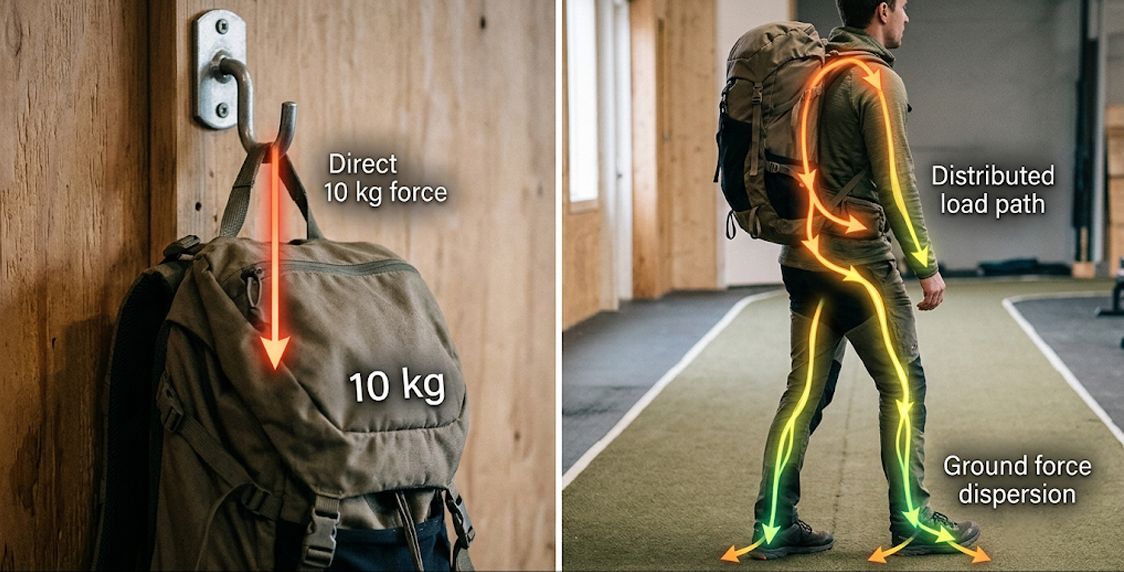
When a pack fails to manage these geometric variables, the physiological consequences are immediate and measurable. Kinesiological studies consistently demonstrate that poorly distributed weight forces the human body to expend significantly more energy per step. If a load sits too far away from the wearer’s center of mass, or if it sways laterally with each stride, the trunk muscles must constantly engage in rotational resistance to prevent falling.
Furthermore, even a well-balanced backpack fundamentally alters human gait. The added mass forces modifications in stride length, posture, and muscle recruitment patterns across the hamstrings, quadriceps, core, and shoulders. As the total weight increases, these gait adaptations become increasingly pronounced, accelerating metabolic fatigue. This explains why carrying 10 kilograms in an ill-fitting, unbelted sack for a single hour can induce more muscular soreness and exhaustion than carrying the same weight in an ergonomically optimized, frame-supported pack for an extended duration.
Industry Perspectives and Modern Design Philosophy
Designers and ergonomists within the modern carry-goods industry increasingly emphasize that the ultimate objective of advanced backpack engineering is not necessarily to make a heavy load feel weightless, but rather to make it feel integrated.
According to leading gear designers, a truly successful pack acts as an extension of the human body rather than an external impediment. When the load rests in the optimal anatomical zone—close to the core, adequately supported by the hips, and moving synchronously with the wearer’s natural rhythm—the psychological and physical burden changes. The wearer ceases to focus on the presence of the luggage, allowing the body to leverage its evolutionary design for efficient, sustained movement.
As manufacturing materials continue to evolve—incorporating ultra-lightweight composite frames, high-tensile fabrics, and computer-mapped pressure distribution panels—the intersection between human anatomy and load carriage grows increasingly refined. Ultimately, the modern backpack represents a sophisticated technological bridge designed to cooperate with a biological system that was, by all evolutionary accounts, born to carry.