








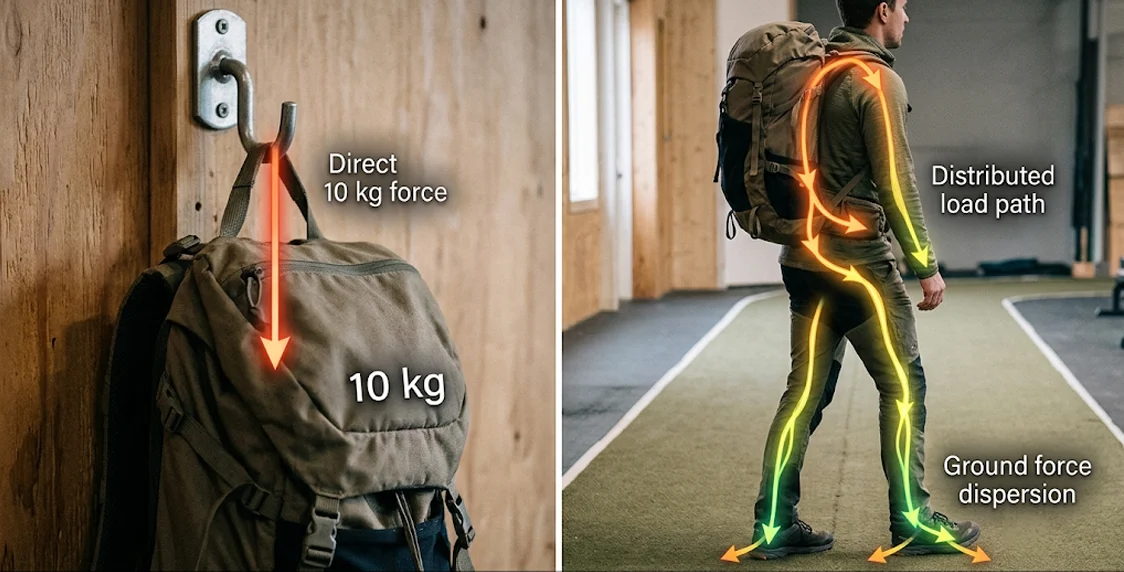
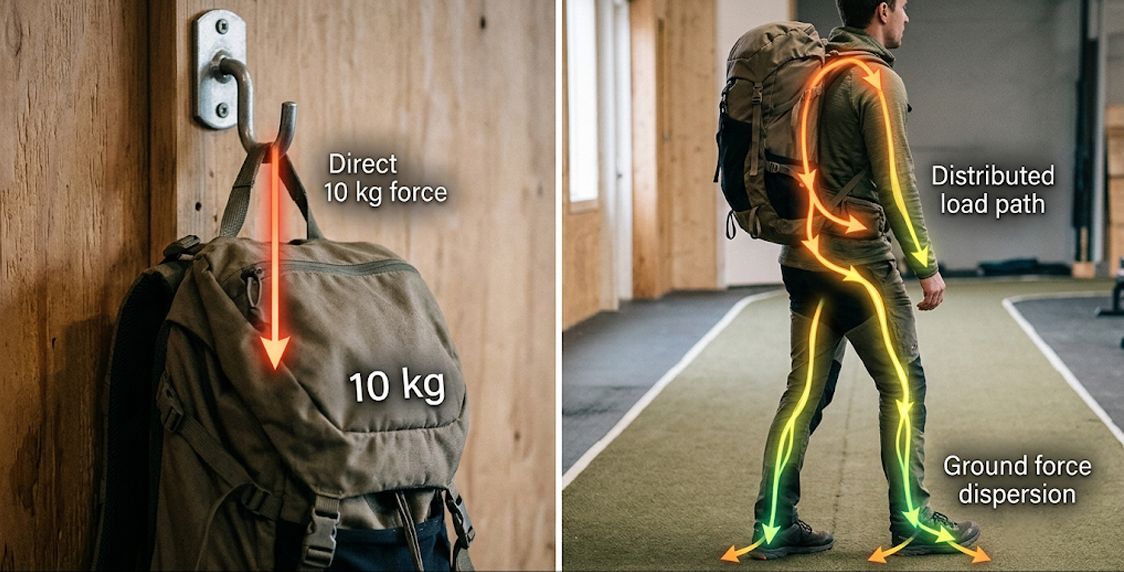
When an individual lifts a 10-kilogram weight and suspends it from a stationary metal hook, the physics are entirely straightforward: the hook experiences the exact 10 kilograms of force directed downward by gravity. However, when that identical 10-kilogram load is introduced to the human body, the mechanical reality shifts dramatically. The weight does not simply rest passively against the torso; instead, it initiates a complex kinetic chain. Its force travels dynamically through the fabric and frame of a pack, presses into the shoulders and hips, cascades downward through the trunk and pelvis, traverses the legs, and ultimately disperses through the feet into the earth. In ergonomics and human kinesiology, this continuous transmission of force is formally defined as a load path.
Understanding the load path reveals why two objects of identical weight can feel vastly different to the person carrying them. While digital scales measure absolute mass, they remain entirely blind to geometry, leverage, and biological efficiency. As researchers in ergonomics and human locomotion have long noted, carrying a load is fundamentally an exercise in physics where the body acts as both a structural frame and a dynamic engine.
The Mechanics of Torque and the Human Center of Mass
To comprehend why a backpack can feel deceptively heavy, one must examine the relationship between the load and the human center of mass. Consider a simple physical demonstration: holding a 10-kilogram weight firmly against the center of the chest requires minimal muscular exertion. However, extending that same weight outward at arm’s length radically alters the physical demand. Although the mass of the object has not changed, the distance from the body’s pivot points has increased, generating significantly greater torque.
This torque forces the muscles of the back, shoulders, and core to work exponentially harder to maintain stability. Ideally, efficient load carriage minimizes muscular fatigue by utilizing the skeleton and joints to transmit structural weight directly downward. Throughout human history, traditional carriage methods—such as balancing heavy vessels or bundles directly on top of the head—have endured across various cultures precisely because this vertical alignment places the load directly along the body’s primary axis, reducing the mechanical advantage of gravity against the spine.
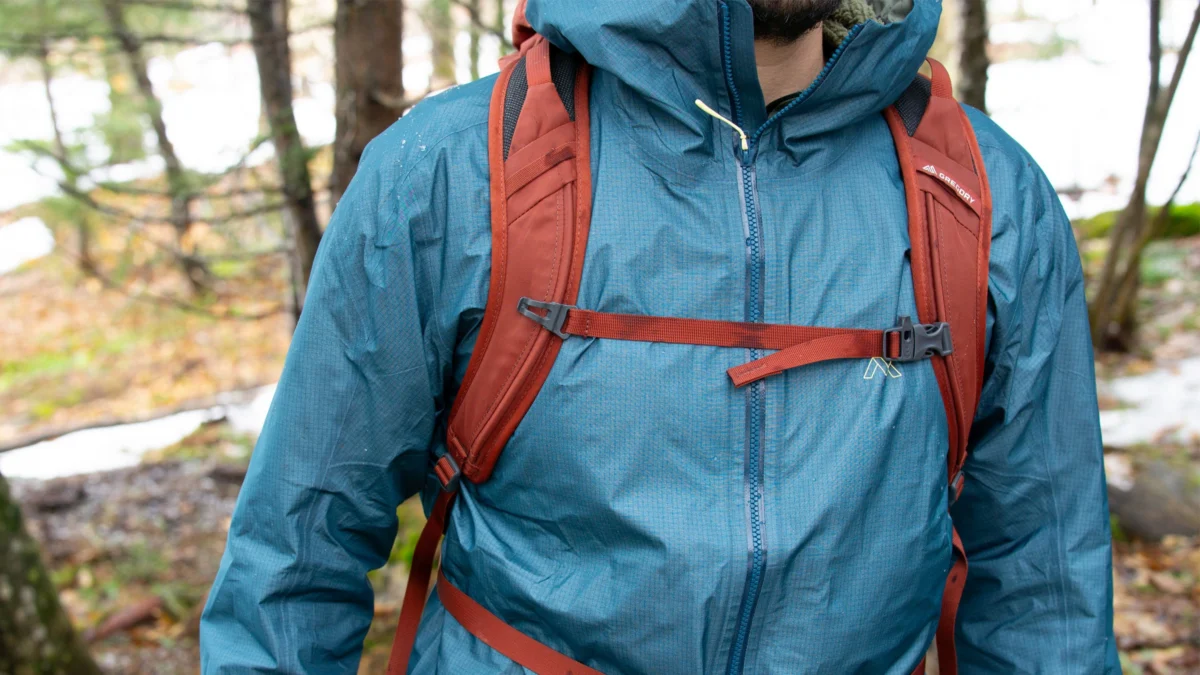
In contrast, modern industrial design must engineer synthetic solutions to achieve similar biomechanical harmony. Innovations such as padded hip belts and adjustable load lifters are direct interventions in the human load path. A properly fitted hip belt intercepts the downward force of a pack, diverting a substantial percentage of the weight away from the sensitive muscles of the shoulders and transferring it directly into the pelvis. From there, the massive skeletal structures of the legs channel the force safely to the ground. Meanwhile, upper load lifters pull the top of the pack inward, shortening the distance between the cargo and the wearer’s center of mass, thereby subduing unwanted torque.
Historical Evolution of Load Carriage
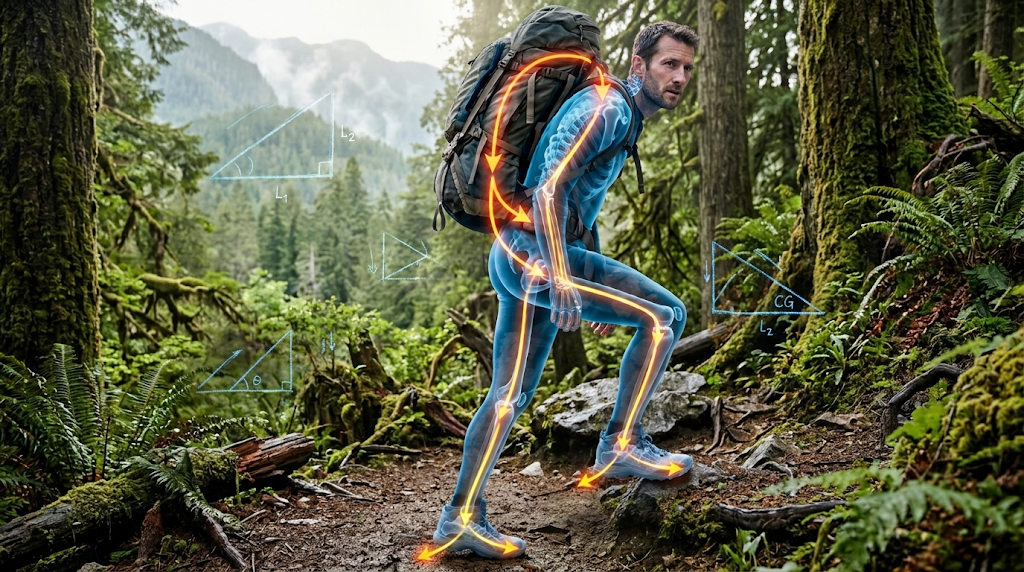
The human capacity for carrying loads is not merely a learned behavior; it is an evolutionary adaptation. Anthropological studies indicate that the genus Homo evolved distinct anatomical features—including arched feet, lengthened legs, and shock-absorbing spinal curvatures—specifically tailored for endurance walking and load-bearing locomotion. For millennia, early humans relied on simple woven baskets, animal skins, and rigid wooden frames to transport resources across vast distances.
The transition toward modern load-carriage systems accelerated dramatically during the 19th and 20th centuries, driven largely by military logistics. Armies worldwide required infantrymen to carry heavy provisions, ammunition, and survival gear over extended campaigns without debilitating physical exhaustion. This military necessity birthed early iterations of external frame packs. By the mid-20th century, innovators began experimenting with internal stays, ergonomic contouring, and advanced synthetic textiles to distribute weight more evenly across the human frame.
The introduction of specialized mountaineering and hiking packs in the 1970s and 1980s marked a turning point where consumer gear began adopting advanced ergonomic principles previously reserved for specialized expeditions. Today, the design of a backpack is treated as a rigorous exercise in biomechanics rather than simple luggage construction.
Biomechanical Impacts on Gait and Energy Expenditure
When an individual dons a loaded backpack, the physiological response is immediate and systemic. Even with a perfectly balanced and fitted pack, the human gait undergoes subtle yet measurable alterations. Stride length, posture, and muscle recruitment patterns shift dynamically to accommodate the extra mass.
Clinical studies observing human gait under load reveal that carrying weight increases metabolic energy expenditure significantly. The trunk must constantly engage to resist rotational forces, particularly when the load shifts unpredictably. If a pack is poorly designed—meaning the cargo sits too far from the spine, lacks internal stability, or fails to anchor securely at the hips—the wearer’s muscles must expend excessive energy with every single step just to prevent the pack from swaying or pulling the torso backward.
Consequently, a poorly engineered backpack can make a moderate load feel punishingly heavy. The body is forced to compensate for structural deficiencies in the equipment through constant muscular micro-corrections, leading to premature fatigue, shoulder strain, and lower back discomfort.
Anatomy of Modern Pack Design
Modern backpack manufacturers rely on a specific suite of hardware and design architecture to manage the load path effectively. Understanding these components clarifies how modern gear interacts with human anatomy:
- The Internal or External Frame: Serves as the backbone of the system, providing rigid or semi-rigid structure that dictates how the entire load behaves and prevents the pack from sagging.
- The Hip Belt: Acts as the primary weight-transfer mechanism, channeling the majority of the vertical load from the torso down into the pelvis and lower limbs.
- Load Lifters: Angled straps connecting the top of the shoulder harness to the upper frame, responsible for drawing the upper portion of the pack closer to the wearer’s back and eliminating backward pull.
- The Sternum Strap: Bridges the shoulder harnesses across the chest, stabilizing the shoulder straps and preventing them from sliding outward while ensuring the pack moves in unison with the upper body.
- Pack Depth and Compression Straps: Manage the volumetric profile of the cargo, ensuring that heavy items remain compressed against the frame rather than shifting outward and increasing leverage against the spine.
Expert Perspectives and Industry Insights
Ergonomics experts and industrial designers emphasize that the ultimate objective of advanced pack design is integration rather than mere weight reduction.
"A truly exceptional backpack does not necessarily make a heavy load feel weightless," notes a leading biomechanics researcher specializing in human locomotion. "Instead, it makes the load feel entirely integrated with your own physical structure. When the geometry is correct, the hardware disappears into the background of your movement."
Designers point out that when a pack’s load path is optimized, the wearer experiences a psychological shift. The constant mental and physical awareness of carrying dead weight fades, replaced by a fluid coordination between human movement and equipment. This synergy echoes humanity’s evolutionary history as persistence hunters and gatherers who traversed vast landscapes with provisions secured to their bodies.
Broader Implications and Future Horizons
As materials science and biomechanical research continue to advance, the future of load carriage is poised to explore even tighter integration between gear and human anatomy. Innovations in 3D-printed conforming frames, adaptive suspension systems that dynamically adjust to uneven terrain, and smart textiles capable of real-time pressure distribution are currently undergoing development in laboratories worldwide.
These technological pursuits share a singular underlying philosophy: respecting the anatomical design of the human body. By treating carrying not as a burden imposed upon the body, but as a collaborative mechanical system governed by precise laws of physics, designers are moving closer to the ideal equilibrium. In this optimal state, luggage ceases to feel like an external imposition, transforming instead into a seamless extension of human mobility.