






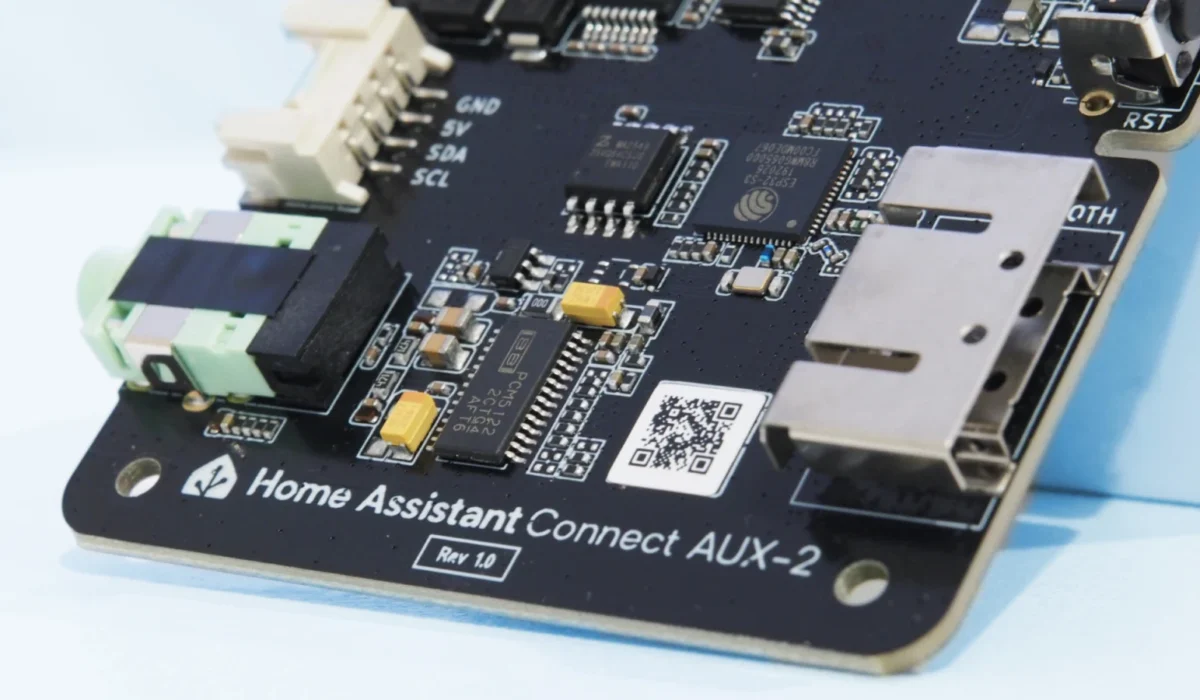
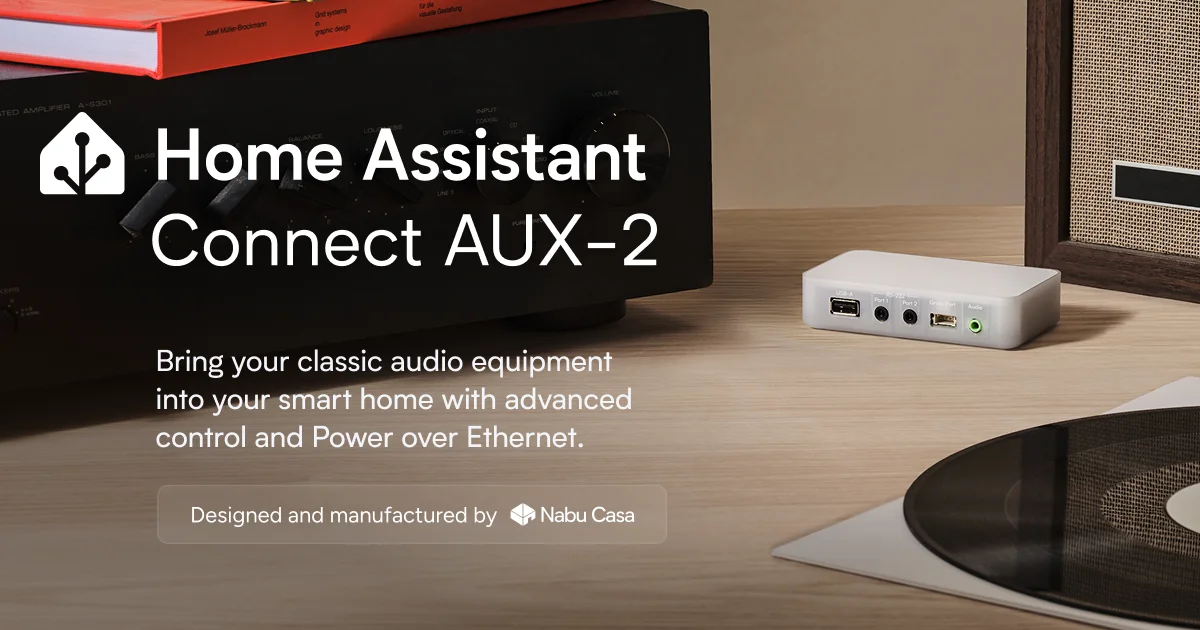
Nabu Casa, the commercial entity behind the official hardware ecosystem of Home Assistant and a core commercial partner of the Open Home Foundation, has officially announced the global launch of the Home Assistant Connect AUX-2. Retailing at $69 or €59, the compact device is engineered to bridge the operational gap between legacy home hardware and modern automated ecosystems. By integrating multiple connectivity protocols into a single chassis—including power over Ethernet (PoE), advanced audio streaming, dual serial ports, a Bluetooth proxy antenna, and hardware expansion headers—the Connect AUX-2 positions itself as a Swiss Army knife for smart home enthusiasts and professional installers alike.
The launch reflects an ongoing industry trend toward sustainability and device longevity, directly challenging the planned obsolescence and walled-garden strategies frequently employed by major consumer electronics manufacturers.
Background and Origins: From Portable Z-Wave to a Multi-Port Hub
The genesis of the Connect AUX-2 can be traced back to the open-source community’s growing frustration with localized hardware placement limitations. In October 2025, Nabu Casa introduced portable Z-Wave capabilities over Wi-Fi and PoE, addressing the common issue of smart home servers being relegated to basements or utility closets with poor wireless signal penetration.
Initially, the product engineering team conceived a simple enclosure designed solely to power the Connect ZWA-2 or ZBT-2 adapters via Power over Ethernet. Concurrently, software developers within the Home Assistant ecosystem were aggressively expanding native support for serial-controlled devices. Because PoE infrastructure accounted for the majority of the planned hardware overhead, project leads realized that incorporating additional physical ports would result in minimal cost increases while exponentially multiplying the device’s utility.
Merging serial and USB controller designs sparked further innovation. With Music Assistant and the Sendspin audio streaming protocol gaining rapid adoption, engineers added a combined analog and digital optical audio jack. Iterative prototyping eventually yielded a second serial port, a Grove hardware expansion connector, and a high-gain Bluetooth antenna. The resulting device was christened AUX—representing Audio, USB, and X for serial communication—and is manufactured to support the Open Home Foundation’s broader mission: ensuring that no functional device is left behind in the transition to connected living.
Technical Architecture and Core Capabilities
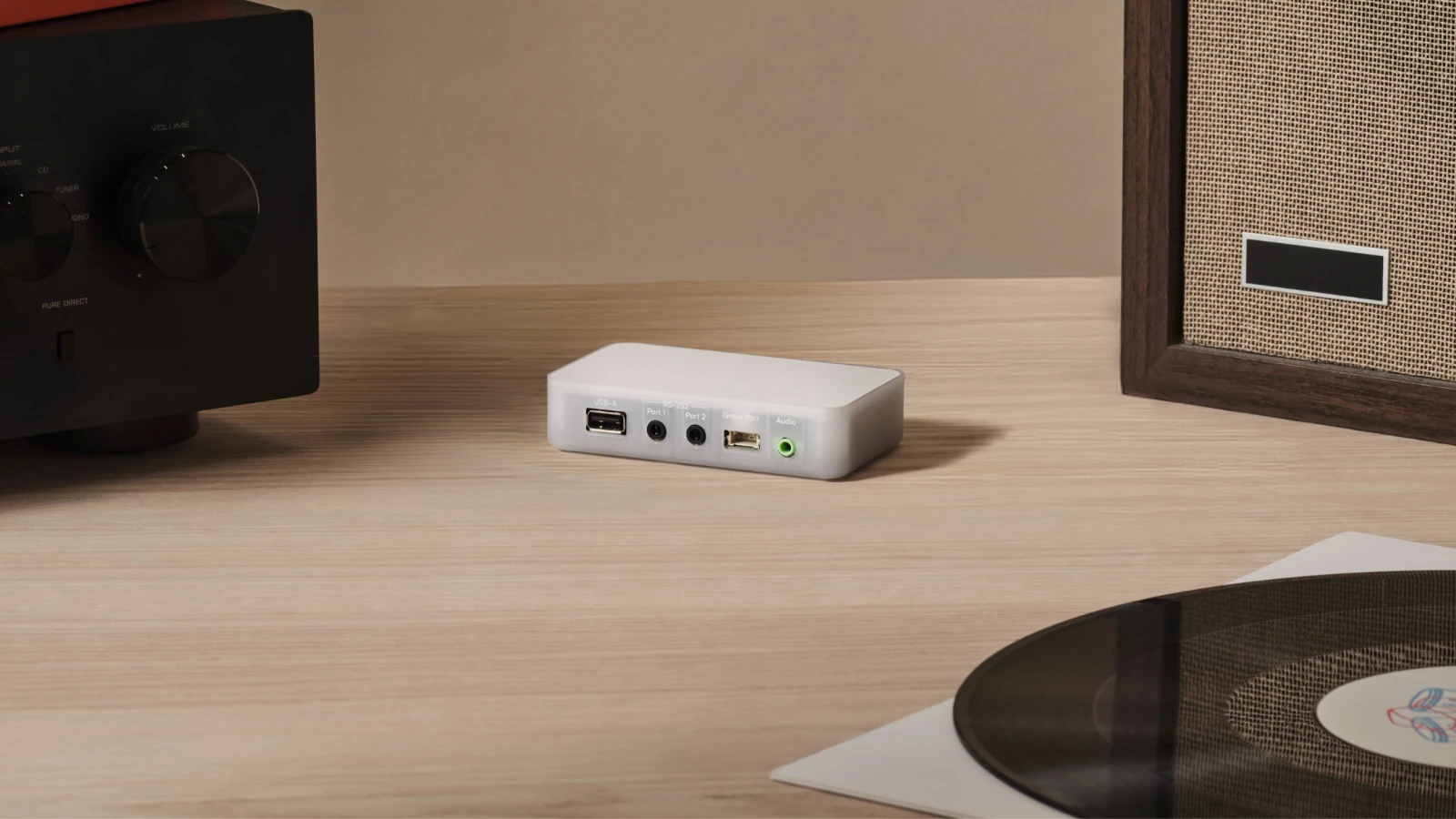
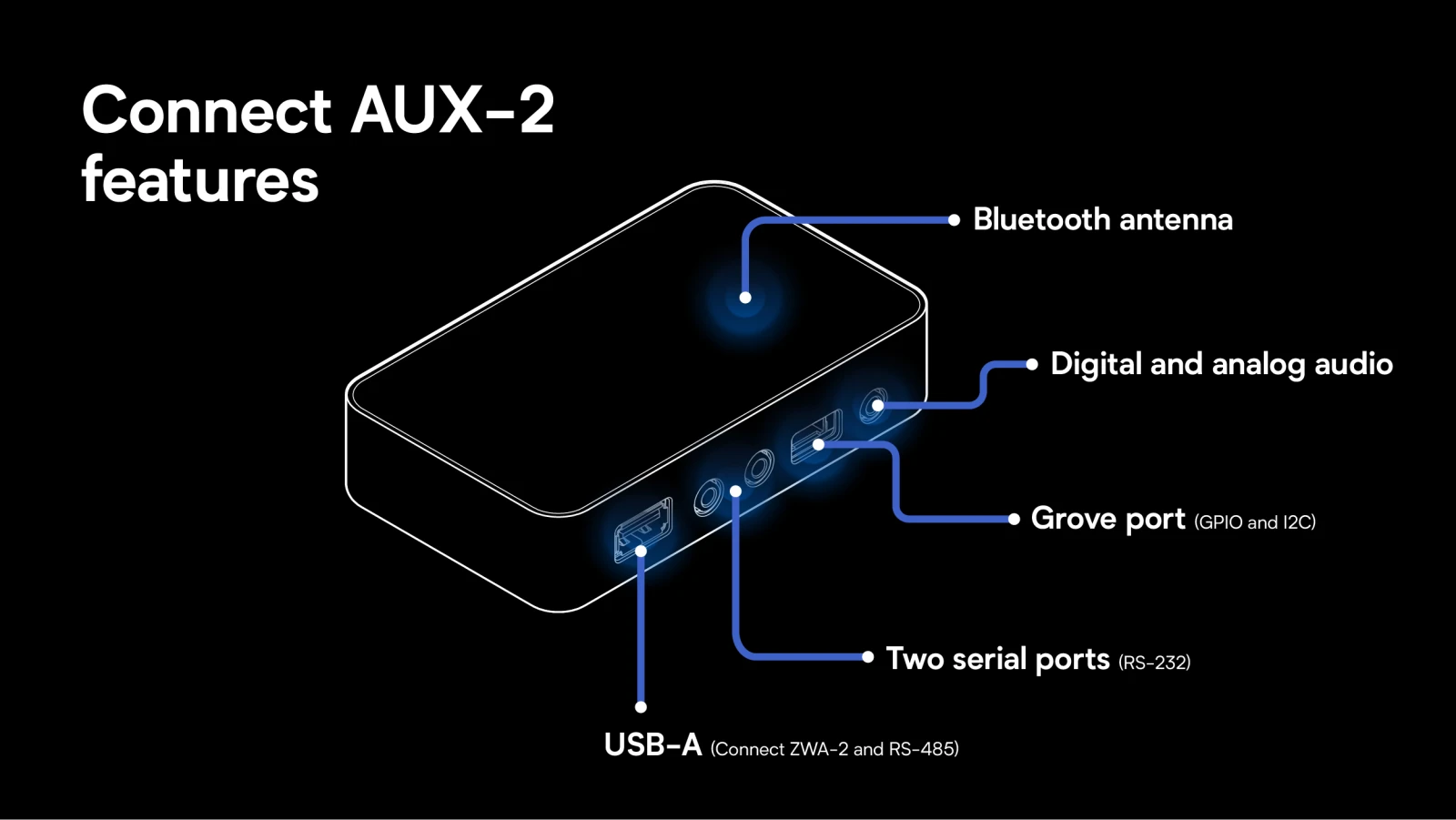
The Connect AUX-2 is structured around four primary functional pillars, allowing it to function simultaneously as an audio streamer, a serial command bridge, a network-extended radio adapter, and a Bluetooth proxy.
1. High-Fidelity Audio Integration
The device addresses a common consumer dilemma: legacy audio amplifiers and Hi-Fi systems that deliver superior acoustic performance but lack network streaming capabilities. By coupling an optical digital audio input with a serial control port, the AUX-2 transforms traditional sound systems into synchronized multi-room audio nodes.
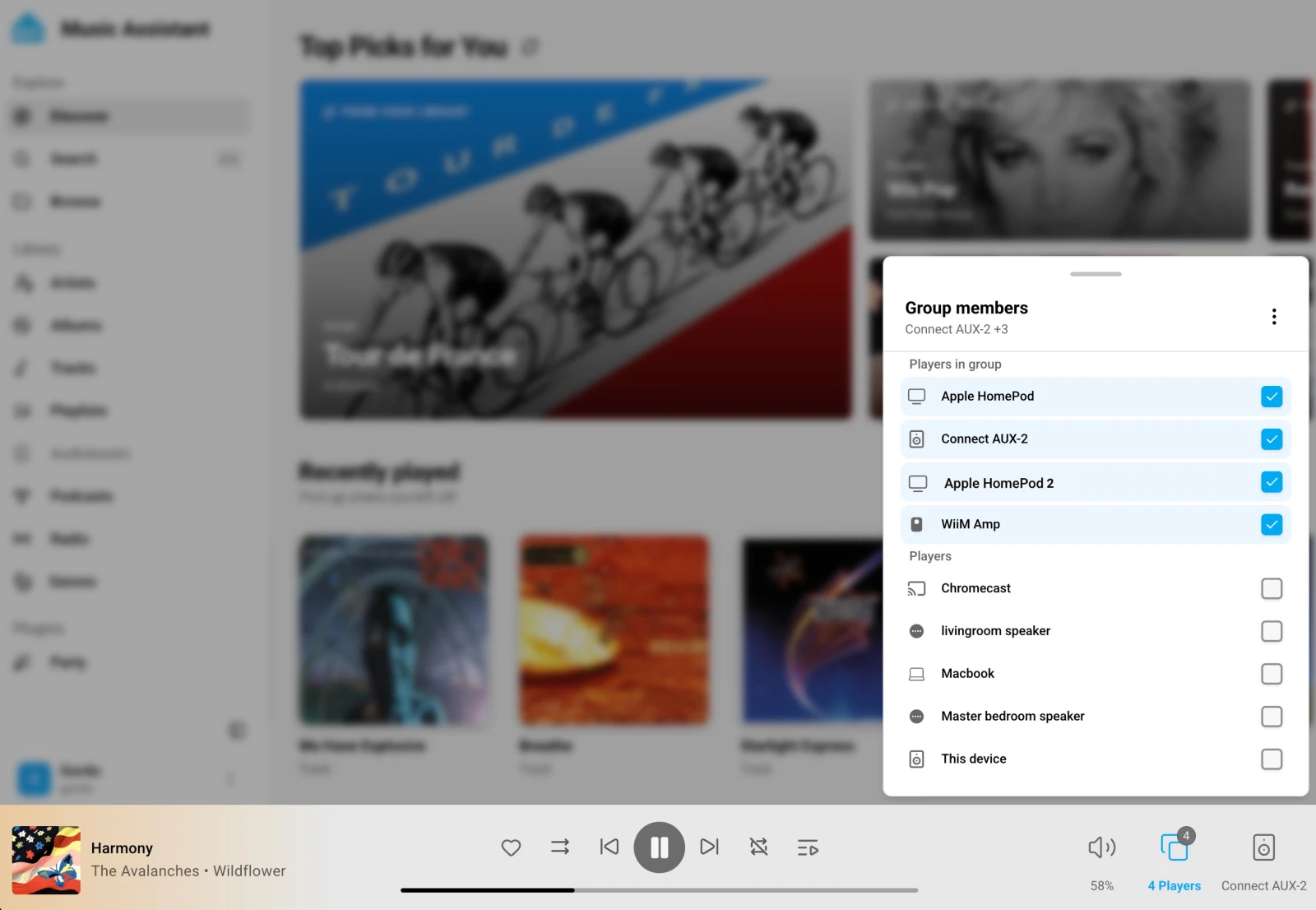
The onboard Digital-to-Analog Converter (DAC) provides a noticeable performance improvement over previous iterations like the Voice Preview Edition, rendering self-hosted FLAC libraries and streaming services with pristine clarity. Furthermore, the device features automatic cable sensing, dynamically switching playback between analog and digital outputs based on the connected hardware. Integrated with Music Assistant, multiple AUX-2 units—or mixed configurations involving Apple HomePods and Sonos speakers—can stream audio in tight synchronization, effectively bypassing proprietary audio ecosystems.
2. Serial and Industrial Control
For decades, professional automation systems have relied on RS-232 and RS-485 serial standards to communicate with climate control units, solar inverters, and AV receivers. The AUX-2 includes two onboard serial ports utilizing the RS-232 standard, while supporting Modbus protocol implementation via the USB-A port and an inexpensive adapter.
This capability allows homeowners to liberate smart devices from restrictive cloud architectures. For instance, users can sever network access to modern smart TVs suspected of telemetry collection and route control commands entirely locally via the device’s serial integration. On the hardware level, Nabu Casa incorporated physical TX/RX signal-switching toggle switches on the chassis underside, eliminating the need for users to manually solder or modify custom serial cables.
3. Network-Extended Radio Modules
Radio frequency range remains a persistent hurdle in home automation mesh networks. The AUX-2 allows Zigbee and Z-Wave adapters—such as the Connect ZWA-2—to be decoupled from the primary server location and positioned centrally within a residence using a single Ethernet cable. While Z-Wave has undergone extensive long-term testing with highly favorable results, engineers note that Zigbee network implementation over Ethernet remains in an evaluation phase. Thread protocol integration, conversely, was omitted from the current hardware generation due to strict latency sensitivities that preclude reliable performance over standard network connections.
4. Dedicated Bluetooth Proxy
Bluetooth Low Energy (BLE) sensors and key trackers frequently suffer from signal degradation when managed by centralized hubs. The AUX-2 functions as a dedicated Bluetooth proxy remote adapter. Equipped with a high-gain internal antenna, the device independently discovers and routes BLE telemetry back to the Home Assistant core. When powered via Ethernet, the hardware avoids the RF interference typical of devices that share single antennas between Wi-Fi and Bluetooth bands.
Infrastructure and Open-Source Modifiability
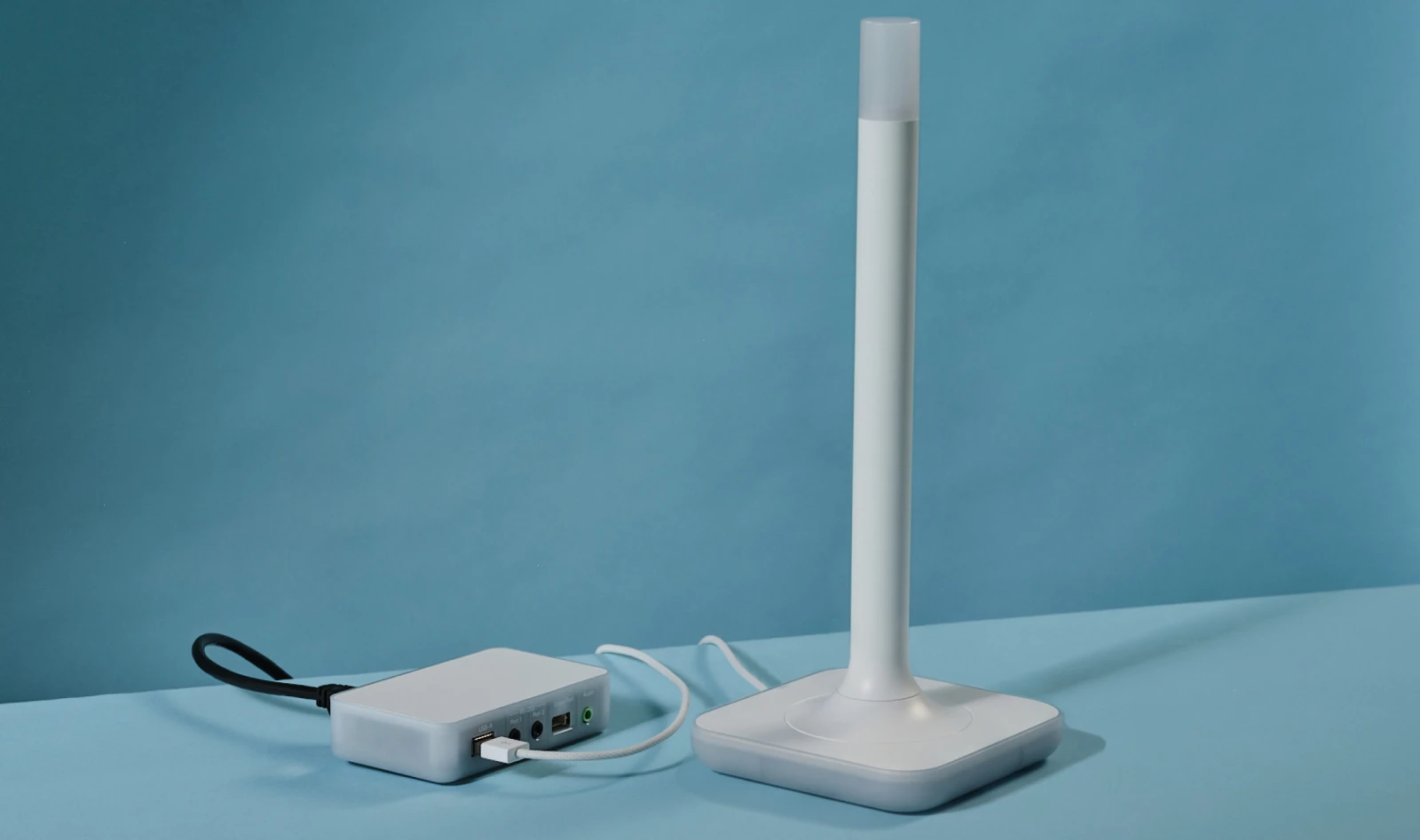
In alignment with the open-source philosophy of the Open Home Foundation, the Connect AUX-2 is shipped completely unsealed and unlocked, encouraging hardware hacking and alternative firmware experimentation. The inclusion of a Grove connector allows users to connect I2C and SPI sensors—such as temperature, humidity, or ambient light monitors—directly to the unit without opening the casing. Data collected from these sensors is surfaced natively in Home Assistant dashboards.
Physical disassembly requires removing only four standard Phillips head screws, eschewing the destructive sonic-welded plastic clips common in consumer electronics. Nabu Casa has committed to publishing all printed circuit board (PCB) schematics and 3D printing files for the casing, empowering the maker community to design bespoke enclosures and custom ESPHome firmware iterations.
Industry Implications and Market Analysis
The release of the Connect AUX-2 underscores a growing consumer preference for modular, interoperable hardware over closed smart home ecosystems. By enabling users to retain functional legacy appliances—ranging from high-end amplifiers to solar power inverters—Nabu Casa directly counters the linear economic model of consumer electronics consumption.
Industry analysts observe that the inclusion of Power over Ethernet (PoE) at a $69 price point provides a compelling value proposition for professional integrators and advanced DIY practitioners. PoE eliminates the requirement for dedicated wall-wart power supplies, reducing installation clutter and improving network reliability through hardwired data transmission.
The commercial success of the AUX-2 will likely serve as a benchmark for future open-source hardware developments, proving that consumer demand exists for multi-purpose automation tools that prioritize local control, data privacy, and hardware longevity over cloud dependency. The device is available for purchase worldwide as of today through authorized retail channels and the official Nabu Casa distribution network.