






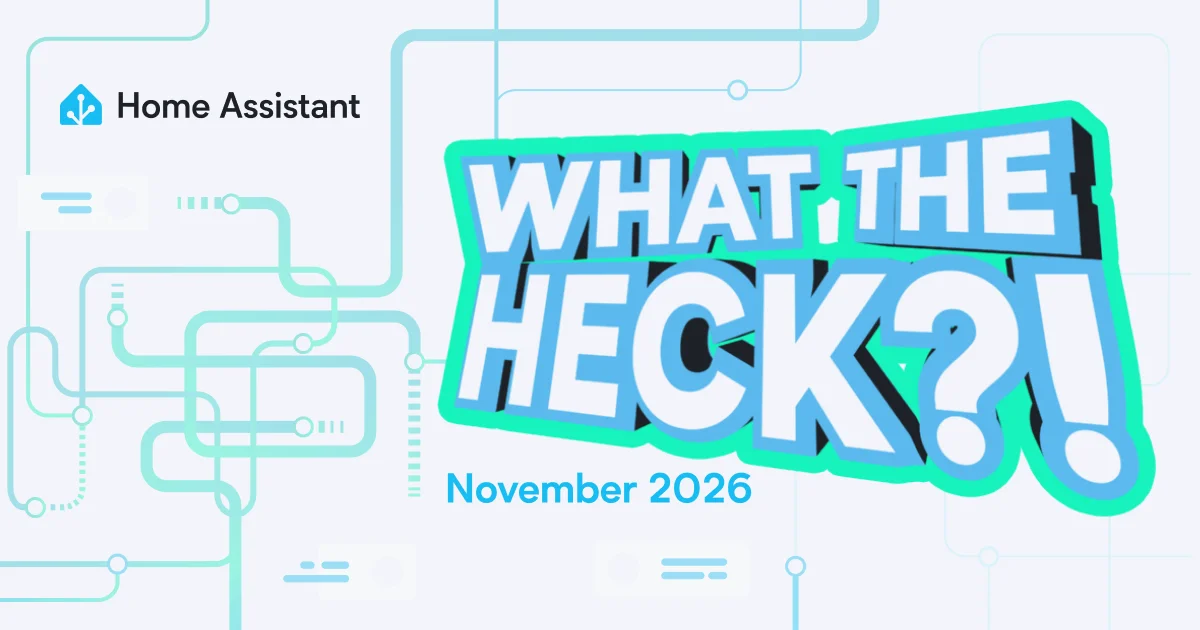
The Open Home Foundation and the development team behind Home Assistant have officially launched the highly anticipated return of the Month of What the Heck initiative, running throughout the entire month of November. This community-driven event invites users worldwide to highlight usability friction points, interface hurdles, and general daily annoyances encountered while interacting with the popular open-source smart home automation platform. Designed to bridge the gap between technical developers and everyday consumers, this year’s campaign places a specific emphasis on non-technical participants and individuals who share living spaces with primary system administrators.
Background and Context of the Initiative
Launched periodically by the Home Assistant core development team, the Month of What the Heck serves as a concentrated feedback loop intended to capture the authentic, unfiltered experiences of the platform’s user base. While traditional software development relies on bug tracking systems, feature requests, and telemetry data, these mechanisms often fail to capture the subtle frustrations of user experience design. Core maintainers and technical contributors, having spent years immersed in the ecosystem, frequently suffer from the curse of knowledge—a cognitive bias where an individual, communicating with other knowledge workers, unknowingly assumes that others have the background to understand them.
Consequently, settings, workflows, and dashboard configurations that appear intuitive to developers can frequently confound casual users. The initiative seeks to dismantle these invisible barriers by encouraging the community to voice minor irritations that rarely rise to the level of a formal software bug report, yet collectively degrade the daily smart home experience.
Evolution of User Accessibility in Home Assistant
In recent years, the Open Home Foundation has increasingly pivoted its strategic roadmap toward mainstream approachability. Historically, open-source home automation platforms catered almost exclusively to enthusiasts willing to write custom configuration files, manage server environments, and troubleshoot network protocols. However, as the smart home market matured, the demographic of individuals residing in automated homes expanded to include family members, roommates, and guests who possess little interest in the underlying technology.
A notable milestone in this ongoing evolution occurred with the deployment of Home Assistant 2026.10, which decoupled profile picture management from system administrator privileges. Prior to this update, altering a user profile icon required administrative intervention within the backend settings—a minor technicality that created unnecessary friction for multi-user households. By decentralizing such basic personalization tasks, the platform demonstrated how removing micro-friction points can significantly enhance a user’s sense of ownership and comfort within the environment.
The 2026 Campaign Focus: Multi-User Households
A central pillar of the November 2026 campaign is the active solicitation of feedback from individuals who do not personally maintain their household’s smart home infrastructure. Organizers have issued a formal call to action for primary administrators to actively consult their co-habitants, family members, and partners regarding their day-to-day interactions with the platform.
Statistics and industry trends within the Internet of Things (IoT) sector consistently indicate that smart home deployments suffer from high abandonment rates or domestic friction when automation logic conflicts with human habits. By targeting the voices of non-technical occupants, Home Assistant aims to gather critical qualitative data on how automation interfaces are perceived by the broader public. Prompts distributed to household administrators encourage inquiries into unexpected automations, confusing dashboard layouts, and instances where the smart home’s behavior feels opaque or unpredictable.
Submission Guidelines and Forum Structure
To streamline the influx of feedback, submissions are centralized within a dedicated category on the official Home Assistant community forum. The submission window remains open for the duration of November, utilizing specific organizational guidelines to maximize efficiency for developers and community contributors.
Participants are instructed to submit individual observations as separate discussion topics rather than consolidating multiple grievances into a single thread. This granularity facilitates targeted community discussion, voting metrics, and direct linkage to software patches. The platform explicitly clarifies that the initiative is not intended for requesting brand-new device integrations or reporting software bugs suitable for GitHub repositories. Instead, the focus remains squarely on user experience, interface design, documentation clarity, and companion application usability.
Furthermore, acknowledging the global footprint of the Home Assistant community, organizers have established provisions for non-native English speakers. Contributors are encouraged to utilize translation software or artificial intelligence tools to draft their submissions, provided they include the original text in a hidden collapsible block. This methodology ensures that nuanced phrasing and intent are preserved for developers reviewing the data.
Implications for the Smart Home Industry
The Month of What the Heck functions as more than a mere customer service channel; it operates as a foundational blueprint for product development. Data aggregated during previous iterations directly influenced core architectural updates, user interface overhauls, and the streamlining of complex integrations.
As the smart home landscape transitions from a novelty hobbyist market into a standard residential utility, platforms like Home Assistant face mounting pressure to deliver enterprise-grade reliability paired with consumer-grade simplicity. Initiatives that systematically harvest usability critiques provide open-source projects with a competitive advantage, allowing them to iterate rapidly based on real-world domestic scenarios rather than theoretical design paradigms.
Subsequent to the conclusion of the submission window in late November, core maintainers and volunteer contributors will review the collected topics. While no formal guarantee is made regarding the implementation of every suggestion, highly prevalent pain points historically serve as priority items for upcoming software release cycles. Through this collaborative framework, Home Assistant continues to refine its ecosystem, ensuring that home automation remains accessible, intuitive, and harmonious for everyone under the roof.