






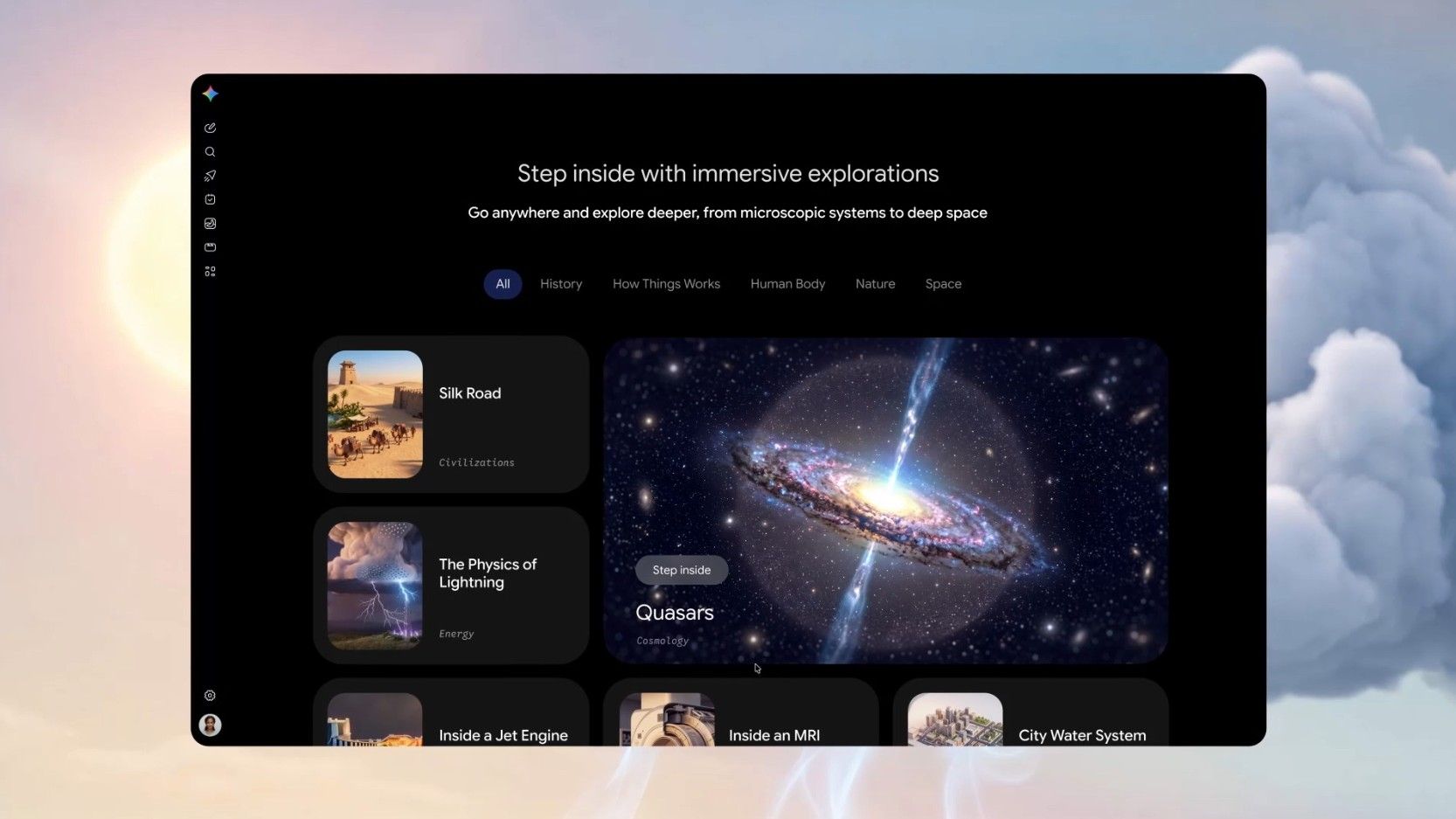
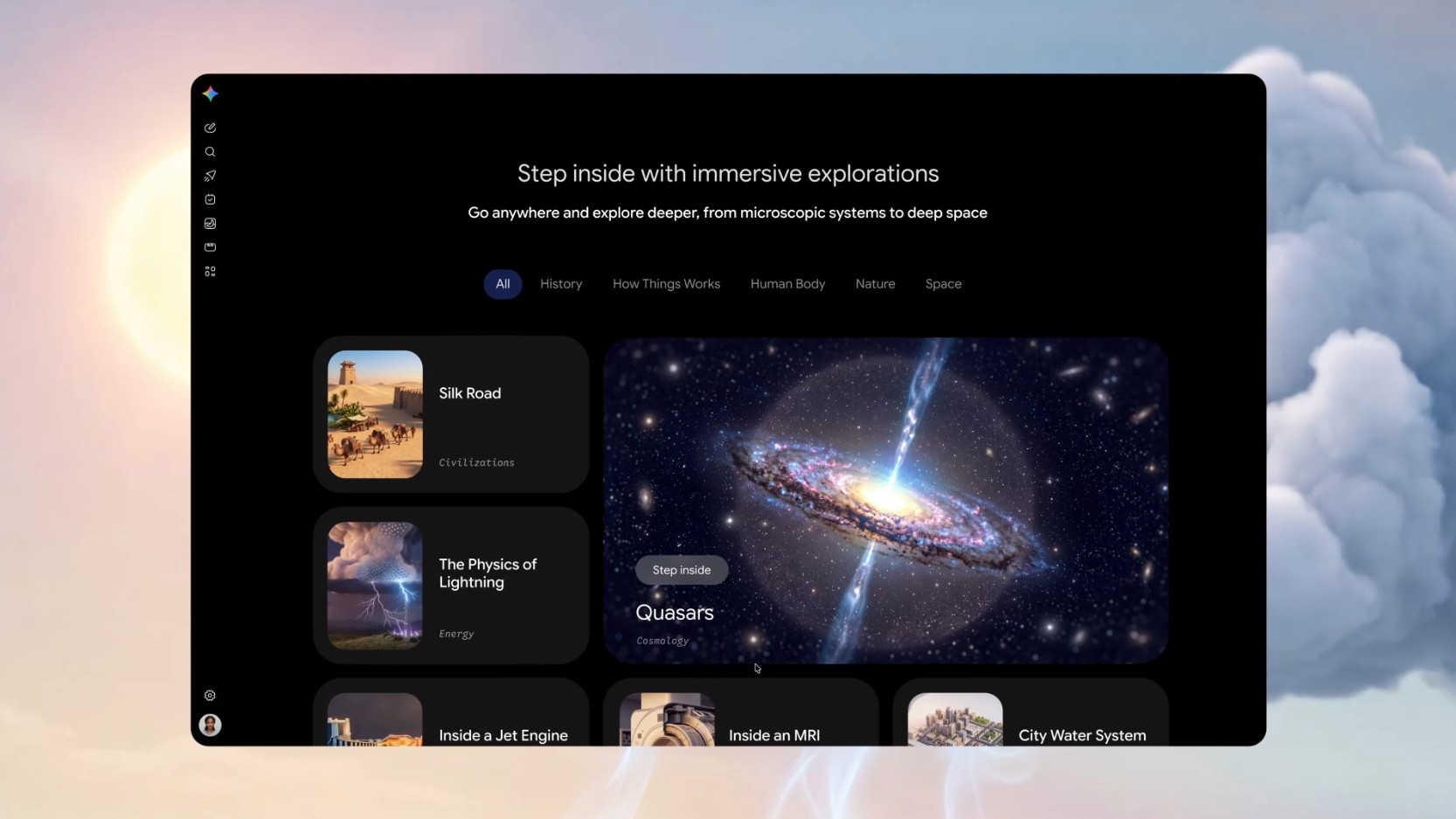
Google has officially introduced a groundbreaking educational feature within its Gemini ecosystem, aimed at revolutionizing how students interact with complex digital learning materials. Titled "Immersive Explorations," the new tool is designed to move beyond traditional text-heavy interfaces by integrating layered, interactive visuals that allow learners to dissect complex scientific and historical concepts piece by piece. Available now within the dedicated Gemini student hub, the feature represents a major step forward in Google’s ongoing initiative to integrate generative artificial intelligence into global classrooms.
By allowing students to peel back layers of digital imagery—ranging from the outer edges of distant quasars to the microscopic molecular structures of plants—Google is attempting to address common engagement hurdles in modern digital education. Rather than forcing students to sift through dense walls of explanatory text, Immersive Explorations pairs concise, context-providing paragraphs with interactive graphics that respond directly to user engagement.
Transforming the Digital Classroom: Main Facts of the Launch
The introduction of Immersive Explorations addresses a longstanding critique of educational technology: that digital textbooks often replicate the limitations of physical books by presenting information in static, two-dimensional formats. With the new Gemini tool, students can access a curated library of complex topics that break down into microscopic or macroscopic components through a simple click-and-explore interface.
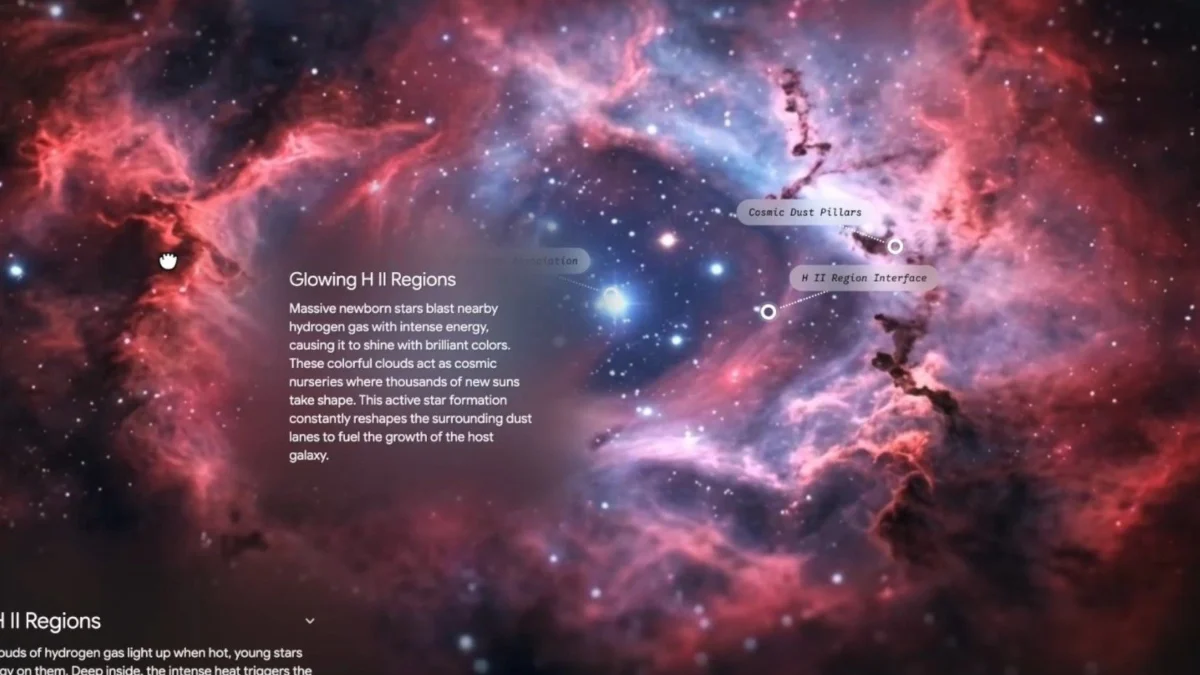
For example, when studying astronomy, a student can examine a full-scale visualization of a quasar, then zoom in to isolate and inspect individual components such as host galaxies or surrounding interstellar dust lanes. Each layer unlocks targeted informational pop-ups and supplementary text that explain the scientific significance of that specific fragment. Beyond space exploration, the initial launch library covers diverse scientific fields, including paleontology (via interactive dinosaur models), botany (cellular and molecular structures of plants), and earth sciences (the physical mechanics behind lightning storms).
Google has ensured that the tool is accessible across multiple demographics upon its initial rollout. The feature is currently live within the Gemini app and web interfaces, supporting a robust initial roster of languages that includes English, Indonesian, Hindi, Brazilian Portuguese, French, and simplified Chinese. For users operating outside these linguistic regions, the platform defaults temporarily to English while regional localization updates are developed.
A Chronology of Google’s Educational AI Integration
The deployment of Immersive Explorations does not happen in a vacuum; it is the latest milestone in a calculated, multi-year rollout of AI-driven educational infrastructure by Google. Understanding the trajectory of these tools provides critical context for how Gemini has transitioned from a general-purpose chatbot into a specialized educational assistant.
Early Milestones and Safety Guardrails
Google’s journey into AI-powered learning tools accelerated significantly when the company expanded Gemini availability to teenagers utilizing school-managed Google Workspace accounts. Recognizing the unique responsibilities associated with minor users and academic integrity, Google implemented strict safety guardrails and robust fact-checking mechanisms. This rollout was accompanied by the introduction of "Coach," an interactive tool designed to guide students through various academic subjects using adaptive quizzes and gamified learning loops rather than simply supplying direct answers to homework prompts.
Expansion into Educator Workflows
Simultaneously, Google focused on empowering teachers through integrations with Google Classroom and NotebookLM—subsequently rebranded in certain contexts as Gemini Notebook. This phase allowed educators to leverage AI to streamline administrative and instructional burdens. Teachers gained the ability to generate customized AI "experts" tailored to specific syllabus topics, offering targeted support to students struggling with particular concepts. Furthermore, educators could rapidly synthesize their own curriculum materials to generate custom rubrics, study guides, and comprehensive quizzes, significantly reducing lesson-planning overhead.
The Shift to Visual and Experiential Learning
With the infrastructure for safe deployment and educator collaboration firmly established, Google turned its attention to cognitive ergonomics. Recognizing that diverse learning styles require more than text-based conversational interfaces, the company conceptualized Immersive Explorations. By combining the vast informational retrieval capabilities of large language models with spatial, multi-layered visual interfaces, Google has bridged the gap between raw data generation and intuitive comprehension.
Technical Architecture and Pedagogical Implications
The mechanics behind Immersive Explorations rely on the synthesis of multimodal generative AI models capable of mapping relational data to visual coordinates. When a user interacts with a digital layer—such as clicking on a plant’s chloroplast within a molecular graphic—the Gemini backend does not merely retrieve a static image asset. Instead, it dynamically contextualizes the visual selection within the broader conversational and educational session, allowing the student to ask follow-up questions about that specific component without losing the macro-level context.
Educational analysts point out that this pedagogical approach aligns closely with constructivist learning theories, which posit that students construct knowledge best through active engagement and manipulation of their environment rather than passive consumption. By breaking complex phenomena down into manageable, hierarchical layers, the tool reduces cognitive load—a well-documented barrier in science, technology, engineering, and math (STEM) education.
However, the integration of generative AI into foundational learning environments continues to invite careful scrutiny from academic researchers, school boards, and parent advocacy groups. Questions regarding data privacy, algorithmic bias, and the potential erosion of traditional critical-thinking skills remain central to ongoing discussions. Google has attempted to mitigate these concerns by anchoring Gemini’s educational tools within managed school accounts, where institutional administrators retain oversight and content filtering capabilities.
Broader Market Impact and Future Outlook
Google’s aggressive push into the educational technology sector places it in direct competition with other major technology conglomerates and specialized ed-tech startups vying for dominance in the AI-enhanced classroom. As school districts worldwide evaluate their digital transformation budgets, the ability to offer comprehensive, multimodal learning assistants embedded directly into ubiquitous platforms like Google Classroom and the Gemini app presents a formidable market advantage.
Industry experts anticipate that the success of Immersive Explorations will pave the way for broader integration of augmented reality (AR) and virtual reality (VR) technologies within the Gemini ecosystem. As processing power at the edge improves and multimodal AI models become more adept at real-time spatial rendering, tools that currently rely on two-dimensional screens could easily transition into fully immersive spatial computing environments.
For now, educators, students, and institutional leaders are observing the rollout of Immersive Explorations as a bellwether for the future of digital textbooks. By successfully marrying conversational AI with interactive visual decomposition, Google has set a new benchmark for how complex academic subjects can be communicated to the next generation of learners. As support for additional languages rolls out in the coming months, the global reach of these tools is expected to expand significantly, cementing Gemini’s role as a foundational pillar in modern educational technology.