The rapid proliferation of generative artificial intelligence across industries has laid bare a fundamental engineering paradox: while modern large language models (LLMs) continue to scale in parameter count and capability, the physical hardware required to serve them faces severe performance bottlenecks. Every time a user interacts with an AI-powered coding assistant, customer service chatbot, or real-time autonomous agent, the underlying system is bound by an architectural constraint known as autoregressive generation. In this sequential paradigm, models produce responses strictly one token at a time. For applications demanding instantaneous feedback, this latency creates a significant barrier to commercial scale and user satisfaction.
To overcome this limitation without altering underlying model weights, retraining neural networks, or sacrificing output accuracy, machine learning engineers have increasingly turned to an inference-acceleration technique called speculative decoding. By fundamentally altering how candidate text is generated and evaluated at the hardware level, this methodology consistently yields inference speedups of two to three times. As production environments demand higher throughput and lower latency, speculative decoding is rapidly transitioning from a novel academic concept to a standard configuration in modern inference engines.
The Hardware Constraint: Memory-Bandwidth Binding in Modern GPUs
To understand why speculative decoding is so effective, one must first examine the physical mechanism of LLM generation. Large language models operate autoregressively, meaning the creation of each sequential token requires reading the entire context of all preceding tokens and passing it through every layer of the network.
The primary performance inhibitor in this process is not raw mathematical computation, but data transfer. Modern enterprise accelerators, such as the NVIDIA H100 GPU, possess immense computational capacity capable of executing trillions of floating-point operations per second. However, the billions of parameters that constitute an LLM must be stored in the GPU’s high-bandwidth memory (HBM). Before a single token can be generated, the entirety of these model weights must be transferred from memory into the processor cores.
Because this weight transfer must occur independently for every single token produced, the processor spends the vast majority of its operational cycle sitting idle, waiting for data to arrive. In computer architecture, this phenomenon is categorized as being memory-bandwidth bound. Simply adding more processing power to a server yields diminishing returns, because the system’s speed is dictated strictly by how fast data can traverse the physical bus, rather than how rapidly the arithmetic logic units can calculate it.
The Mechanics of Speculative Decoding: A Two-Model Synergy
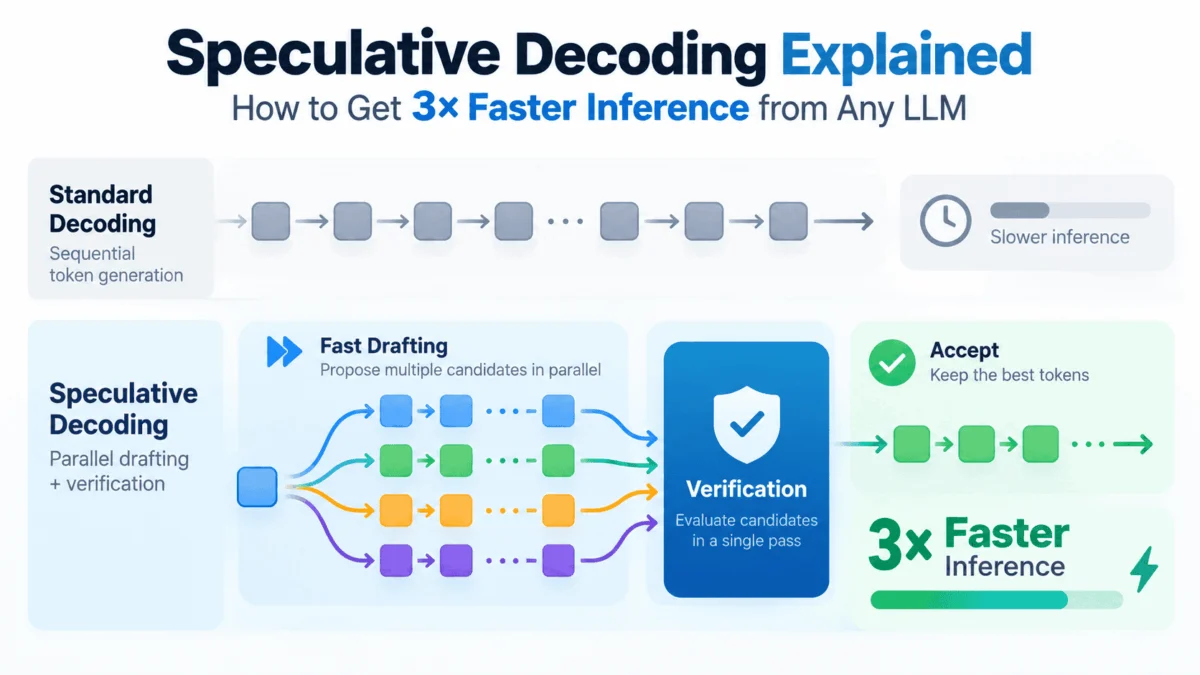
Speculative decoding bypasses this memory bottleneck by reframing the generation process from a purely sequential task into a parallelized pipeline. Instead of relying on a single large model to output one token at a time, the architecture employs a collaborative, two-tier system consisting of a draft model and a target model.
The foundation of this pipeline rests on a small, lightweight draft model—often possessing a fraction of a billion parameters. Because of its diminutive size, the draft model can generate a short sequence of candidate tokens (typically ranging from four to eight) at high speed. While the draft model still operates autoregressively, its reduced parameter footprint allows it to read from GPU memory much faster than its larger counterpart.
Once the draft model outputs this prospective sequence, the heavy target model steps in. Rather than evaluating the tokens sequentially, the target model processes the entire batch of candidate tokens in a single, highly parallelized forward pass. Because modern accelerators are natively optimized for matrix-parallel operations, evaluating a short sequence of tokens simultaneously takes only marginally longer than evaluating a single token.
During this single forward pass, the target model scores the candidate sequence and performs a probabilistic verification check. Utilizing a rigorous statistical validation framework, the target model accepts or rejects each token based on a comparison with its own internal probability distribution. This mathematical oversight guarantees that the final output possesses the exact same statistical distribution as if the target model had generated every token independently. The quality and fidelity of the text remain entirely uncompromised.
Navigating the Speculative Loop and Efficiency Trade-offs
The operational cycle of speculative decoding—frequently termed the speculative loop—functions through a precise sequence of computational steps. First, the draft model rapidly extrapolates a prospective sequence of text. Second, the target model ingests this sequence in a single batch, loading its expansive parameter set from memory only once for the entire block of tokens.
In the verification phase, the target model evaluates the first candidate token. If the target model’s confidence in that token meets or exceeds the draft model’s confidence, the token is provisionally accepted. The process repeats down the sequence until a divergence occurs. If a token is rejected, the system samples a corrected token from an adjusted probability distribution that mathematically accounts for the discrepancy between the two models, terminating the current speculative step.
In optimal scenarios where all candidate tokens are accepted, the target model may append an additional token at the end of the batch, effectively yielding five to nine tokens for roughly the computational cost of a single target-model inference pass. Conversely, in the worst-case scenario—characterized by poor alignment between the draft and target models—the initial candidate is rejected immediately. This introduces a minor computational overhead compared to standard decoding, as the time spent by the draft model yields no accepted tokens. Consequently, practitioners must carefully select compatible model pairings to avoid negative speed scaling.
Evolution of the Technique: Beyond the Traditional Two-Model Setup
While the original formulation of speculative decoding required maintaining two distinct neural networks in memory—introducing minor architectural and deployment overhead—recent advancements have expanded the methodology to eliminate the need for an external draft model.
One prominent innovation is Medusa, which modifies the target model directly by attaching multiple auxiliary prediction heads to its final transformer layer. Each secondary head is trained to independently predict a different future token position, allowing the target model to self-draft candidate sequences without external support.
Another advanced approach is the Eagle (Extrapolation Algorithm for Greater Language-model Efficiency) framework. Eagle shifts the drafting mechanism away from final output tokens, instead generating candidate sequences based on the target model’s rich internal hidden states. Because hidden states encapsulate deeper contextual nuances, Eagle achieves significantly higher acceptance rates on complex, domain-specific text.
Meanwhile, Prompt Lookup Decoding removes secondary models entirely by scanning the immediate prompt and conversation history for repeating n-grams, utilizing these structural patterns as direct draft candidates. This technique has proven exceptionally effective for document summarization and software development environments, where generated text frequently mirrors input vocabulary.
Production Implications and Deployment Considerations
As speculative decoding matures, major inference frameworks—including vLLM, Hugging Face’s text-generation-inference, and llama.cpp—have integrated the capability as a native configuration setting. For enterprise deployment teams, enabling the feature requires architectural parameter tuning rather than custom software engineering.
Data-driven analyses indicate that speculative decoding yields the most pronounced performance gains in single-request, low-batch environments involving long-form generation, such as code completion, technical documentation, and complex question-answering systems. However, infrastructure engineers must evaluate operational workloads carefully; in heavily batched, high-throughput production servers, the memory overhead consumed by speculative drafting can occasionally detract from overall hardware utilization, impacting the processing of concurrent requests.
By redefining how memory bandwidth and compute resources interact during inference, speculative decoding has successfully dismantled one of the most persistent bottlenecks in artificial intelligence engineering. As the practice becomes ubiquitous across modern serving stacks, it offers a clear pathway toward faster, more responsive AI deployment without compromising the computational integrity or accuracy of state-of-the-art models.