







The landscape of commercial aviation is standing on the precipice of a profound transformation, driven by mounting environmental pressures and innovative breakthroughs in aerospace engineering. While the global airline industry is notorious for its heavy reliance on fossil fuels and its stubborn carbon footprint, a new wave of zero-emission propulsion technology is quickly moving from the drawing board to reality. Leading this charge is Dutch startup Elysian Aircraft, which aims to redefine short-haul travel through its flagship regional airliner concept, the E9X. With a targeted entry-to-service date of 2034, the company envisions a future where commercial electric flights are a standard booking option for everyday passengers across Europe and beyond.
The Scale of the Challenge: Aviation’s Environmental Toll
Commercial aviation has long presented one of the most difficult sectors to decarbonize. According to comprehensive data cited by climate advocacy organizations such as Stay Grounded, traditional aircraft account for more than 2 percent of global heating when accounting for carbon dioxide and other non-CO2 emissions, including nitrogen oxides and water vapor trails. In wealthy, highly industrialized nations, that proportional share is significantly higher due to dense domestic and regional flight networks.
Unlike ground transportation, where battery weight and vehicle size are less restrictive, long-range heavy aviation cannot currently rely solely on traditional lithium-ion battery technology due to energy density limitations. However, short-to-medium-haul flights—which constitute a massive share of global aviation frequency—present a viable window for electrification. By targeting regional routes rather than transoceanic journeys, aerospace engineers can utilize cutting-edge battery architectures without pushing current technological limits past the breaking point.
The Anatomy of the E9X: Innovation in Wing Design
At the core of Elysian’s ambitious strategy is the E9X commercial airliner, a clean-sheet design developed in close collaboration with aerospace researchers at the Delft University of Technology (TU Delft). Rather than attempting to retrofit existing fossil-fuel-powered airframes with electric motors—a method that severely compromises range and payload capacity—Elysian has designed the E9X from the ground up to optimize energy storage and aerodynamics.
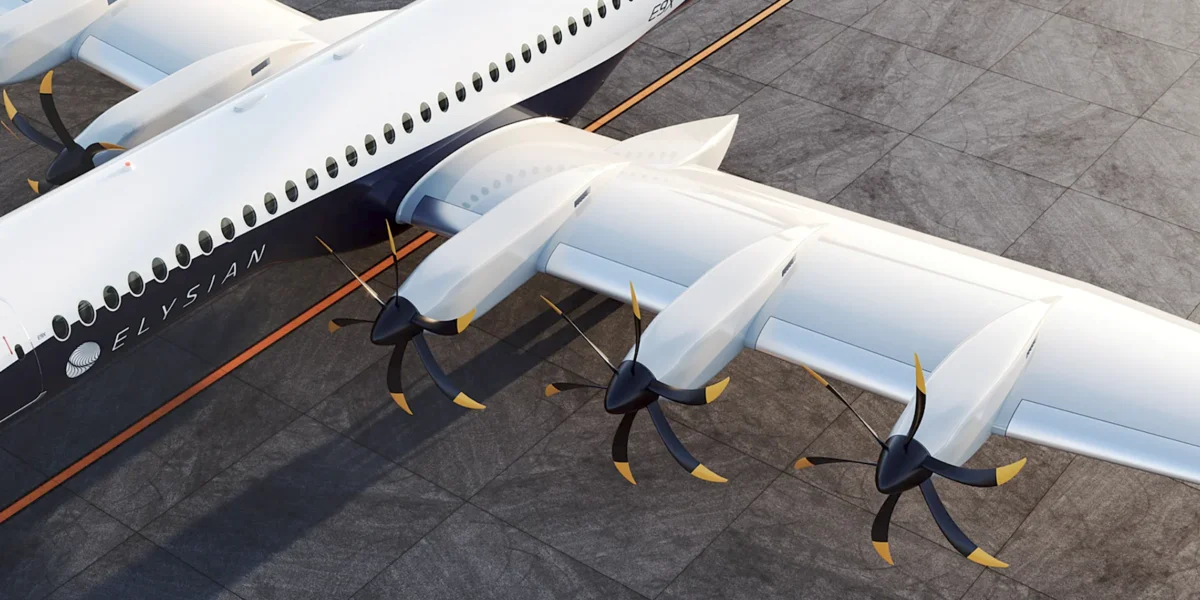
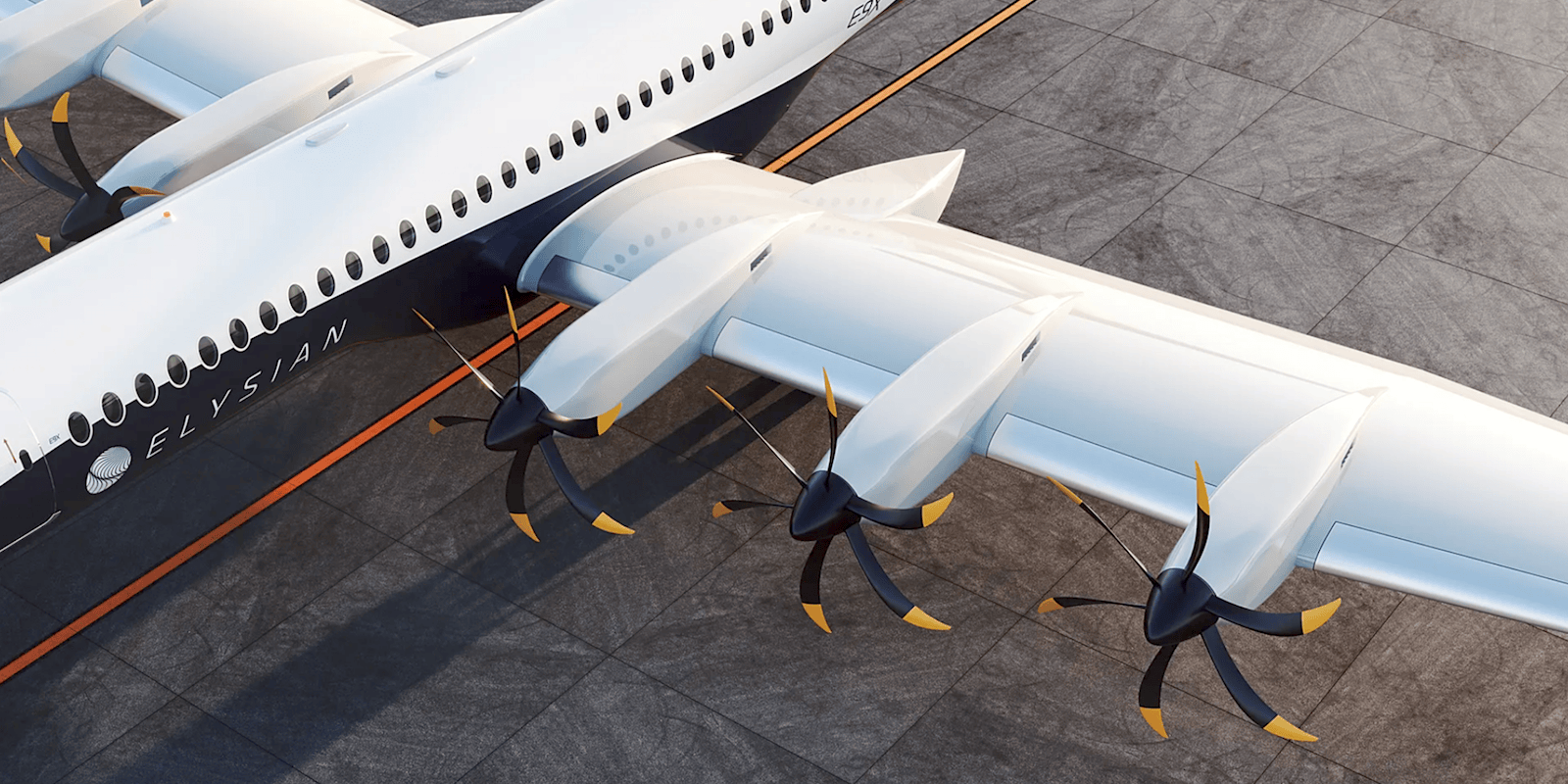
The defining feature of the E9X lies within its oversized, structurally reinforced wings. In traditional aircraft, wings primarily serve to generate lift while housing fuel tanks. The E9X repurposes this architectural space by packing modular battery systems directly into the wings. This strategic placement distributes the heavy weight evenly across the airframe, mitigating structural stress and maintaining optimal center-of-gravity dynamics. Power from these modular batteries is then fed to six electric motors driving high-efficiency propellers.
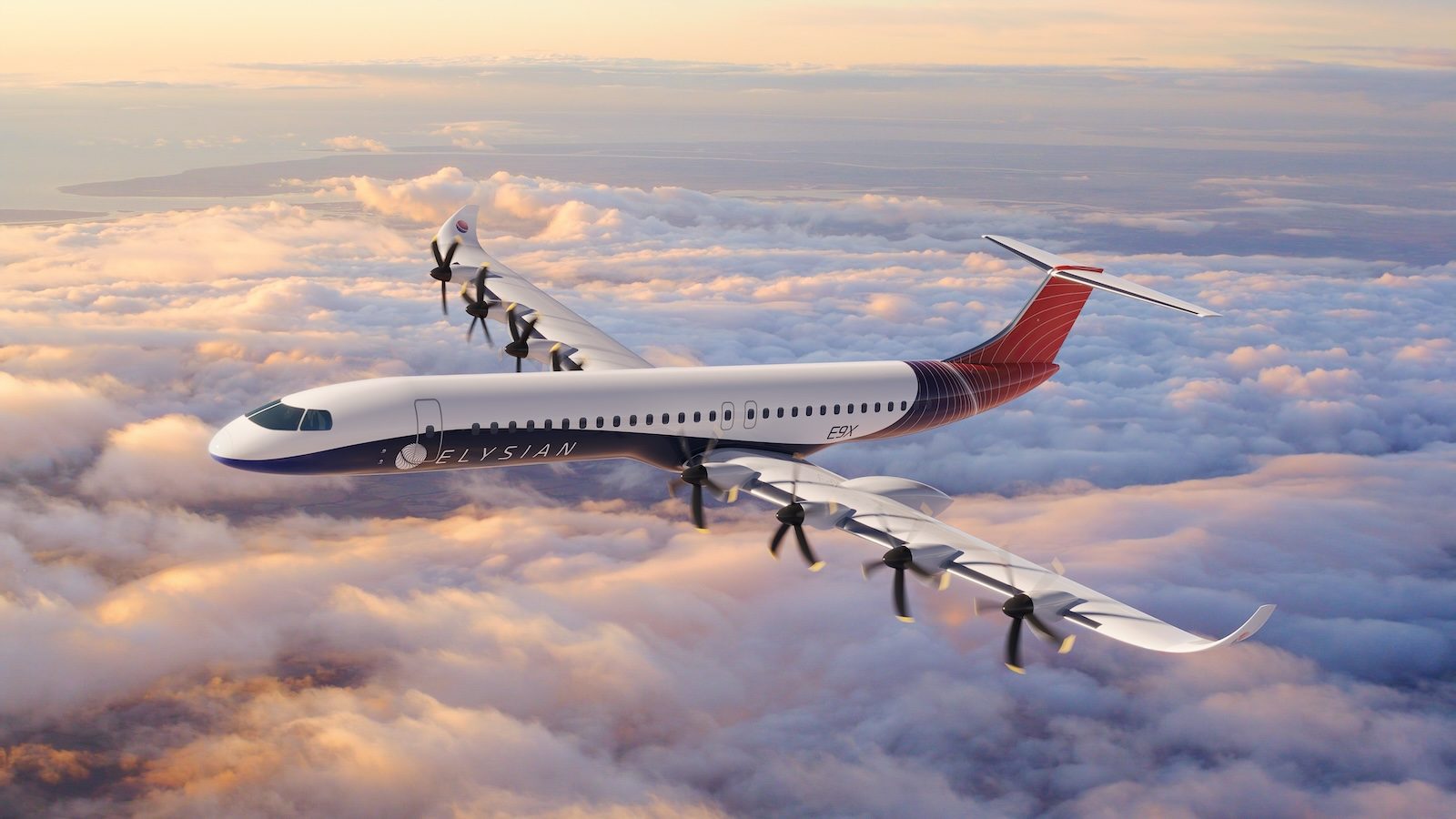
While precise technical specifications regarding battery chemistry and motor output remain heavily guarded, the projected performance metrics are robust. The E9X is engineered to transport between 90 and 100 passengers over an initial operational range of 800 kilometers (approx. 500 miles), with a long-term goal of stretching that distance to 1,000 kilometers (approx. 620 miles). According to Elysian co-founder Daniel Jacobson, this specific distance threshold is the sweet spot of global aviation. Covering routes up to 1,000 kilometers effectively addresses nearly half of all scheduled commercial passenger flights worldwide, translating to a potential 20 percent reduction in total global aerospace emissions once the fleet is fully deployed.
A Step-by-Step Chronology Toward 2034
The journey toward a certified commercial electric airliner requires a meticulous, multi-phase developmental timeline. Elysian Aircraft has systematically advanced its engineering roadmap over recent years to move past theoretical modeling and into physical validation.
- Initial Conceptualization and Academic Partnership: The foundation of the E9X was forged in partnership with TU Delft, focusing on the fundamental physics of integrating heavy battery payloads into slender wing structures.
- Conceptual Design Reviews: Elysian successfully completed its second formal conceptual design review, validating the aerodynamic profile, battery thermal management systems, and structural integrity of the E9X airframe.
- Scaled Demonstrator Flights: To prove the aerodynamic feasibility of its unique configuration, the startup collaborated with Germany’s DLR (Deutsches Zentrum für Luft- und Raumfahrt / German Aerospace Center) to test scaled demonstrators in controlled flight environments.
- Industry Partnerships (Current Phase): Elysian is actively engaging with major aviation stakeholders, including legacy airlines KLM and Transavia, to evaluate operational feasibility, maintenance requirements, and passenger integration. Additionally, aircraft leasing firm TrueNoord has joined the coalition to research financing models and commercial support structures for electric fleets.
- Targeted Entry into Service (2034): Pending regulatory approvals, rigorous airworthiness testing, and manufacturing scale-up, Elysian aims to achieve full commercial certification and passenger-carrying service by the mid-2030s.
Industry Collaboration and Commercial Viability
Developing a zero-emission commercial aircraft requires far more than just engineering prowess; it demands an entire ecosystem overhaul. Airlines, airports, lessors, and regulatory bodies must align to support a new paradigm of flight. Recognizing this, Elysian has deliberately built a coalition of industry partners early in its development cycle.

By partnering with major carriers like KLM and Transavia, Elysian is ensuring that the E9X is designed with airline economics in mind. Turnaround times at gates, charging infrastructure compatibility, pilot training requirements, and cabin layout efficiency are all being factored into the design phase. Furthermore, the involvement of aircraft lessor TrueNoord highlights the financial sector’s growing interest in sustainable aviation assets. For electric aviation to succeed globally, lessors must feel confident in the long-term residual value and market demand for battery-electric airframes, shielding airlines from prohibitive upfront capital risks.
Broader Implications for European Aviation and the Economy
The introduction of aircraft like the E9X could fundamentally alter the economics of regional travel. Aside from eliminating in-flight carbon emissions, electric propulsion offers significant operational advantages over traditional turbofans and turboprops. Electric motors feature fewer moving parts, drastically reducing maintenance costs and mechanical downtime. Furthermore, electric aircraft are substantially quieter than their combustion counterparts, which could ease strict noise abatement regulations at European airports nestled close to urban centers, potentially allowing for expanded scheduling windows.
Most notably, operating costs for electric aircraft would be decoupled from the volatile global oil market. As geopolitical tensions and resource scarcity continue to cause unpredictable fluctuations in jet fuel prices, airlines operating battery-electric fleets powered by renewable energy grids would enjoy more stable, predictable operational expenses. This stability could translate into more consistent ticket pricing for consumers.

As research institutions, startups, and legacy carriers push forward into the next decade, the prospect of booking an emission-free, quiet regional flight across Europe is steadily transitioning from an environmental ideal into an achievable commercial reality. If startups like Elysian Aircraft maintain their current trajectory, the aviation industry’s century-long dependence on fossil fuels may finally find a formidable challenger by 2034.