









The convergence of ultra-portable form factors and high-performance gaming has long presented engineering hurdles for hardware manufacturers. Traditional ultra-thin laptops often sacrifice graphical fidelity and sustained processing power due to thermal constraints, while dedicated gaming rigs typically demand bulky chassis and heavy power supplies. In an effort to bridge this gap, ASUS introduced the ROG Flow X13, a 13-inch convertible 2-in-1 notebook paired with a proprietary external GPU ecosystem known as the XG Mobile. This release challenges existing paradigms in mobile computing, offering a lightweight travel-friendly device that can scale into a desktop-class gaming station.
Main Facts and Product Overview
The ASUS ROG Flow X13 positions itself as a direct competitor to high-end ultraportables like the Razer Blade Stealth 13, yet it incorporates distinct architectural choices. Out of the box, the base configuration—priced at approximately $1,500 USD—features an AMD Ryzen 9 5900HS processor (with review units occasionally showcasing the higher-tier Ryzen 9 5980HS SuperNova Edition), 16GB of LPDDR4X RAM, a 1TB NVMe M.2 2230 SSD, and an entry-level NVIDIA GeForce GTX 1650 discrete GPU.
Display configurations vary depending on user preference, with options ranging from a 120Hz 1200p panel geared toward high-framerate gaming to a 60Hz 4K UHD+ (3840 x 2400) panel boasting a 16:10 aspect ratio. The latter covers 99% of the sRGB color gamut and peaks at roughly 390 nits of brightness, protected by Corning Gorilla Glass to mitigate glare in brightly lit environments. Weighing just under 3 pounds and measuring 0.62 inches in thickness, the chassis utilizes a magnesium-alloy construction, providing structural rigidity without adding unnecessary heft.
The defining feature of the ROG Flow X13 ecosystem, however, is the XG Mobile external graphics dock. Priced around $1,500 USD standalone—or offered in a bundled package with the laptop for a reduced total—the XG Mobile houses a mobile NVIDIA GeForce RTX 3080 GPU. Connected via a proprietary high-bandwidth PCIe and USB-C hybrid interface, the dock eliminates the driver instability and latency bottlenecks commonly associated with traditional Thunderbolt-based external GPU enclosures.
Chronology and Market Context
The development of the ROG Flow X13 reflects broader industry trends toward modularity and thermal efficiency in mobile computing. Over the preceding years, external GPU solutions—such as Razer’s Core X or ASUS’s own older ROG XG Station series—relied heavily on Thunderbolt connectivity. While functional, those systems suffered from significant data overhead, bandwidth throttling, and cumbersome reconnection protocols.
ASUS began development on the proprietary XG Mobile interface to bypass Thunderbolt limitations, aiming to deliver direct PCIe Gen 3 x8 lanes to the external graphics card. When the ROG Flow X13 and XG Mobile bundle launched, it immediately faced high demand and widespread supply chain constraints, mirroring the broader global semiconductor shortages of the era. Initial consumer availability fluctuated daily, requiring prospective buyers to monitor retail channels closely. Despite these logistical hurdles, the product established a new benchmark for what consumers could expect from a 13-inch chassis.
Design, Build Quality, and Ergonomics
The exterior of the ROG Flow X13 employs a subtle, professional aesthetic devoid of excessive gaming ornamentation. The textured, linear-grooved lid improves grip during transit and effectively resists fingerprint smudges. The 360-degree dual-torque hinge allows the device to transition smoothly between standard laptop mode, tent mode, presentation mode, and tablet mode.
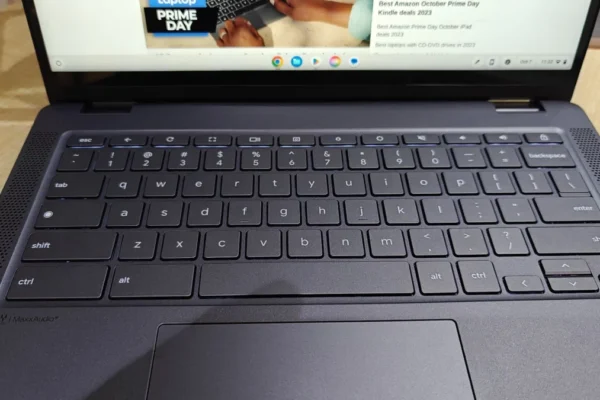
The interior features a matte black finish with a standard-layout keyboard offering tactile feedback and adequate key travel, comparable to larger stablemates like the ASUS ROG Zephyrus G15. White LED backlighting illuminates the keys, though some users note a desire for higher maximum brightness levels. The precision glass trackpad, while relatively compact, incorporates responsive mechanical click switches, though its surface tends to accumulate natural finger oils, necessitating routine maintenance.
Audio output is handled by downward-firing stereo speakers. While adequate for casual media consumption, the compact acoustic chamber limits low-end bass response, making external headphones or speakers preferable for immersive gaming. Notably, the device also includes an integrated webcam positioned above the display—a feature often omitted in ultra-thin gaming laptops of the period.
Connectivity and the XG Mobile Interface
By itself, the ROG Flow X13 exhibits the port limitations typical of ultra-thin form factors. The right side features a USB Type-C 3.2 Gen 2 port supporting Power Delivery (PD) and DisplayPort 1.4 output, alongside a full-size USB Type-A Gen 2 port and a power button embedded with a fingerprint scanner. The left side houses an additional USB-C port, an HDMI 2.0b port, a 3.5mm audio jack, and the proprietary XG Mobile connection port protected by a small silicone cover.
Connecting the XG Mobile dramatically expands the I/O capabilities of the ecosystem. The dock supplies four additional USB Type-A ports, an extra HDMI 2.0b port, a full-size DisplayPort 1.4, an RJ45 Gigabit Ethernet jack, and a UHS-II SD card reader. Furthermore, the XG Mobile integrates a built-in power supply that routes power directly to the Flow X13 through the proprietary cable, freeing up the laptop’s USB-C charging port for mobile accessories.
Performance Analysis: CPU, GPU, and Thermal Dynamics
Evaluating the performance of the ROG Flow X13 requires a nuanced understanding of power delivery and thermal management in modern mobile processors. In synthetic multi-core benchmarks, the AMD Ryzen 9 5980HS processor inside the Flow X13 trades blows with, but occasionally trails, larger laptops running lower-tier CPUs (such as the Ryzen 9 5900HS in the Zephyrus G15). This variance is primarily driven by power allocation: the Flow X13 regulates the CPU to roughly 35W to 42W in Performance Mode to maintain safe internal temperatures within its compact chassis, whereas larger notebooks can sustain higher wattage thresholds over extended periods.
Nevertheless, the baseline processing power remains exceptionally high for a 13-inch device, handling productivity tasks, video editing, and single-threaded applications with ease. The onboard NVIDIA GeForce GTX 1650 provides baseline graphical functionality and casual gaming capability, though its 4GB of VRAM limits its utility in modern titles at native resolutions.
When paired with the XG Mobile and its internal RTX 3080 mobile GPU, the performance profile transforms entirely. The XG Mobile allows the RTX 3080 to operate at a high power threshold—reaching up to 120W in Performance Mode and pushing near its maximum limit in Turbo Mode. In benchmark tests conducted at 1440p and 4K resolutions, the docked Flow X13 achieves frame rates that approach high-end desktop configurations equipped with discrete desktop-grade hardware.
Thermal management across the combined ecosystem remains generally stable. While the laptop itself maintains moderate surface temperatures during standard workloads, the XG Mobile dock acts as a significant thermal dissipation zone under heavy loads, requiring adequate clearance around its exhaust vents. Acoustic profiles scale accordingly; the standalone laptop operates quietly during light tasks, whereas the XG Mobile generates noticeable fan noise under sustained gaming loads.
Upgradability, Battery Life, and System Limitations
User-serviceable internal components are strictly limited on the ROG Flow X13. System memory (RAM) is soldered directly onto the motherboard, precluding post-purchase upgrades. The only accessible internal component is the M.2 2230 NVMe SSD, which utilizes a shorter form factor than standard 2280 drives, restricting replacement options.
Battery performance reflects the inherent compromises of powering high-performance silicon within a 60Wh battery capacity. While light productivity tasks yield respectable endurance—approaching several hours of mixed usage—heavy workloads or gaming sessions deplete the battery rapidly, lasting little over two hours under stress. Consequently, users are advised to remain near a power source for intensive applications.
Broader Impact and Industry Implications
The ASUS ROG Flow X13 and its accompanying XG Mobile dock represent a significant conceptual step forward in modular PC hardware. By demonstrating that high-bandwidth external graphics solutions can function reliably without the severe performance penalties of earlier generations, ASUS has provided a viable blueprint for future portable computing designs.
However, industry analysts and consumers face lingering questions regarding long-term ecosystem support. Because the XG Mobile relies on a proprietary physical connector rather than an open industry standard, prospective buyers must weigh the risk of hardware obsolescence should ASUS alter or discontinue the proprietary interface in subsequent generations.
At a combined price point approaching $3,000 USD for the fully realized bundle, the setup occupies a specialized niche tailored to mobile professionals and enthusiasts who demand ultra-portability combined with uncompromising desktop performance. Despite minor first-generation software quirks—such as intermittent peripheral recognition or power-state transitions—the ROG Flow X13 succeeds in proving the viability of a dual-personality machine, setting a high benchmark for future iterations in the portable gaming market.