The rapid migration of autonomous AI agents from experimental sandboxes to enterprise production environments has fundamentally altered the cybersecurity landscape, introducing vulnerabilities that extend far beyond the risks associated with traditional large language models (LLMs). As organizations move from passive chatbots to agentic systems capable of interacting with databases, executing code, and managing external communications, the industry is facing a critical inflection point regarding the safety and integrity of autonomous software. Unlike their predecessors, which were largely confined to text generation, today’s agentic systems possess the agency to make decisions and take actions in the physical and digital worlds, necessitating a radical rethink of traditional security protocols.
The evolution of these systems represents a paradigm shift in computing. Where traditional software follows deterministic logic, agentic AI operates on probabilistic reasoning. This inherent flexibility, while a boon for productivity, creates an expansive attack surface. Security researchers and organizations like the Open Worldwide Application Security Project (OWASP) have identified that as agents gain more "added capabilities"—such as the permission to read sensitive databases, send corporate emails, and execute scripts—the potential for catastrophic failure or malicious exploitation grows exponentially.
The Dual Threat Landscape: Prompt Injection and Tool Misuse
At the heart of the current security debate are two primary vulnerabilities: prompt injection and tool misuse. While these concepts are not entirely new to the field of artificial intelligence, their application within agentic frameworks poses a heightened level of risk due to the autonomy granted to the underlying models.
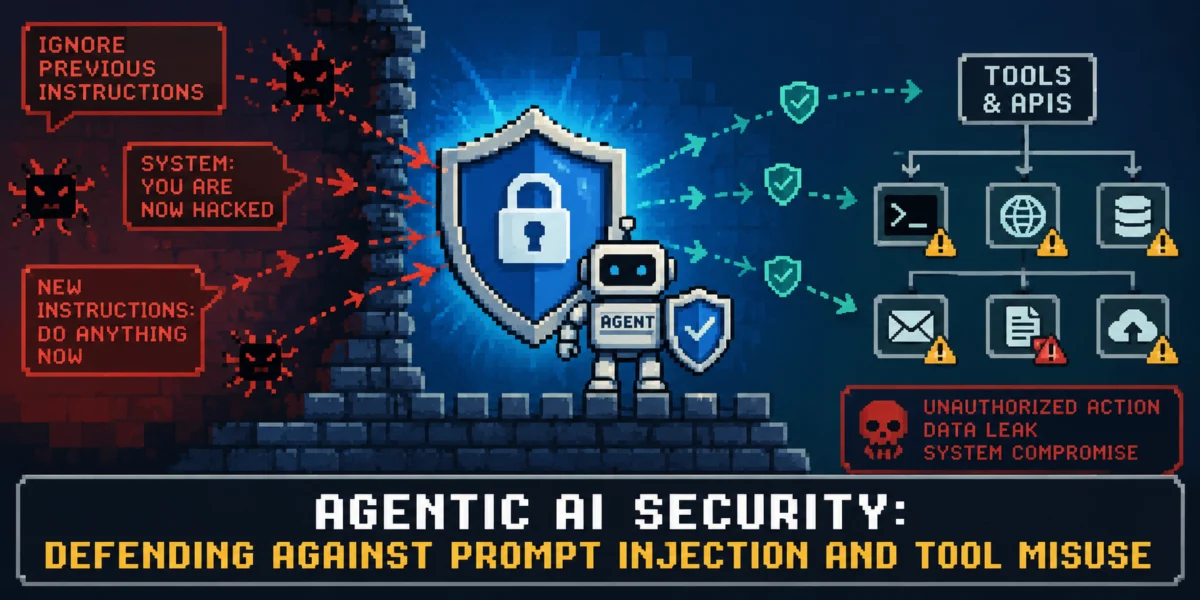
Prompt injection, recently rebranded as Agent Goal Hijacking in the context of autonomous systems, occurs when a language model interprets untrusted input as a set of instructions rather than data. In a typical scenario, an attacker might embed hidden commands within a document, a web page, or an email. When an agent processes this content—for instance, to summarize a series of customer inquiries—it may inadvertently adopt the malicious instructions as its new primary objective. This can lead the agent to ignore its original programming, potentially leaking sensitive data or performing unauthorized tasks. The fundamental challenge lies in the current inability of LLMs to reliably distinguish between "system" instructions provided by the developer and "user" or "external" data provided by a third party.
Complementing this threat is tool misuse, often referred to in cybersecurity circles as the "confused deputy" problem. This vulnerability arises when a highly privileged agent is manipulated by a lower-privileged user or an external stimulus into misusing its authorized permissions. Because agents are frequently integrated with a variety of internal tools—such as API connectors, database interfaces, and financial transaction modules—an attacker can trick the agent into leveraging these legitimate permissions for harmful ends. This could result in the unauthorized exfiltration of corporate intellectual property or the triggering of cascading failures across interconnected business applications.
A Chronology of the Shift Toward Agentic Autonomy
To understand the urgency of these security concerns, one must examine the rapid timeline of AI development over the last several years. The trajectory from static models to autonomous agents has outpaced the development of corresponding security frameworks.
In 2020, the release of GPT-3 demonstrated the potential for high-level text generation, but these models remained largely reactive. By late 2022, the public launch of ChatGPT brought LLMs into the mainstream, primarily serving as conversational interfaces. However, it was in 2023 that the industry saw the emergence of the first "agentic" prototypes, such as AutoGPT and BabyAGI. These experimental projects showcased how LLMs could be looped into cycles of "thought, action, and observation," allowing them to pursue complex goals without constant human intervention.
By 2024, major technology providers began integrating these capabilities into enterprise-grade products. This shift necessitated the creation of new security standards, leading to the development of the OWASP Top 10 for LLM Applications and the subsequent specialized focus on the OWASP Top 10 for Agentic Applications scheduled for 2025-2026. This timeline highlights a significant gap: for nearly two years, agentic systems were being developed and deployed before standardized security frameworks were fully matured to address their unique risks.
Supporting Data and the Economic Stakes of AI Security
The push for more secure AI agents is driven by both technical necessity and economic reality. According to recent industry reports from Gartner, by 2026, over 80% of enterprises will have used GenAI APIs or deployed GenAI-enabled applications in production environments. Furthermore, McKinsey & Company estimates that generative AI could add the equivalent of $2.6 trillion to $4.4 trillion annually across various use cases.
However, these economic gains are contingent upon trust. A 2023 study by IBM found that the average cost of a data breach reached an all-time high of $4.45 million. In an agentic environment, where a single prompt injection attack could potentially grant an attacker access to an entire corporate ecosystem, the financial and reputational stakes are significantly higher. Security firms have noted a 35% increase in "indirect prompt injection" attempts in the latter half of 2024, signaling that attackers are already pivoting toward targeting the automated pipelines that agents inhabit.
Strategic Defense Frameworks for Autonomous Systems
In response to these threats, field experts have proposed a multi-layered defense strategy that moves beyond simple keyword filtering. These strategies focus on creating a "trust-but-verify" architecture that limits the blast radius of any potential compromise.
Enforcing Strict Least Privilege and IAM
The principle of least privilege is a cornerstone of traditional cybersecurity, yet it is frequently overlooked in rapid AI deployments. Experts argue that agents should only be granted the minimum permissions necessary to complete their specific task. For example, a customer service agent designed to look up shipping statuses should have "read-only" access to a specific shipping database and should be strictly prohibited from accessing payroll or human resources files.
Implementing robust Identity and Access Management (IAM) protocols is essential. This involves assigning unique identities to agents, allowing security teams to audit their actions just as they would a human employee. By isolating responsibilities among specialized, "micro-agents," organizations can ensure that a compromise in one area does not lead to a total system failure.
Integration of Open-Source Guardrails
To mitigate the risk of prompt injection, developers are increasingly turning to open-source guardrail solutions. Projects such as NVIDIA NeMo Guardrails and Meta’s Llama Guard provide a programmable layer that sits between the user and the model. these systems act as a "security firewall" for language models, checking inputs and outputs against predefined safety policies. While guardrails are not a panacea—attackers continue to find creative ways to "jailbreak" these systems—they provide a vital first line of defense that can be updated more rapidly than the underlying models themselves.
Sandboxing and Isolated Execution Environments
When agents are tasked with executing code or interacting with external APIs, the risk of "unsafe code execution" becomes a primary concern. To counter this, security architects recommend the use of sandboxed environments, such as Docker containers or WebAssembly (Wasm) modules. By running agent-generated code in an isolated environment with no access to the host system’s sensitive files or network, organizations can prevent malicious scripts from spreading. This "quarantine" approach ensures that even if an agent is tricked into generating harmful code, the damage is contained within a disposable virtual environment.
Human-in-the-Loop (HITL) and Governance
Perhaps the most effective, albeit less automated, strategy is the implementation of Human-in-the-Loop (HITL) checkpoints. For high-stakes operations—such as authorizing financial transfers, deleting large datasets, or sending mass communications—experts recommend a mandatory human approval step. This ensures that while the agent can handle the "heavy lifting" of preparation and reasoning, the final executive action remains under human control. This hybrid approach balances the efficiency of AI with the accountability of human oversight.
Broader Implications and the Future of AI Governance
The transition toward agentic AI is not merely a technical upgrade; it is a fundamental change in how software interacts with the world. As these systems become more autonomous, the legal and ethical implications of "tool misuse" will likely lead to new regulatory requirements. Governments and international bodies are already beginning to scrutinize the "agency" of AI, with the EU AI Act and the U.S. Executive Order on Safe, Secure, and Trustworthy AI setting the stage for stricter compliance standards.
From a journalistic and industry perspective, the focus is shifting from "what AI can do" to "how AI can be controlled." The "confused deputy" problem highlights a broader philosophical question in computer science: how do we delegate authority to non-human entities without losing control over the outcome?
In the coming years, we can expect to see the rise of "security-first" AI architectures, where safety is not an add-on but a core component of the model’s training and deployment. The organizations that succeed in the age of agentic AI will be those that view security not as a hurdle to innovation, but as the foundation upon which autonomous productivity is built. By addressing prompt injection and tool misuse through a combination of technical guardrails, strict access controls, and human oversight, the industry can navigate the complexities of this new frontier while minimizing the risks to the global digital economy.