





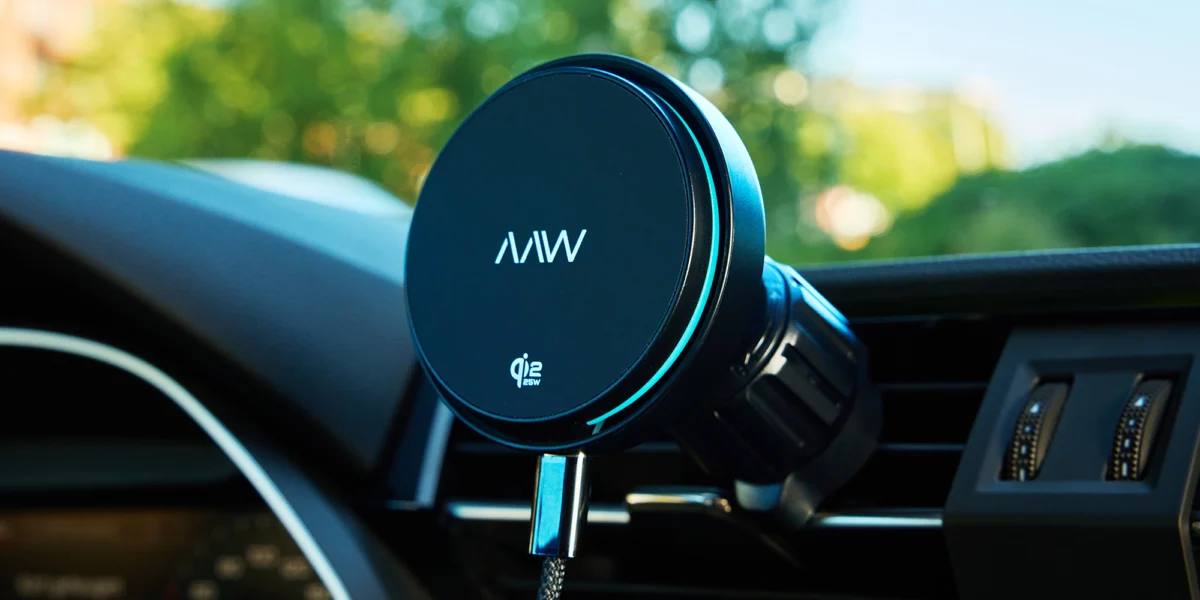
AAWireless, the company widely recognized for its pivotal role in streamlining the in-car experience through its plug-and-play wireless Android Auto adapters, is diversifying its hardware portfolio. The brand has officially unveiled the AAWireless Charge, an active-cooled, 25W wireless charging solution designed to meet the rigorous demands of modern mobile power requirements while driving. This transition marks a significant strategic pivot for the firm, moving from purely software-bridging hardware to high-performance consumer charging peripherals.
Core Specifications and Hardware Engineering
The AAWireless Charge enters a crowded market of automotive accessories with a specific focus on thermal management and charging speed. At its core, the device is a Qi2-certified wireless charger capable of delivering up to 25W of power to compatible handsets. Qi2, the latest standard in wireless charging, relies on the Magnetic Power Profile (MPP) to ensure precise alignment between the charger and the phone’s induction coils, which significantly minimizes energy loss and heat generation.
To further mitigate the thermal issues inherent in rapid wireless charging, particularly when a smartphone is also tasked with running power-intensive applications like GPS navigation or streaming audio, AAWireless has integrated an active cooling system. The unit features a built-in, quiet-operation fan that draws heat away from the rear of the smartphone. This is a critical design choice, as heat is the primary cause of battery degradation and performance throttling in mobile devices. By keeping the device at an optimal temperature, the charger ensures that the 25W power output can be maintained for longer durations without the system safety-limiting the current.

The unit is compatible with Apple’s MagSafe ecosystem, Google’s Pixelsnap, and the broader Qi2 standard. To accommodate a wide variety of users, the package includes both an air vent mount and an adhesive base, providing flexibility for different dashboard architectures. For users with legacy devices or smartphones that lack built-in magnetic alignment, the manufacturer includes two magnetic ring adapters in the box, allowing these phones to benefit from the secure snap-and-charge functionality.
A Chronology of AAWireless Market Evolution
The journey of AAWireless began as a response to a persistent friction point for Android users: the requirement of a wired USB connection to access the full suite of Android Auto features. In 2020, the company launched its inaugural wireless adapter via a crowdfunding campaign, which rapidly became a staple accessory for millions of drivers whose vehicles lacked native wireless smartphone integration.
Over the last four years, the company has focused on firmware updates and iterative hardware improvements to reduce latency and improve compatibility across different vehicle head units. The introduction of the AAWireless Charge represents the company’s first departure from the connectivity category. Following years of brand building within the automotive tech enthusiast community, this product launch suggests an ambition to become a comprehensive "in-car ecosystem" provider. While the original adapters remain available on major retail platforms such as Amazon, the new charging hardware is currently positioned as an exclusive offering, available solely through the official AAWireless direct-to-consumer web portal.
Supporting Data and Technical Context
The shift toward 25W wireless charging in the automotive sector reflects broader trends in mobile technology. Historically, wireless car chargers were limited to 5W or 7.5W outputs, which were often insufficient to counteract the power draw of a phone running Google Maps, Spotify, and 5G connectivity simultaneously. A 25W input represents a significant jump in power density, placing it closer to the performance of desktop wireless charging stands.

The reliance on the Qi2 standard is also a notable industry alignment. Qi2, which was introduced by the Wireless Power Consortium (WPC), is based on Apple’s MagSafe technology. By adopting this standard, AAWireless is positioning its new charger to be future-proof. Data from the WPC suggests that universal adoption of the Magnetic Power Profile will drastically improve the efficiency of wireless power transfer, as misaligned coils are the leading cause of "slow charging" and device overheating in wireless charging setups.
For users seeking "best performance," the manufacturer recommends utilizing the car’s dedicated 12V cigarette lighter outlet in conjunction with the supplied high-wattage adapter. While the device is compatible with existing USB-C ports found in modern vehicle consoles, those ports are often capped at 5W or 10W output, which would be insufficient to trigger the full 25W charging capability of the AAWireless Charge.
Broader Industry Implications and Market Positioning
The launch of the AAWireless Charge has broader implications for the automotive accessory market. Historically, the market has been bifurcated into cheap, generic plastic mounts and high-end, brand-specific wireless charging pads. By occupying the $50 price point, AAWireless is targeting the "prosumer" segment—drivers who value high-speed charging, build quality, and thermal efficiency.
Furthermore, the introduction of active cooling in a consumer car charger highlights a growing awareness of battery health. As smartphones become the primary computing interface for the modern vehicle, their longevity is a concern for consumers. Active cooling systems, previously reserved for high-end gaming phones or professional-grade wireless chargers, are becoming a necessity in vehicles where internal cabin temperatures can soar during summer months.

The company has explicitly clarified that this device does not include an integrated wireless Android Auto adapter. This is a crucial distinction for prospective buyers who might hope for a single-device solution. Instead, the company is positioning the two products as complementary. A user can mount their phone to the AAWireless Charge while simultaneously using an AAWireless adapter hidden in the vehicle’s console to handle the wireless data connection. This "dual-device" approach allows for modular upgrades; if a user switches vehicles or upgrades their phone, they can replace or keep components of their setup independently.
Strategic Outlook
Looking ahead, the success of the AAWireless Charge will likely serve as a litmus test for the company’s ability to expand its brand identity. If the product is well-received, it could pave the way for a wider range of automotive hardware, such as smart interior lighting, dashcams, or advanced vehicle diagnostic tools that utilize the same mobile-first design philosophy.
The decision to keep sales exclusive to the company’s website, rather than launching on Amazon alongside their adapters, may be a strategy to maintain higher profit margins and direct control over the customer experience. This direct-to-consumer model allows for better data collection regarding user satisfaction and potential hardware revisions, which will be vital as the company moves into a more competitive hardware category.
In conclusion, the entry of AAWireless into the wireless charging market is a calculated, logical expansion. By leveraging its existing reputation for reliable, user-focused vehicle technology, the company is betting that its customer base will appreciate the same attention to detail in a charging product that they experienced with the original connectivity adapter. With the inclusion of active cooling and full Qi2 compatibility, the product is well-positioned to address the practical frustrations of modern commuters, signaling that AAWireless is evolving into a more versatile player in the automotive accessory space.