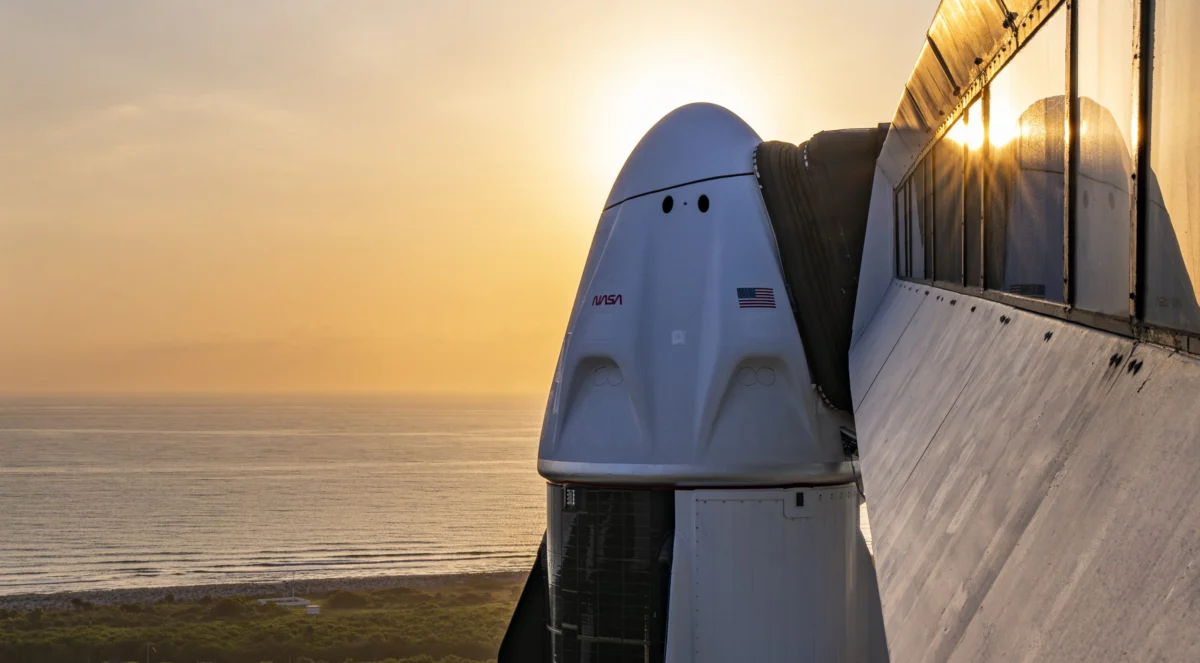
The National Aeronautics and Space Administration (NASA) has officially solidified its reliance on SpaceX for human spaceflight operations well into the back half of the decade. According to an announcement published by the federal space agency, SpaceX has been awarded a $946 million contract modification to supply three additional crew rotation flights to the International Space Station (ISS). This latest agreement incorporates missions Crew-15, Crew-16, and Crew-17 into SpaceX’s overarching Commercial Crew Transportation Capability (CCtTRes) contract. With these three flights added to the ledger, the cumulative value of SpaceX’s primary human spaceflight contract with NASA expands to $5.92 billion across a total of 17 dedicated missions.
The awarded financial framework encompasses a comprehensive suite of mission requirements, including pre-launch ground operations, Falcon 9 rocket integration, Crew Dragon capsule production and maintenance, in-orbit operations, return and recovery procedures, and vital cargo transport capabilities. Furthermore, the spacecraft will provide an essential lifeboat functionality while docked at the orbiting laboratory, ensuring the safety of astronauts in the event of an emergency evacuation. The performance period for these newly commissioned flights extends through the year 2030, matching the current projected operational lifespan of the International Space Station.
Background Context and Procurement Evolution
This $946 million modification serves as a direct execution of plans first signaled by NASA in May, when the agency published a formal notice of intent to procure up to six additional post-certification crew missions. At the time of that initial filing, industry analysts closely scrutinized NASA’s rationale, which explicitly highlighted the persistent technical hurdles and schedule delays encountered by Boeing, the agency’s second commercial crew provider.
Under the original 2014 Commercial Crew Program framework, NASA intentionally contracted two separate providers—Boeing and SpaceX—to ensure redundancy and maintain uninterrupted access to low-Earth orbit. However, disparities in execution timelines have heavily favored SpaceX. While SpaceX successfully inaugurated its first crewed demonstration mission in 2020 and has since maintained a steady cadence of operational flights, Boeing’s CST-100 Starliner program has faced continuous setbacks.
Boeing’s Starliner has yet to successfully complete an operational crew rotation mission for NASA. Its most recent high-stakes crewed test flight in 2024 faced critical technical anomalies, most notably concerning propulsion and thruster performance. Ultimately, the spacecraft returned to Earth uncrewed, leaving NASA astronauts stranded aboard the ISS until alternative transport could be arranged. In the wake of these persistent anomalies, Boeing has dedicated substantial engineering resources to resolving thruster degradation and software issues, pushing its timeline for operational readiness further into the future.
By locking in Crew-15, Crew-16, and Crew-17, NASA has exercised its option for half of the six missions outlined in its May notice. The remaining three flights remain unassigned, leaving an open door for Boeing should the Starliner spacecraft successfully clear final federal safety certifications and prove its operational reliability.
Chronology of the Commercial Crew Partnership

The partnership between NASA and SpaceX under the Commercial Crew Program represents one of the most successful public-private aerospace collaborations in history. The timeline of this relationship underscores a rapid transition from development to routine orbital transit:
- September 2014: NASA awards multi-billion-dollar Commercial Crew contracts to both SpaceX and Boeing.
- May 2020: SpaceX executes the historic Demo-2 mission, carrying NASA astronauts Doug Hurley and Bob Behnken to the ISS aboard the Crew Dragon Endeavour.
- November 2020: NASA officially certifies the Falcon 9 and Crew Dragon system, marking the dawn of regular commercial crew rotation flights.
- 2021–2024: SpaceX successfully executes consecutive crew rotation missions (Crew-1 through Crew-11), reliably swapping out ISS expedition crews and delivering vital supplies.
- June–September 2024: Boeing executes its Crew Flight Test (CFT), which encounters severe thruster anomalies, resulting in the spacecraft returning empty and forcing a re-evaluation of Boeing’s schedule.
- May 2026: NASA issues a formal notice of intent to procure up to six additional post-certification flights to safeguard access to the station.
- September 2026: NASA formally awards SpaceX the $946 million contract modification for Crew-15, Crew-16, and Crew-17, extending performance parameters through 2030.
Official Responses and Industry Implications
SpaceX promptly acknowledged the contract award via official channels, expressing enthusiasm for the continuation of its launching partnership. In a public statement shared on social media, the company confirmed that Falcon 9 rockets and Crew Dragon spacecraft will launch the upcoming missions from Florida spaceports, reinforcing the nation’s domestic launch capabilities.

During industry addresses following the announcement, SpaceX President Gwynne Shotwell addressed the long-term outlook of the company’s human spaceflight hardware. While stopping short of committing to fly the Crew Dragon platform past the year 2030—the anticipated retirement window for the International Space Station itself—Shotwell emphasized that SpaceX has no immediate plans to phase out the spacecraft, given its proven reliability and ongoing demand.
Meanwhile, the current flight schedule remains active. The Crew-12 mission is presently docked at the International Space Station, serving as a vital science and maintenance outpost, while NASA officials have confirmed that the launch of Crew-13 is targeted for the coming weeks. The inclusion of Crew-15 through Crew-17 guarantees that SpaceX will remain the absolute backbone of American orbital logistics for the remainder of the decade.
Strategic Analysis and Broader Impact
The financial expansion of SpaceX’s commercial crew portfolio highlights a broader structural reality within modern aerospace: schedule certainty dictates institutional trust. While NASA remains publicly committed to fostering a dual-supplier ecosystem to avoid a monopoly on low-Earth orbit transportation, the agency’s operational safety mandates require absolute continuity. Any prolonged grounding of the ISS due to access limitations would jeopardize decades of international scientific research and billions of dollars in orbital infrastructure.
By committing nearly a billion dollars to SpaceX for missions extending to the end of the decade, NASA effectively insulates itself against further delays in Boeing’s Starliner program. At the same time, this strategic move buys Boeing the necessary breathing room to thoroughly diagnose, test, and rectify its propulsion flaws without the immediate pressure of a compromised flight manifest.
As low-Earth orbit transitions toward an era defined increasingly by commercial space stations and private orbital enterprise, SpaceX’s reinforced standing as NASA’s primary transit provider solidifies its dominance in the sector. Whether future iterations of human spaceflight architecture will rely on evolved versions of Dragon or shift entirely toward next-generation vehicles like Starship remains to be seen. However, for the immediate future through 2030, the path to the stars for NASA astronauts will run firmly through the Falcon 9 and Crew Dragon partnership.