










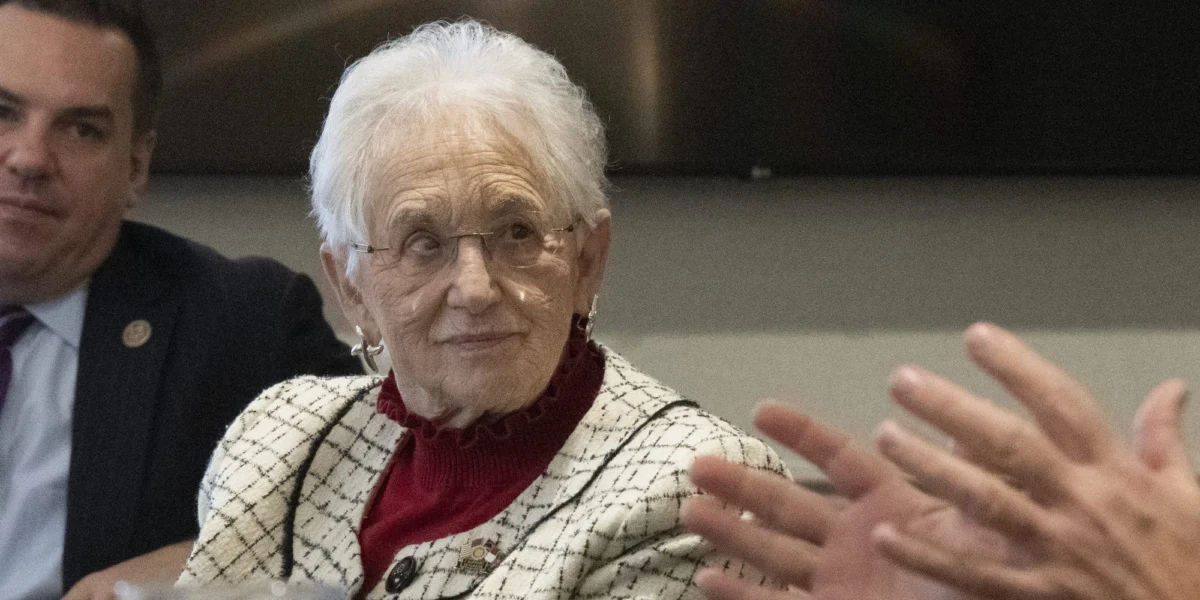
The electoral landscape of North Carolina’s fifth congressional district has shifted dramatically following a tightly contested recount that ultimately unseated 11-term Republican Representative Virginia Foxx. Democrat Chuck Hubbard, a former journalist and native of the district, secured victory by a margin of 330 votes, or approximately 0.12% of the total ballots cast. The outcome concludes one of the final remaining House races of the 2026 midterm elections, a cycle characterized by significant shifts in congressional control and a major democratic majority in the House of Representatives.
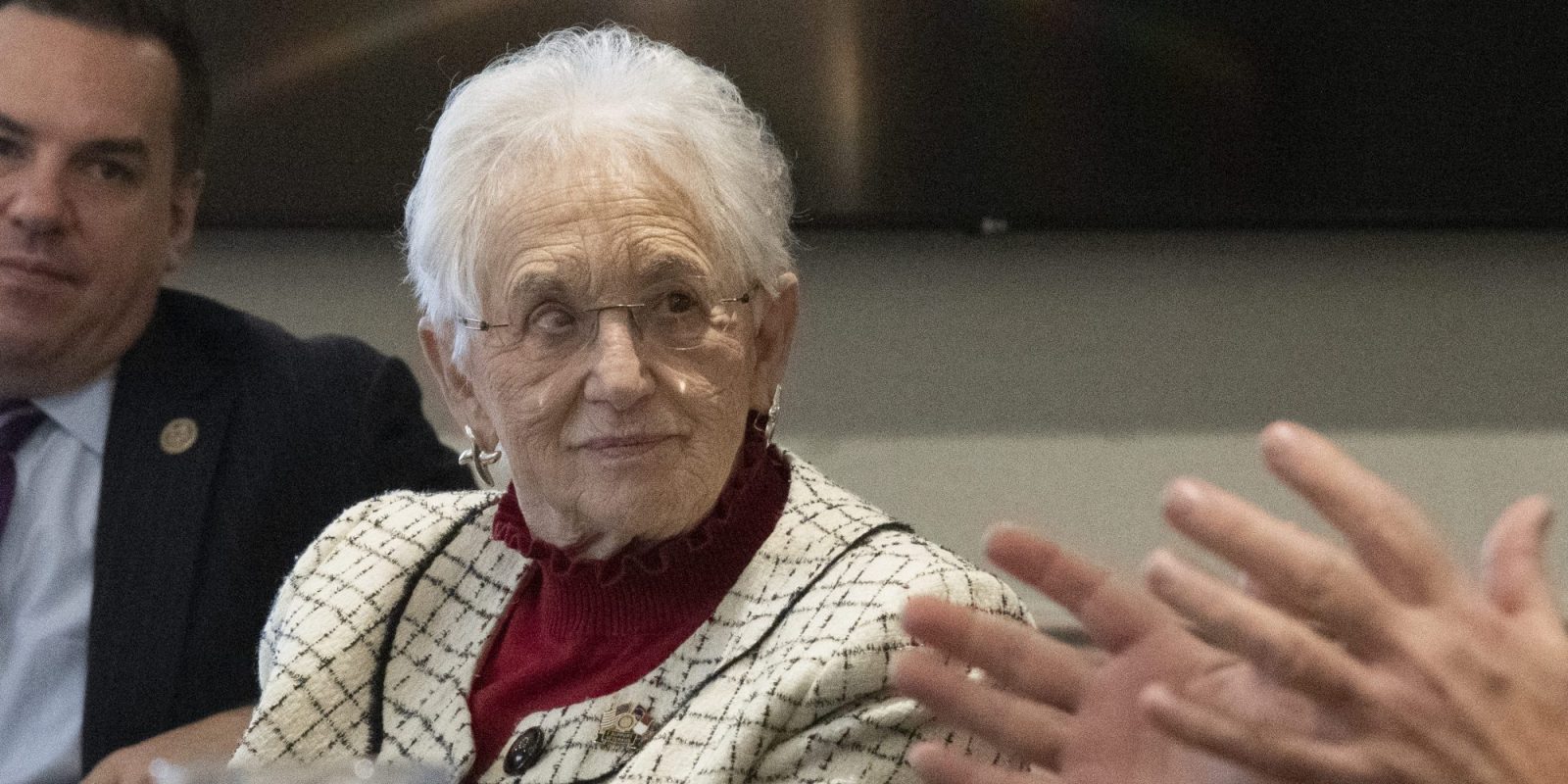
The conclusion of the race brings a definitive end to the legislative tenure of the 83-year-old incumbent, whose final months in office were heavily defined by national media attention surrounding a controversial correspondence with a young constituent regarding environmental policy, electric vehicles, and the national debt.
Origins of the Controversy: A Ten-Year-Old’s Assignment
The sequence of events leading to the national spotlight began earlier in the year when Christian Mango, a ten-year-old elementary school student residing in North Carolina, participated in a routine classroom assignment encouraging students to research a public policy topic and communicate their findings to an elected official.
Mango selected electric vehicles (EVs) as his primary subject. In his written correspondence, the student outlined several arguments favoring the adoption of electric transportation, citing environmental benefits, lower operational costs, and the elimination of direct gasoline consumption. Furthermore, Mango proposed the implementation of a federally backed $5,000 tax rebate to incentivize consumer adoption of zero-emission vehicles, alongside broader expressions of concern regarding global climate metrics, public health impacts from air pollution, and the preservation of glacial ice sheets.
While the letter contained minor conflations common to elementary-level inquiries—such as merging short-term weather patterns with long-term climate trends—the core arguments mirrored mainstream economic and environmental policy debates regarding the transition away from fossil-fuel-dependent infrastructure. Emily Mango, the student’s mother, noted that her son had independently researched and cited facts to articulate a position entirely separate from partisan politics, expressing pride in his academic initiative.
The Congressional Response and Public Reaction
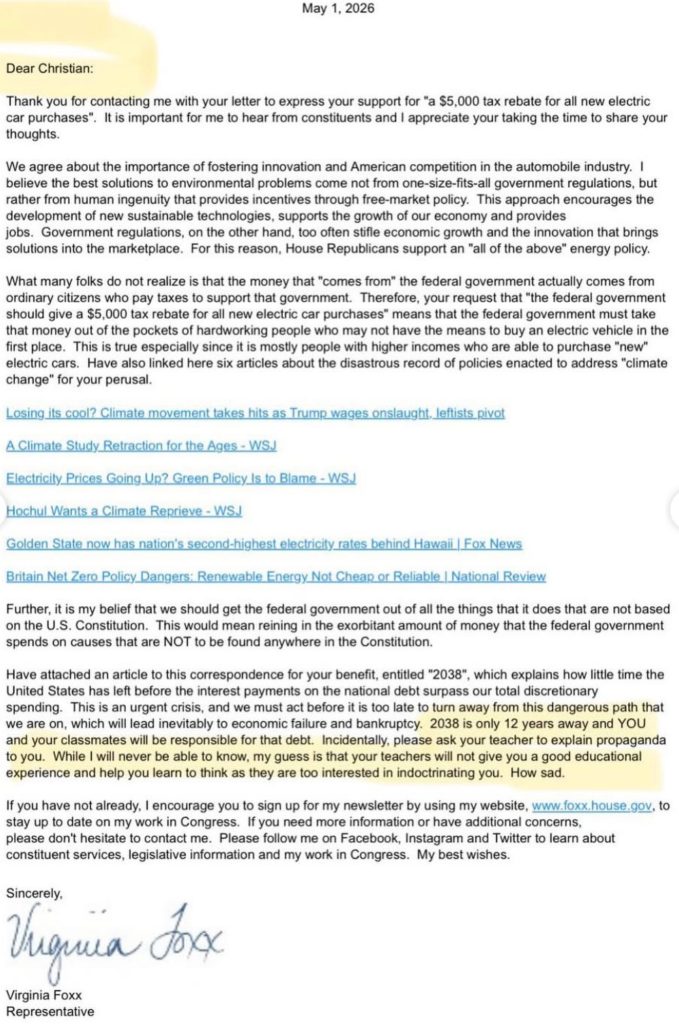
Upon receiving the letter, Representative Foxx’s office issued a formal written reply that quickly became a focal point of public contention. Rather than addressing the specific points raised by the fourth-grade constituent regarding vehicular electrification, the correspondence directed the child toward several conservative opinion pieces and publications, warning against what the representative termed ideological indoctrination within the educational system.
The response asserted that federal tax credits for electric vehicles disproportionately benefit higher-income demographics capable of purchasing new automobiles, while cautioning the ten-year-old student about the long-term economic implications of national government debt. Specifically, the letter noted that younger generations would ultimately bear financial responsibility for accumulated federal liabilities.
Emily Mango publicly shared the letter via social media, characterizing the tone as dismissive and inappropriate for correspondence directed at a minor. The post rapidly gained traction, drawing widespread criticism from educational advocates, political commentators, and environmental groups who argued that the interaction represented a missed opportunity for civic mentorship. Critics also pointed out perceived contradictions within the representative’s arguments, noting that Foxx had previously voted in favor of large-scale federal fiscal legislation that significantly expanded the national debt, while simultaneously opposing targeted consumer incentives for clean energy technologies.
Legislative Record on Energy and the National Debt
The policy positions articulated in the congressional response prompted closer examination of Representative Foxx’s voting record regarding energy infrastructure and federal spending. Over her nearly two-decade tenure in the House of Representatives, Foxx consistently advocated for an "all-of-the-above" energy strategy, which her congressional office defined as supporting traditional fossil fuel extraction alongside alternative energy sources.
However, environmental analysts and industry observers frequently noted that this legislative approach translated primarily into opposition against regulatory frameworks favoring renewable energy and zero-emission vehicles. Foxx previously voted in opposition to provisions within the Inflation Reduction Act of 2022, which established consumer incentives for electric vehicles, home energy efficiency upgrades, and domestic manufacturing of clean technology components.
Supporters of the federal incentives argued that the legislation was structured to be deficit-neutral or deficit-reducing through enhanced tax compliance enforcement, a claim supported by independent economic scoring from organizations such as the Committee for a Responsible Federal Budget. Conversely, congressional opponents argued that green energy subsidies represented government overreach and inefficient market intervention.
The debate over fiscal responsibility also played a central role in the exchange. While Foxx’s letter cautioned young constituents regarding the trajectory of federal debt, policy analysts highlighted her vote in favor of subsequent legislative packages that modified tax structures and significantly increased projected long-term federal deficits. Critics argued that utilizing future debt liabilities as a counterargument against investments in infrastructure modernization and environmental mitigation created an inherent policy contradiction.
The 2026 Midterm Context and Gerrymandering Dynamics
The local electoral contest in North Carolina’s 5th District unfolded against a broader national backdrop of political realignment during the 2026 midterm elections. National sentiment shifted significantly amid ongoing economic pressures, global energy market volatility, and voter fatigue concerning incumbent leadership. These dynamics contributed to substantial electoral losses for the Republican Party across multiple traditionally safe congressional districts.
In North Carolina specifically, the electoral map had been the subject of extensive legal and political maneuvering. Republican state lawmakers had executed mid-decade congressional map redraws intended to secure durable legislative majorities. Political scientists and redistricting watchdogs frequently categorized these adjustments as aggressive gerrymandering designed to disperse opposition voters while consolidating safe margins for incumbents.
However, the scale of the national political shift ultimately disrupted these strategic projections. The narrow victory margins engineered to maximize seat distribution backfired during a wave election cycle, leading to unexpected Democratic gains in several suburban and rural districts nationwide.
In North Carolina’s 5th District, which had historically favored Republican candidates by substantial margins—including a 19-percentage-point victory for Foxx in the 2024 general election—the political environment underwent a profound contraction. Democratic challenger Chuck Hubbard capitalized on voter dissatisfaction and localized mobilization, steadily closing the polling gap as election day approached.
Recount, Concession, and Implications for the 120th Congress
Following the initial tabulation of ballots in November, the race was too close to call, prompting a formal request for a recount under North Carolina election laws. The statewide and county-level boards of elections conducted a comprehensive review of provisional ballots, absentee returns, and machine tallies.

The final certified count confirmed that Chuck Hubbard had surpassed Virginia Foxx by exactly 330 votes, securing 50.06% of the vote share compared to Foxx’s 49.94%. Confronted with the certified results, Foxx officially conceded the race, bringing closure to the longest-running undecided contest of the 2026 cycle.
The outcome finalized the composition of the United States House of Representatives for the upcoming congressional term, granting the Democratic Party a narrow majority of 258 seats—their largest legislative footprint in the chamber since the early 1990s.
Political analysts view the unseating of a deeply entrenched incumbent as a milestone indicator of shifting voter demographics and the tangible political consequences of constituent relations. For North Carolina’s 5th District, the transition to a new congressional representative marks the end of an era defined by Foxx’s twenty-two years in federal office and signals a fresh chapter in local legislative representation, concluding a political cycle that unexpectedly bridged national fiscal policy debates with a fourth-grade classroom assignment.