








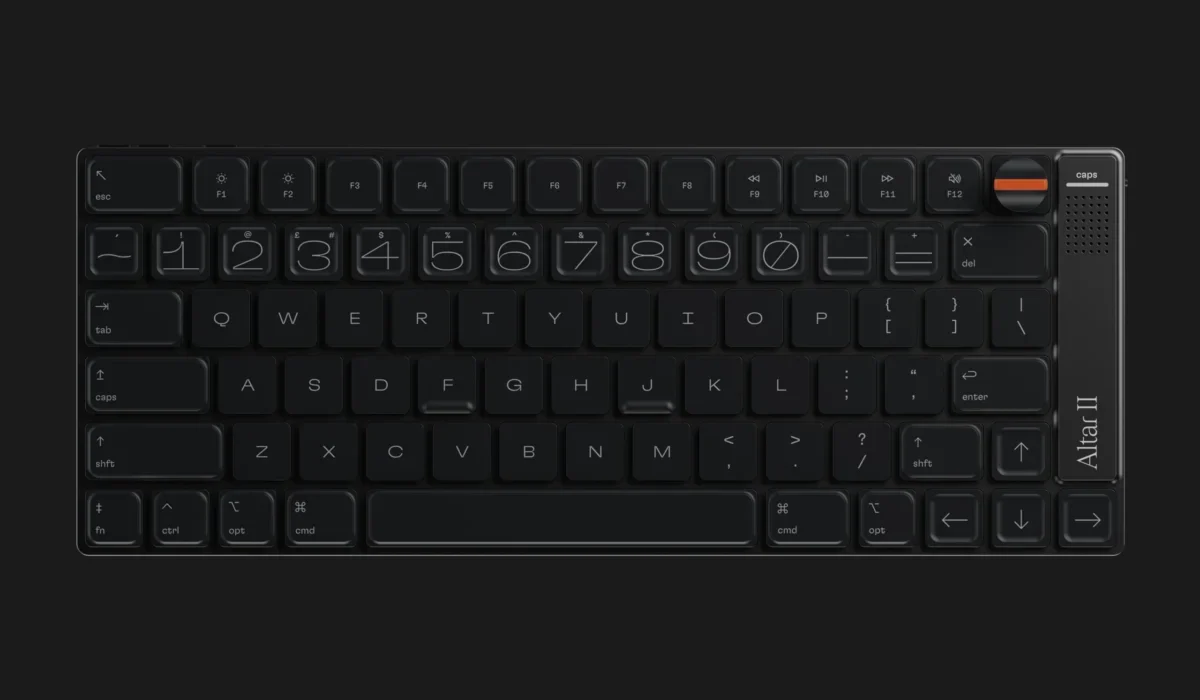
The global market for computer peripherals has witnessed a significant engineering milestone with the introduction of the Altar II, a mechanical keyboard that measures a mere 4.75 millimetres in thickness. Developed specifically for macOS users, the device successfully navigates the historically difficult compromise between ultra-thin aesthetic minimalism and the tactile satisfaction expected from traditional mechanical switches. By integrating custom switch architecture, localized haptic feedback, and a suite of productivity-enhancing features into a chassis thinner than many modern smartphones, the Altar II has rapidly captured the attention of the tech community, securing full crowdfunding backing well ahead of its official commercial release schedule.
Engineering the Thinnest Mechanical Keyboard
Achieving a sub-five-millimetre profile in a mechanical keyboard required a complete rethinking of internal switch mechanics and structural layout. Traditional mechanical keyboards rely on deep travel distances and bulky spring assemblies to provide feedback, which inherently dictates a thicker chassis. In contrast, the Altar II employs custom-engineered low-profile switches that manage to deliver a notable 1.8 millimetres of travel distance. While shorter than standard desktop switches, this travel depth provides a recognizable tactile bump and actuation point, mitigating the common user complaint that ultra-thin keyboards feel indistinguishable from membrane or laptop scissor-switch alternatives.
To address the acoustic and vibrational challenges typically associated with thin-profile typing surfaces, the manufacturers integrated an innovative Inertial Damper system. This internal dampening mechanism absorbs excess kinetic energy upon bottoming out, significantly reducing noise output and unwanted chassis vibration. Consequently, the Altar II maintains a quiet, solid typing experience that contrasts sharply with the hollow, clacking sound profile often produced by thin metal or plastic enclosures.
Advanced Control Interfaces and Tactile Feedback Systems
Beyond its primary typing surface, the Altar II incorporates several sophisticated control modules designed to enhance workflow efficiency for creative professionals and digital office workers. Prominent among these is the customizable M-Dial, a rotary physical interface that allows users to adjust system volume, media playback, and application-specific parameters with fine-grained precision. Unlike standard media keys, the M-Dial features real-time haptic feedback, offering physical resistance or detents that communicate changes directly to the user’s fingertips.
Furthermore, the keyboard features an integrated Harmonic Synthesiser designed to supply nuanced haptic responses for modifier keys and critical system notifications. This multi-layered tactile communication layer works in tandem with the NiteLite backlighting system, ensuring optimal visibility in low-light environments without introducing excessive power consumption or light bleed.
Ergonomics and Efficiency Through the ESPtype System
Typing ergonomics on the Altar II are governed by the proprietary ESPtype key shape system. Recognizing that different regions of a standard keyboard layout serve distinct functional purposes, the ESPtype framework assigns unique topological profiles to specific keyboard zones. By tailoring the contour, curvature, and surface area of the keycaps to match the natural resting angles and movement ranges of individual fingers, the design improves overall typing efficiency and reduces hand fatigue during extended usage sessions.

Despite its dense array of electronic features—which also includes a built-in miniature speaker for audio alerts—the Altar II boasts a battery endurance of up to 30 days on a single charge. This longevity is achieved through intelligent power management protocols that selectively deactivate peripheral sensors and backlighting zones during periods of inactivity.
Crowdfunding Momentum and Commercial Timeline
The development and commercialization of the Altar II follow a carefully structured timeline typical of modern hardware startups leveraging direct-to-consumer crowdfunding platforms.
The project officially launched on Kickstarter with an ambitious financial target intended to cover the final phases of tooling, manufacturing line setup, and software optimization for macOS environments. Backer response proved immediate and robust, with the campaign surpassing its primary funding goal within days of its public debut.
With the funding phase successfully concluded, the production roadmap outlines the following schedule leading to consumer delivery:
- Q4 2026: Finalization of tooling, mass-production testing, and software integration for macOS compatibility.
- Q1–Q2 2027: Initiation of assembly lines, quality assurance trials, and initial factory packaging.
- July 2027: Official global shipping commencement for Kickstarter backers and early-access pre-order customers.
Priced at $299, the Altar II occupies the premium tier of the mechanical keyboard market, positioning itself alongside high-end custom builds and luxury productivity tools rather than mass-market office accessories.
Broader Market Implications and Industry Impact
The introduction of the Altar II highlights a broader trajectory within the personal computing hardware sector: the convergence of ultra-portable design philosophies with uncompromising performance standards. For years, Apple ecosystem users seeking a dedicated mechanical keyboard often had to choose between bulky, high-profile gaming peripherals that clashed with minimalist desk aesthetics, or compromise on tactile feedback by using standard low-profile membrane boards.
By pushing the boundaries of mechanical switch height down to 4.75mm without sacrificing critical travel depth or functional feedback, the Altar II establishes a new benchmark for peripheral engineering. Industry analysts note that if the device successfully delivers on its manufacturing promises by the July 2027 delivery window, it could compel larger mainstream hardware manufacturers to reevaluate their own low-profile accessory lines. The integration of advanced haptic actuation, specialized zone profiling, and extended battery life within such a constrained physical footprint demonstrates that thinness no longer requires the complete abandonment of advanced mechanical engineering.
As consumers increasingly demand workspace peripherals that combine visual elegance with professional-grade ergonomics, the success of projects like the Altar II suggests a lucrative future for niche, high-performance hardware designed explicitly for modern desktop ecosystems.