










The intersection of luxury travel and avant-garde fashion has yielded some of the industry’s most compelling partnerships over the past decade, and the latest joint venture between German luggage manufacturer Rimowa and French luxury fashion house Maison Margiela stands as a testament to this ongoing creative dialogue. Scheduled for an official global release on November 19, the Rimowa x Maison Margiela collection marries Rimowa’s industrial engineering and iconic aluminum fabrication with Maison Margiela’s deconstructivist design ethos. At the center of the collaboration is Margiela’s celebrated Bianchetto technique—a hand-painted white finish applied over a dark base, designed to purposefully chip, crack, and wear away with
time, revealing the material underneath through the natural friction of travel.
Priced between $4,300 and $4,900, the capsule collection comprises two primary statement pieces: Rimowa’s signature Classic Cabin suitcase and Maison Margiela’s distinctive 5AC XL bag. By synthesizing Rimowa’s utilitarian durability with Margiela’s conceptual artistry, the collection appeals directly to luxury consumers, frequent flyers, and collectors of contemporary fashion artifacts who view travel gear not merely as functional utility, but as a canvas for personal expression and narrative accumulation.
Main Facts of the Collection
The collaborative lineup focuses on meticulous craftsmanship, tactile contrast, and subversive design details that subvert the pristine expectations typically associated with luxury luggage.
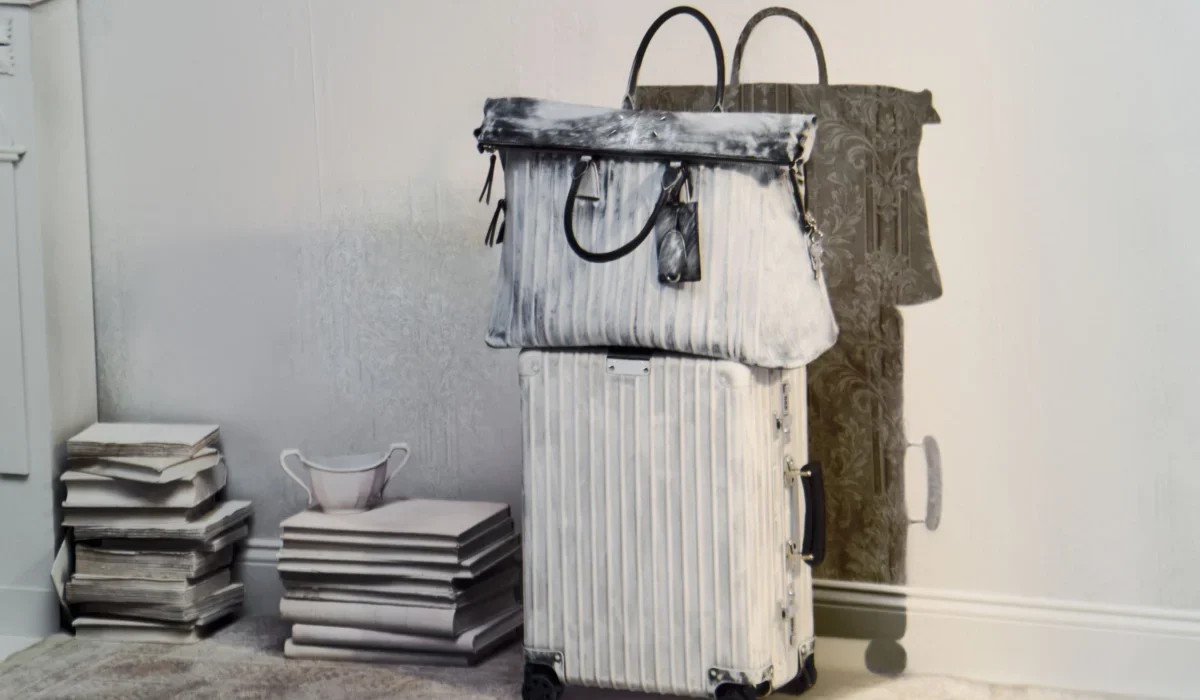
The Rimowa Classic Cabin in this collection serves as a pristine white monolith upon first unboxing. However, because the exterior of both the suitcase and the 5AC XL bag is hand-painted using Maison Margiela’s signature Bianchetto process, no two pieces are identical. The white paint is deliberately applied by hand over a dark base, meaning that after a handful of uses, the transit-induced scuffs, scratches, and abrasions will begin to flake the white coating away. This evolving patina transforms each piece of luggage into a visual diary of the owner’s journeys.
Interior and Hardware Details: Inside the Classic Cabin, the design narrative continues with a crisp white lining complemented by premium leather detailing. True to Maison Margiela’s penchant for exposed construction, the interior features visible stitching and overlocked edges, drawing attention to the artisanal labor required to construct the piece. Externally, the traditional aluminum Rimowa logo badge has been modified with Margiela’s trademark white-thread four stitches—an understated yet globally recognized hallmark of the fashion house that signals brand affiliation without relying on loud, overt logos.
The 5AC XL Bag: In a reciprocal nod to Rimowa’s industrial design language, Maison Margiela’s iconic 5AC XL bag has been entirely reimagined. The leather body has been updated with Rimowa’s unmistakable parallel groove pattern. To achieve this, designers utilized an advanced high-frequency technique to stamp the signature 3D ridges into the bag’s structure. Furthermore, extreme precision was applied to the alignment of these grooves; when the 5AC XL is placed atop or beside the Classic Cabin, the vertical ridges of both items align seamlessly, creating a unified architectural silhouette.
Chronology and Background Context
The genesis of this collaboration reflects a broader industry trend wherein legacy luggage brands partner with high-fashion houses to capture younger, style-conscious demographics. Rimowa, founded in Cologne, Germany, in 1898 and acquired by luxury conglomerate LVMH in 2016, has increasingly leaned into high-profile design partnerships. Over the past several years, Rimowa has collaborated with streetwear giants like Supreme and Off-White, contemporary artists like Daniel Arsham, and luxury fashion houses such as Dior and Fendi.

Maison Margiela, founded in Paris in 1988 by Belgian designer Martin Margiela and currently under the creative direction of John Galliano, has long championed anti-luxury, conceptual fashion, and the elevation of everyday objects through unconventional treatments. The Bianchetto finish, which originates from traditional hand-painted Italian artisan techniques popularized by Margiela in the early 2000s, has been applied to footwear, ready-to-wear garments, and leather goods, but its application to anodized aluminum travel cases represents a novel technical challenge.
Preliminary discussions and prototyping between the engineering teams in Cologne and the design studios in Paris began more than a year prior to the official announcement. Developing a hand-painted white coating that could adhere to structured aluminum without immediately peeling off entirely—while still allowing for a controlled, aesthetically pleasing aging process—required extensive material testing. The high-frequency molding used to transpose Rimowa’s aluminum groove pattern onto Margiela’s supple leather bags similarly demanded months of technical refinement to ensure structural integrity and textural harmony.
Supporting Data and Pricing Structure
The Rimowa x Maison Margiela collection occupies the ultra-luxury tier of travel and fashion accessories. With price points ranging from $4,300 to $4,900, the items are positioned significantly higher than standard production models from either brand, reflecting the limited-edition nature, intensive hand-finishing processes, and co-branded exclusivity.
- Rimowa Classic Cabin (Bianchetto): Estimated at the upper end of the collection’s spectrum, reflecting the complex hand-painting of large-format aluminum shells, custom interior textile work, and specialized hardware.
- Maison Margiela 5AC XL Bag (Bianchetto with High-Frequency Grooves): Positioned alongside the luggage, incorporating luxury leather craftsmanship, specialized tooling for the groove stamping, and aligned design geometry.
Both items will be released simultaneously on November 19 through official retail channels, including select Rimowa flagship stores, Maison Margiela boutiques, and their respective e-commerce platforms (rimowa.com and maisonmargiela.com). Given the limited production runs typical of such collaborations, analysts anticipate high demand among collectors and quick sell-through rates on the secondary market.
Official Responses and Industry Perspectives
While formal corporate statements from executive leadership emphasize the mutual respect between the two houses, industry observers and fashion critics have offered insightful commentary on the partnership’s strategic alignment.
Representatives from Rimowa have noted that the collaboration allows the brand to push the boundaries of its century-old manufacturing traditions, demonstrating that industrial aluminum can be successfully subjected to radical, art-driven interventions. Conversely, Maison Margiela’s studio has framed the project as an exploration of permanence versus transience. By applying a finish that deteriorates through use, the collaboration challenges the conventional consumer anxiety surrounding the preservation of luxury goods. Instead of treating a $4,000-plus suitcase as a fragile object to be kept pristine in a dust bag, the Rimowa x Maison Margiela collection actively encourages its own destruction as a form of artistic completion.
Broader Impact and Market Implications
The launch of the Rimowa x Maison Margiela collection underscores several vital shifts in the contemporary luxury goods market:
- The Rise of Experiential Luxury: Modern consumers—particularly Millennials and Generation Z—increasingly value items that tell a personal story. By engineering a patina process directly into the product design, Rimowa and Margiela are selling not just a static object, but a dynamic, long-term visual narrative shaped by the owner’s travels.
- Cross-Category Synergy: The deliberate alignment of the 5AC XL bag’s high-frequency grooves with the aluminum ridges of the Classic Cabin highlights a growing demand for cohesive travel ecosystems. Rather than offering standalone accessories, luxury brands are increasingly creating modular collections where travel gear and personal carry-alls function as unified design statements.
- Elevated Streetwear and Industrial Fusion: As the boundaries between technical utility and high fashion continue to blur, collaborations of this caliber validate the crossover appeal of industrial design within avant-garde wardrobes.
As the November 19 release date approaches, anticipation continues to build across global fashion capitals. Whether these pieces will be deployed on international flights or preserved as sculptural collector’s items in private wardrobes remains to be seen; however, the collaboration has already firmly established a new benchmark for how heritage manufacturing and conceptual design can intersect in the modern luxury landscape.