










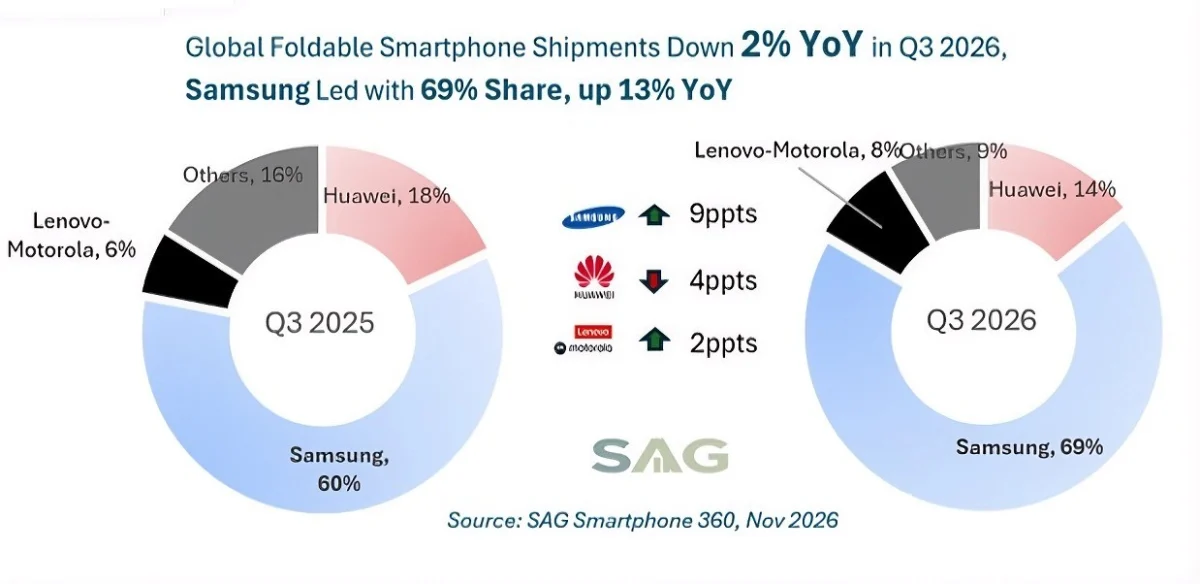
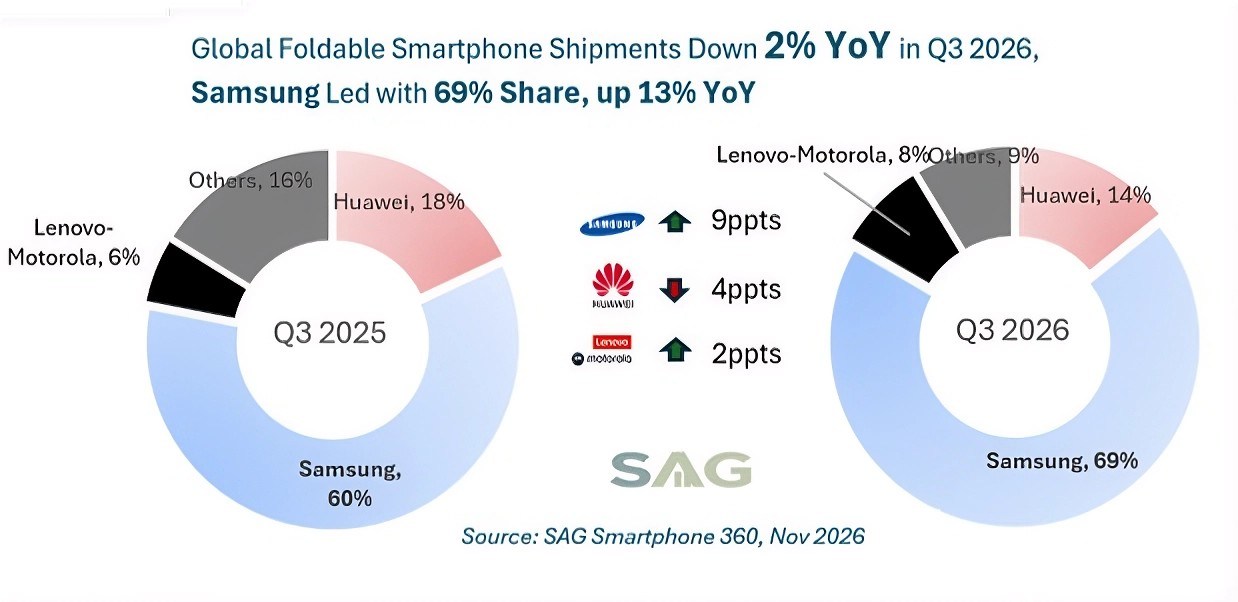
The global foldable smartphone landscape witnessed a definitive consolidation of power during the third quarter of 2026, as Samsung reclaimed its position as the undisputed market leader. According to the latest research data from Smart Analytics Global (SAG), the foldable sector experienced a modest contraction of 2% year-over-year, totaling 7.5 million units shipped. Despite this overall market cooling, Samsung managed to capture an impressive 69% of the global market share—the highest level of dominance the company has achieved since 2023. This resurgence underscores the efficacy of the company’s current hardware strategy, particularly regarding its premium "wide" foldable product line.
A Chronology of Q3 Market Dynamics
The third quarter of 2026 was characterized by a transition period within the mobile industry. As manufacturers braced for the highly anticipated arrival of the Apple iPhone Duo, which officially began shipping on October 23, the market saw a temporary stagnation in consumer demand for existing flagships.
The launch of the Samsung Galaxy Z Fold8 on August 7 served as the primary catalyst for the company’s quarterly performance. Within the 55-day window between the product’s release and the conclusion of the fiscal quarter on September 30, industry analysts, including noted tech observer Ice Universe, estimate that Samsung moved approximately 2.85 million units of the Z Fold8. This figure accounts for more than half of the company’s total foldable shipments for the entire three-month period, translating to an average of 50,000 units shipped per day.
For other market participants, the quarter proved challenging. Huawei, historically a strong contender in the foldable space, saw its market share decline by four percentage points. Analysts attribute this drop primarily to a softening of demand within China, which serves as the company’s core stronghold. Conversely, the Lenovo/Motorola conglomerate managed to buck the downward trend, securing a 2% gain in market share, bolstered by the successful regional rollout of the Razr 70 series.

Supporting Data and Regional Performance
The success of the Galaxy Z Fold8 was not limited to domestic markets or singular territories. Samsung reported double-digit growth in foldable shipments across key European markets and South Korea. This performance is largely attributed to the "wide" foldable form factor, which has gained significant traction among enterprise users and power consumers who prioritize multi-tasking capabilities on larger displays.
While Samsung thrived, the broader foldable market struggled with external headwinds. SAG data indicates that the total shipment volume of 7.5 million units reflects a market that is still sensitive to broader economic fluctuations and supply chain volatility. Production challenges, particularly those impacting the initial rollout of the Apple iPhone Duo, have caused research firms to adjust their full-year 2026 projections downward.
The struggle for market share has also been influenced by internal cannibalization within product lines. In the case of Huawei, the introduction of the non-folding Pura X View has disrupted the momentum of the company’s traditional foldable offerings, such as the Pura X and Pura X Max. By offering a high-end experience that deviates from the folding form factor, Huawei inadvertently diluted the appeal of its own foldable ecosystem during a period where consumer interest in experimental hardware was already waning.
Official Perspectives and Market Implications
Industry experts suggest that the current market landscape is a precursor to a more competitive 2027. The delay in the mass-market availability of the Apple iPhone Duo has created a "waiting period" effect, where potential high-end buyers have delayed purchasing decisions.
"The market is in a state of recalibration," noted a spokesperson from the Smart Analytics Global research team. "While the Q3 data shows a contraction, the underlying technology continues to mature. The 2026 figures are largely indicative of a transition between the ‘early adopter’ phase and the ‘mainstream adoption’ phase of foldable technology. Apple’s entry, while delayed by production constraints, will likely serve as the primary driver for market recovery in 2027."
The implications of this shift are significant. With Apple expected to command as much as 40% of the market in 2027 once production stabilizes, the foldable sector is transitioning from a niche category dominated by Samsung to a mainstream battleground. Samsung’s current 69% share is expected to face intense pressure, but the company’s early head start in software optimization for wide-format displays provides it with a substantial moat against newer entrants.
Broader Economic and Industrial Impact
The decline in foldable interest within the Chinese market—a region that has historically fueled global growth—remains a concern for manufacturers. As a primary market for both domestic giants like Huawei and international players like Apple, the lower-than-expected demand in China has forced a pivot in global sales strategies. Companies are now looking toward emerging markets in Southeast Asia and Latin America to offset the cooling demand in North Asia.
Furthermore, the rise of "wide" foldables like the Z Fold8 and the iPhone Duo is fundamentally changing the expectations for mobile hardware. Consumers are increasingly viewing these devices not merely as luxury items, but as legitimate replacements for tablets and entry-level laptops. This convergence of categories is expected to sustain the long-term growth of the industry, despite temporary quarterly declines.
Looking Toward 2027: A Year of Projected Growth
Smart Analytics Global remains optimistic about the long-term outlook for the sector, estimating a 55% year-over-year growth for the global foldable market in 2027. This growth is contingent upon several factors:
- Supply Chain Stabilization: The resolution of manufacturing bottlenecks for new entrants like Apple will be critical in meeting pent-up consumer demand.
- Product Diversification: As the "wide" foldable form factor becomes standard, manufacturers will likely introduce more affordable iterations to capture the mid-range consumer segment.
- Software Integration: The success of hardware will increasingly depend on third-party application optimization. As more developers tailor their software for folding screens, the utility of these devices will continue to rise.
The projected two-thirds market dominance of wide-format foldables in 2027 suggests that the industry has collectively settled on a preferred design language. While smaller, "clamshell" devices continue to appeal to fashion-conscious consumers, the market’s center of gravity has clearly shifted toward devices that offer maximal screen real estate.

Conclusion
The third quarter of 2026 serves as a snapshot of a market in flux. Samsung’s success with the Galaxy Z Fold8 has provided a blueprint for how a manufacturer can maintain relevance through product iteration and regional growth, even in a shrinking market. However, the impending full-scale entry of Apple and the evolving preferences of the Chinese consumer base signal that the status quo will be short-lived.
As 2026 draws to a close, the focus shifts to the final quarter performance and the ability of manufacturers to address production deficits. Whether the market can achieve the forecasted 55% growth in 2027 will depend on the industry’s ability to move beyond the technical hurdles of the current generation and deliver a value proposition that justifies the premium pricing inherent to foldable technology. For now, Samsung remains the architect of the current foldable standard, but the upcoming year promises a fundamental restructuring of the global hierarchy.