











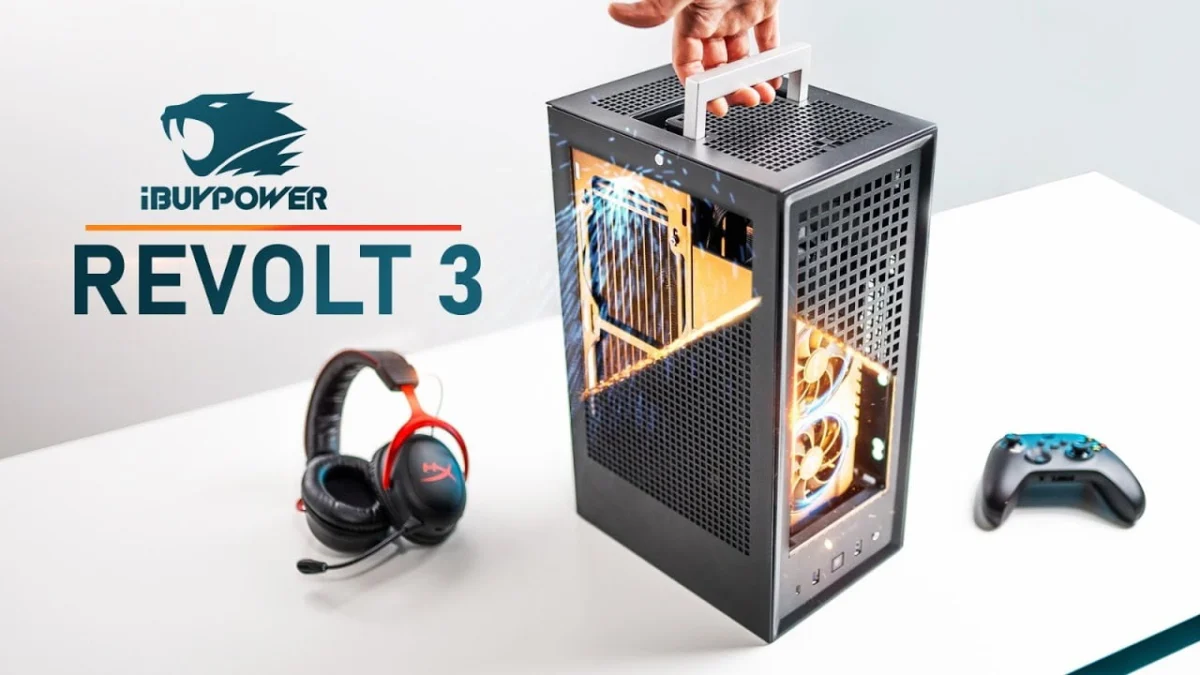
The custom PC building and prebuilt systems market is undergoing a structural shift toward space-saving footprints, prompting major hardware manufacturers to rethink traditional desktop configurations. Prominent high-end system builder iBUYPOWER has officially entered the standalone enthusiast chassis market with the development of the Revolt 3, an 18.4-liter vertical Mini-ITX enclosure. Originally unveiled as the "Revolt 3 MK3" at the Consumer Electronics Show (CES), the chassis has since shed its alphanumeric suffix and transitioned from a proprietary system-exclusive component to a dual-pronged commercial product. Slated for a tentative release window of July 2021, the Revolt 3 will be marketed both as a standalone hardware purchase and as the housing foundation for iBUYPOWER’s pre-built production and gaming ecosystems.
Evolution, Chronology, and Market Positioning
The trajectory of the Revolt 3 reflects a broader industry trend where major system integrators seek to diversify their revenue streams by offering standalone components directly to DIY (Do-It-Yourself) enthusiasts. When iBUYPOWER first teased the chassis at CES under the Revolt 3 MK3 moniker, industry analysts and hardware reviewers noted its distinct resemblance to vertically oriented, space-optimized towers like the NZXT H1 and the SSUPD Meshlicious.
Following positive initial feedback, the company elected to drop the "MK3" designation to streamline branding and initiated an open feedback loop with the PC building community regarding pricing tiers and aesthetic variants. By targeting a July 2021 commercial launch, iBUYPOWER aims to capitalize on the sustained global demand for compact gaming rigs capable of housing high-wattage components without the thermal throttling traditionally associated with small form factor (SFF) builds.
Dual Pricing and Configuration Strategy
One of the most consequential strategic decisions facing iBUYPOWER is the pricing and packaging structure of the Revolt 3. Consumer response during the prototype phase will dictate how the chassis enters the market. Two primary commercial models are currently under evaluation:
- The Standalone Chassis Option: Priced at approximately $90 USD, this configuration targets budget-conscious builders and enthusiasts who already possess an SFX or SFX-L power supply. It provides the core structural framework without bundled hardware, allowing users maximum flexibility over their component selection.
- The Bundled Power Supply Option: Priced at approximately $200 USD, this tier includes an 80-Plus Gold certified SFX-L power supply rated at 700 watts. This bundle features factory pre-routed, custom-length cables designed specifically for the chassis’s dimensions, substantially reducing cable management complexity for first-time SFF builders.
In addition to hardware bundles, iBUYPOWER has sought consumer consensus regarding the color scheme of the interchangeable front mesh panel. While traditional black and silver finishes offer seamless integration with standard desk aesthetics, alternative options such as gold introduce unique visual differentiation, albeit with varying degrees of color cohesion across the chassis ecosystem.
Engineering, Dimensions, and Spatial Architecture
With an internal volume of 18.4 liters, the Revolt 3 occupies a middle ground in the SFF landscape. It is visibly larger than ultra-compact footprints like the NZXT H1 and SSUPD Meshlicious, yet it maintains a slender, tower-oriented visual profile that minimizes desk footprint.
The structural design abandons tempered glass in favor of a 360-degree mesh ventilation layout, prioritizing thermal dissipation over internal visibility. All four exterior panels feature coarse, magnetic dust filters and utilize a tool-less removal mechanism, allowing for rapid disassembly and maintenance.
Ergonomics and Portability Features
Addressing the mobile demands of modern LAN-party attendees and hybrid workers, iBUYPOWER integrated a push-to-release retractable carrying handle into the top of the chassis. Engineered to support the full weight of a completed high-end system, the handle provides structural utility without compromising the clean lines of the upper panel. Additional ergonomic inclusions feature low-profile, retractable headphone holders housed on both lateral flanks of the tower, maximizing desk organization.
The rear I/O layout incorporates a pass-through power switch, eliminating the need to access the recessed power supply switch within the chassis interior. The front I/O panel is adequately equipped with dual USB 3.0 ports, a 4-pole headset audio jack, and a USB-C Gen 2 port. Notably, iBUYPOWER engineered a modular approach to the USB-C connectivity, allowing users to connect the port either via an external pass-through cable to the motherboard’s rear I/O or directly to an internal motherboard header by swapping out a dual-screw modular insert—a design flexibility rarely seen in competing SFF enclosures.
Internal Layout and Component Compatibility
The interior architecture of the Revolt 3 is purposefully engineered to maximize spatial efficiency while mitigating common SFF assembly hazards.
GPU and Motherboard Integration
The layout accommodates a triple-slot graphics card directly on the primary side of the enclosure. Crucially, the design eliminates the need for a PCIe riser cable. By mounting the GPU directly to the motherboard via standard orientation, iBUYPOWER circumvents the signal integrity hurdles, added cost, and potential black-screen issues frequently associated with PCIe Gen 4 riser cables in compact builds. The Mini-ITX motherboard is mounted beneath the power supply compartment with its I/O orientation directed downward.
Cooling and Radiator Support
Thermal management for the central processing unit is facilitated by a versatile, swivel-mounted radiator bracket. The bracket supports both 240mm and 280mm liquid cooling radiators, providing approximately 58mm of combined clearance for radiator and fan thickness. Alternatively, users may install standard CPU tower heatsinks up to 140mm in height.
Storage Configuration
Storage versatility is maintained through dedicated mounting points capable of housing up to two 2.5-inch solid-state drives behind the GPU chamber, alongside a single 3.5-inch mechanical hard drive slot positioned adjacent to the power supply unit. This upper chamber also serves as a practical routing zone for surplus cabling if mechanical drives are omitted.
Assembly Workflow and Cable Management
The assembly experience within the Revolt 3 varies depending on whether the builder utilizes the pre-bundled power supply. Factory-cut, custom-length cables significantly streamline the initial wiring process, eradicating the excess cable clutter typical of standard-length SFX power supplies. However, the use of dense, low-profile ribbon cables can introduce stiffness, making compression and concealment challenging within tight routing channels.
Prototype evaluations highlighted specific areas requiring refinement ahead of mass production:
- Radiator Bracket Stability: The pivoting radiator bracket lacks a mechanical locking mechanism in the open position, causing it to fall inward during pump block installation and liquid cooler maintenance.
- PSU Shroud Tolerances: The power supply cable cover exhibits a tendency to bulge outward under dense cable loads, encroaching slightly into the GPU chamber and impeding the seamless closure of the side panel. iBUYPOWER engineering teams have acknowledged this structural limitation, committing to reinforced shroud designs for production units.
- Top Exhaust Configuration: The removal of the top panel reveals dual mounting slots for 80mm auxiliary fans designed to assist with GPU exhaust. Alternatively, removing this bracket provides marginal clearance adjustments for oversized graphics cards.
Cooling Performance and Thermal Dynamics
Thermal performance in the Revolt 3 prototype demonstrates capable heat dissipation for graphics hardware, though CPU temperatures reflect the challenges of vertical tower thermodynamics. Because the primary CPU liquid cooling radiator functions as the primary exhaust mechanism for the enclosure, heat generated by the graphics card directly influences intake air temperatures across the radiator fins.
Furthermore, hardware analysts note that the coarse magnetic mesh filters, while effective at preventing large particulate ingress, act as a noticeable airflow restriction compared to the high-performance fine mesh utilized in larger mid-tower chassis. Optimization of filter density and minor adjustments to the internal hard drive cage positioning—which partially obstructs the upper radiator fan—represent key areas for potential thermal improvement in retail revisions.
Broader Industry Implications
The commercial introduction of the iBUYPOWER Revolt 3 underscores a significant evolution in how tier-one system integrators interact with the broader PC hardware component market. By translating proprietary pre-built chassis designs into standalone retail products, companies like iBUYPOWER are directly challenging established case manufacturers in the highly competitive Mini-ITX segment.
Priced competitively around $90 for the chassis alone or approximately $200 with an included 700W 80-Plus Gold SFX-L power supply, the Revolt 3 addresses longstanding consumer demands for cost-effective, riser-free vertical enclosures. While prototype-stage evaluations reveal necessary refinements regarding structural tolerances, cable routing rigidity, and thermal optimization, the core architecture establishes a strong foundation. As the July 2021 release date approaches, the reception of the Revolt 3 will likely serve as a litmus test for future component-level diversification strategies among high-end system builders.