







The laptop hardware market has long been dominated by established industry giants such as Dell, HP, ASUS, and MSI, leaving boutique manufacturers to carve out specialized niches for enthusiasts seeking maximum performance. Among these smaller competitors is Eluktronics, a brand that has consistently attempted to bridge the gap between custom-built boutique aesthetics and mass-market reliability. Following previous releases like the RP-15—which positioned itself as one of the fastest Ryzen-based laptops in its class—the company has expanded its portfolio with the introduction of the Prometheus XVII Ultra.
This 17-inch desktop replacement arrives during a turbulent period for the semiconductor industry, where high-end components remain scarce and consumer demand frequently outstrips manufacturing output. Named after the Greek titan associated with fire and paired with contemporary marketing terminology denoting elite status, the Prometheus XVII Ultra attempts to justify its heavy footprint and premium price tag through sheer computational and graphical throughput. By combining AMD Ryzen 5000H series mobile processors with high-wattage NVIDIA GeForce RTX graphics, Eluktronics targets a demographic of power users and competitive gamers who prioritize raw performance over slim portability.
Pricing, Configuration Tiers, and Market Availability
The global supply chain constraints affecting advanced semiconductors have significantly complicated the rollout of high-end gaming laptops, particularly those featuring AMD processors paired with flagship NVIDIA graphics. Eluktronics has navigated these challenges by fulfilling backorders incrementally, leading to occasional production delays driven by high consumer demand.
The entry-level tier for the Prometheus XVII Ultra begins at approximately $1,700 USD. This base configuration equips consumers with an older AMD Ryzen 7 4800H CPU, 16GB of system memory, a 512GB NVMe solid-state drive, and an NVIDIA GeForce RTX 3060 GPU. Stepping up to the next pricing tier requires an additional $400, which introduces a notable hardware shift by substituting the AMD processor with an Intel 10th Generation Core i7-10875H CPU paired with an RTX 3070 graphics card.
For buyers seeking the latest AMD architecture, an investment of $2,500 introduces the AMD Ryzen 7 5800H CPU alongside an NVIDIA GeForce RTX 3080 featuring 16GB of dedicated VRAM. The review configuration utilized for performance evaluations includes double the memory and storage capacity, elevating the total cost to approximately $2,800 USD. While this pricing places the machine firmly in the upper echelon of consumer laptops, it presents a compelling value proposition when compared directly against competing models utilizing equally high-wattage RTX 3080 implementations. Furthermore, Eluktronics incentivizes purchases of $2,500 or more by including a comprehensive gaming bundle consisting of a thick mouse pad, a lightweight gaming mouse, a gaming headset, and a 10-foot HDMI cable.
Design, Build Quality, and Chassis Architecture
From an aesthetic standpoint, the exterior of the Prometheus XVII Ultra maintains a restrained and minimalist profile. The chassis is constructed from a hybrid assembly of plastic and aluminum components, avoiding overly aggressive gamer-centric styling. For users seeking a customized appearance, Eluktronics offers an optional dbrand black matrix skin for an additional $10. Subtle RGB light bars embedded along the chassis edges provide customizable illumination via proprietary control software.
Measuring just under one inch in thickness, the 17-inch chassis requires a sizable backpack for transport. Weighing in at approximately six pounds, the device is firmly categorized as a desktop replacement rather than a portable workstation. The central hinge design, while functional, exhibits noticeable flex when the display is opened with a single hand, and minor chassis wobbling can be observed when the unit is used on an unreinforced surface. Because Eluktronics utilizes a chassis framework shared by other original design manufacturers (ODMs), the physical architecture lacks proprietary distinctiveness.
Keyboard Layout, Ergonomics, and Input Devices
Opening the laptop reveals a spacious interior layout that accommodates a full numeric keypad, a natural consequence of the 17-inch form factor. The keyboard features a rigid surface with minimal key wobble and precise travel distance, resulting in a tactile typing experience suitable for both prolonged typing sessions and high-intensity gaming. The key feedback closely mirrors industry benchmarks set by competing models such as the ASUS ROG Zephyrus G15.
However, the layout presents distinct ergonomic compromises. The arrow keys occupy the same physical footprint as standard alphanumeric keys, frequently leading to misinputs during navigation. Additionally, the numeric keypad omits a secondary Enter key, a deficiency that may frustrate professionals who rely heavily on data entry applications like Microsoft Excel. Illumination is handled by a single-zone RGB backlight system, offering adequate brightness for low-light environments but limited customization for advanced lighting profiles.
The integrated glass trackpad is exceptionally large, surpassing the dimensions found on competing machines like the Dell XPS 17. While the smooth glass surface facilitates seamless cursor navigation, palm rejection remains a persistent issue. Resting the right palm near the primary click areas frequently impedes window dragging operations. Although software options permit disabling the right half of the trackpad, this workaround severely diminishes usability and indicates a need for further firmware refinement. Furthermore, the distance between the palm rest edge and the primary keys may cause minor ergonomic strain for users with smaller hands.
Display Performance and Visual Specifications
The Prometheus XVII Ultra is offered with a single display option: a matte-finish IPS-type panel featuring a Quad HD (2560×1440) resolution and a 165Hz refresh rate. The native resolution provides sufficient screen real estate for multitasking without requiring aggressive UI scaling, striking an effective balance for a 17-inch mobile form factor.
Color accuracy testing indicates that the panel covers 99% of the sRGB color space, 76% of the Adobe RGB spectrum, and 79% of the DCI-P3 gamut. These metrics ensure adequate performance for casual content creation, photo editing, and gaming. However, relative to competing systems within the same price bracket, the color gamut coverage is somewhat constrained. Furthermore, peak luminance tops out at approximately 350 nits, which can limit visibility in brightly lit environments or outdoor settings.
Connectivity, Ports, and Expansion Options
The I/O port distribution is a notable strength of the Prometheus XVII Ultra, utilizing the left, right, and rear edges of the chassis to optimize cable management.
The left edge houses a single USB 3.1 Gen 2 Type-A port alongside separate 3.5mm audio jacks for headphones and microphones. The right edge provides two additional USB Type-A ports operating at the slower Gen 1 standard, accompanied by a full-size UHS-I SD card reader. The rear panel accommodates the proprietary power input, a gigabit Ethernet port, an HDMI 2.1 video output, and a USB Type-C port with DisplayPort passthrough capabilities. This rear-centric layout successfully reduces cable clutter around the user’s mouse hand during stationary desktop deployment.
Internal accessibility is facilitated by immediately accessible dual memory slots, both of which are populated in higher configurations. Storage expansion is supported by a primary NVMe M.2 slot alongside an additional secondary M.2 slot. The system also includes a hardware MUX switch, allowing users to bypass NVIDIA Optimus technology and route display signals directly through the discrete graphics processing unit for maximum frame rates.
Software Ecosystem and Performance Modes
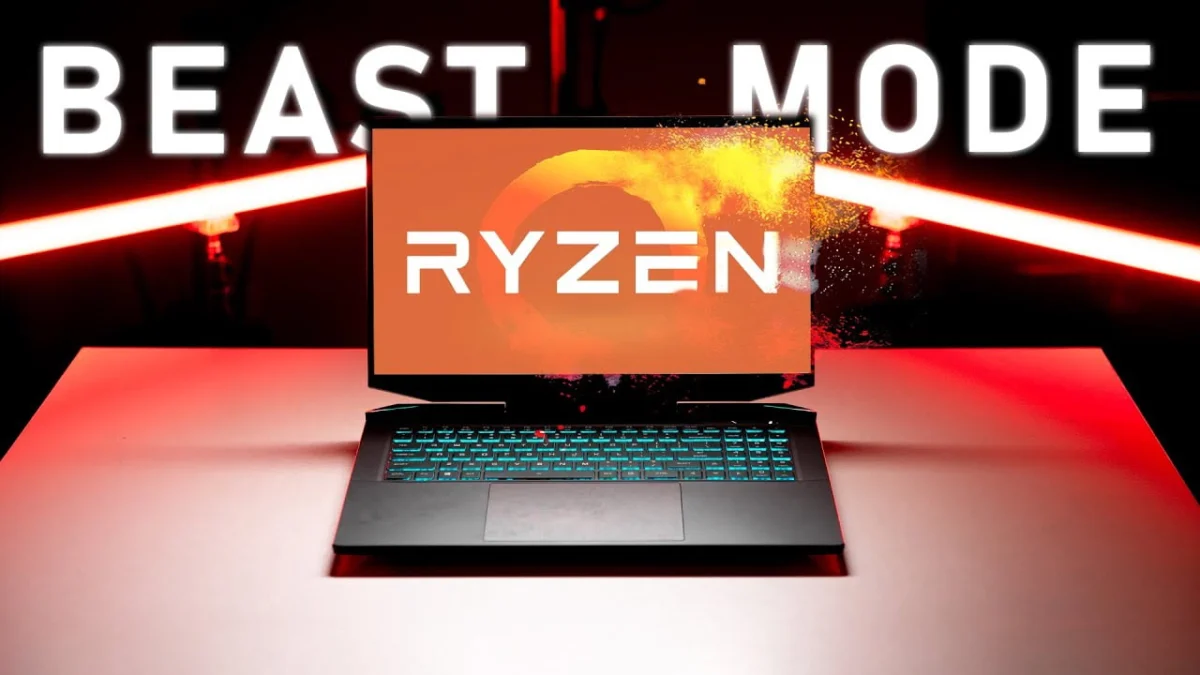
Eluktronics provides a proprietary control application designed to manage system power states, fan profiles, and hardware overclocking. The software offers three primary operational profiles: Office Mode, Balanced Mode, and Beast Mode.
Within Balanced and Beast modes, users can manually adjust CPU power targets up to 80 watts, modify GPU behavior, define custom fan curves, and toggle Dynamic Boost. Disabling Dynamic Boost allows the NVIDIA RTX 3080 GPU to draw up to 150 watts of power—a significant increase over standard mobile specifications. Despite the depth of manual control, the software interface can feel unintuitive and clunky when saving and switching user profiles, representing a regression in user experience compared to previous iterations seen in models like the RP-15.
Battery Life and Power Management
Given its 17-inch chassis, high-performance components, and a relatively modest 62Wh battery capacity, the Prometheus XVII Ultra yields constrained battery longevity. Even under light web browsing workloads in Office or Balanced modes, battery depletion occurs rapidly, reinforcing the machine’s classification as a desktop replacement rather than a portable mobile workstation. Activating Beast Mode yields similar results during low-load tasks, as power-saving states continue to govern baseline component frequencies when maximum performance is unneeded.
CPU Thermal Dynamics and Processing Benchmarks
System performance scales dramatically depending on the selected power profile. While Office Mode throttles processing capabilities to conserve energy and reduce thermal output, Balanced Mode and standard Beast Mode operate within a close 10-watt performance window. Maximizing the sliders in Beast Mode unlocks the processor’s highest power limits, though thermal constraints cause sustained power delivery to settle around 73 watts following initial processing bursts.
Under maximum load, the additional thermal energy generated by the overclocked CPU requires aggressive fan intervention, resulting in higher operating temperatures. Despite these thermal pressures, processing benchmarks reveal that the AMD Ryzen 7 5800H within the Prometheus trades blows closely with competing implementations like the ASUS ROG Zephyrus G15—which utilizes a higher-tier Ryzen 9 processor—while occasionally yielding to the older Eluktronics RP-15 in specific multi-threaded workloads.
GPU Power, Thermal Regulation, and Gaming Performance
The NVIDIA GeForce RTX 3080 graphics card benefits substantially from the software’s advanced power tuning. While standard configurations supply 135 watts, enabling Beast Mode with maximum sliders pushes power delivery to 150 watts.
Thermal monitoring indicates that the cooling solution manages heat dissipation effectively, keeping GPU temperatures well below the 87°C thermal threshold across all testing modes. However, empirical gaming benchmarks highlight diminishing returns when pushing power delivery to the absolute maximum. At native Quad HD resolution, the 150-watt RTX 3080 delivers superior frame rates compared to lower-wattage alternatives, yet it consumes approximately 50% more power than the RTX 3070 configuration found in the Razer Blade 15 Advanced, while yielding only a 15% increase in frame rates.
Acoustic performance scales predictably with the selected power mode. Office Mode remains nearly silent, while Beast Mode produces significant fan noise under heavy computational loads. For optimal acoustic comfort during extended gaming sessions, Balanced Mode provides the most favorable balance between fan noise and processing throughput.
Conclusion
The Eluktronics Prometheus XVII Ultra delivers exceptional raw processing and gaming performance, supported by an extensive I/O selection, a responsive keyboard, and granular software controls that empower advanced users to tune system parameters manually. However, these technical strengths are counterbalanced by notable compromises, including a generic chassis design, an oversized and inconsistent trackpad, a weak display hinge, mediocre built-in speakers, and subpar battery life.
For consumers whose purchasing decisions are dictated exclusively by raw gaming performance per dollar, the Prometheus XVII Ultra represents a viable, high-wattage desktop replacement. For users seeking a refined, cohesive everyday computing experience at a near-$3,000 price point, alternative market offerings may prove more compelling.