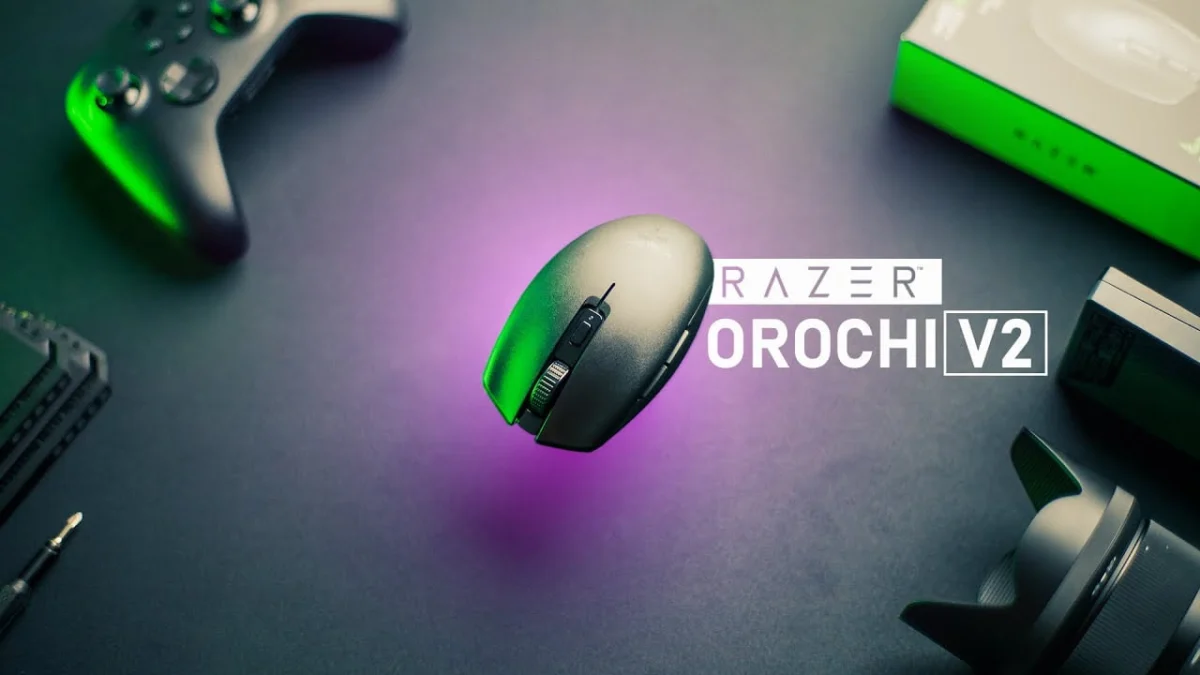
The peripherals market has long been dominated by a select few contenders in the budget and mid-range wireless gaming mouse category, but shifting consumer demands for lightweight agility, extended battery longevity, and dual connectivity have paved the way for new industry standards. Competing directly against established staples like the Logitech G305 and SteelSeries Rival 3 Wireless, Razer introduced the Orochi V2, a compact, high-performance peripheral engineered specifically to address the compromises typically associated with smaller form-factor mice. Priced competitively at $69 USD, the Orochi V2 enters the market attempting to bridge the gap between tournament-grade responsiveness and everyday utilitarian mobility.
Design and Build Quality: Rejecting the Perforation Trend
In an era where many manufacturers resort to honeycomb shells and hollow perforations to shed grams, Razer has taken a distinctly traditional approach with the Orochi V2. The mouse features a completely solid exterior shell constructed from durable, high-grade polymers designed to withstand rigorous daily use. Despite utilizing a removable top plate mechanism—engineered to facilitate custom aesthetics and internal battery access—the chassis exhibits exceptional structural integrity. Users experience virtually zero creaking, flexing, or unintended structural shifting under tight grips or aggressive flick movements.
Beneath the removable magnetic top cover, the internal layout reveals a thoughtfully organized compartment capable of housing both AA and AAA batteries. This dual-battery compatibility introduces a granular level of user customization, allowing gamers and productivity professionals to tailor the mouse’s overall weight and balance point. Inserting a standard AA lithium battery shifts the center of gravity slightly rearward, while a lighter AAA cell alters the weight distribution in favor of rapid, frictionless gliding. The battery slots are angled purposefully within the chassis, demonstrating meticulous engineering aimed at optimizing balance regardless of the power source selected.
Weight Distribution and Ergonomic Metrics
Weighing in at a remarkably light 58 grams without any internal battery installed, the Orochi V2 scales up to approximately 73 grams with a standard AA lithium battery, or roughly 69 grams when paired with a AAA alternative. For context, this places the Razer mouse in direct competition with ultra-lightweight alternatives such as the SteelSeries Aerox 3 Wireless (68 grams) and the Glorious Model O Wireless (71 grams), while undercutting the heavier Logitech G305, which typically weighs around 89 grams with an equivalent AA lithium power source.
The ergonomic profile of the Orochi V2 departs from ultra-miniature designs like the Razer Viper Mini, opting instead for a distinct hump at the rear, gentle thumb contours, and carefully sloped sides that accommodate ring and pinky fingers naturally. This contouring provides a familiar anchor point for users transitioning from symmetrical budget mice, fostering superior control during high-speed tracking and micro-adjustments. Furthermore, the inclusion of large, premium PTFE (polytetrafluoroethylene) feet on the underside ensures a smooth, consistent glide across various mouselab surfaces, reducing friction and minimizing wrist fatigue during extended operational sessions.
Connectivity Innovations and Multi-Device Support
Flexibility remains a core pillar of the Orochi V2’s architecture, highlighted by its dual-mode connectivity suite featuring both low-latency 2.4GHz Razer HyperSpeed wireless and standard Bluetooth. The inclusion of Bluetooth functionality enables seamless switching between a primary desktop rig equipped with a USB dongle and a portable notebook utilized for travel or office work.
A notable technological advancement integrated into the Orochi V2 is multi-device pairing via a single USB dongle. Standardized across select Razer peripherals, this feature allows users to operate both a compatible wireless keyboard and mouse through a single USB receiver, conserving valuable ports on modern ultrabooks and compact desktop hubs. While Razer notes that running multiple peripherals on a single transceiver can introduce marginal signal interference or stuttering in high-interference environments—making it less ideal for top-tier competitive esports—it represents a progressive step toward reducing peripheral clutter and streamlining desktop connectivity.
Sensor Precision and Mechanical Switch Longevity
At the heart of the Orochi V2 lies the Razer 5G Advanced Optical Sensor, capable of tracking up to 18,000 DPI. Operating with absolute precision, the sensor supports software-level adjustments through Razer Synapse, allowing users to customize lift-off distances down to 1mm from the default 2mm threshold. This adjustability caters directly to competitive players who frequently lift and reposition their mice during rapid target acquisition sequences.
To maximize operational runtime without sacrificing tactile feedback, Razer opted against utilizing optical switches—which are common in the brand’s flagship wired offerings—due to their higher power consumption. Instead, the Orochi V2 incorporates second-generation Razer mechanical switches (Green Kailh GM 4.0 switches), rated for an impressive 60 million clicks. These switches deliver a crisp, highly tactile actuation profile paired with a distinct, satisfying acoustic response. The mechanical scroll wheel further enhances utility, offering sharply defined steps that provide precise tactile feedback during weapon switching, document scrolling, or timeline manipulation in creative software.
Power Efficiency and Battery Longevity
One of the most compelling engineering achievements of the Orochi V2 is its exceptional power efficiency. Utilizing Bluetooth mode, the mouse is rated to deliver up to 950 hours of continuous operation on a single battery. When switching to the high-performance 2.4GHz HyperSpeed wireless mode, that endurance is roughly halved to approximately 425 hours—figures that comfortably surpass many industry competitors. Battery status monitoring is integrated directly into the Razer Synapse software suite, featuring customizable low-battery threshold notifications that alert users well in advance of power depletion, thereby eliminating unexpected mid-game disruptions.
Customization and Accessory Ecosystem
Expanding beyond performance metrics, Razer has introduced unique personalization options for the Orochi V2. For a $20 USD premium over the base $69 price point, consumers can order the mouse through the Razer Customs platform, choosing from a wide catalog of pre-built artist designs or configuring custom top plates with personalized color schemes and graphics. This direct-to-consumer customization model eliminates the need for aftermarket third-party skins.
Complementing the mouse is Razer’s introduction of universal grip tapes, available separately for approximately $10 USD. Designed to be cut and applied across various peripherals including mice, keyboards, and game controllers, these reusable grip tapes enhance friction and tactile security during intense gaming sessions. Users can strategically apply the textured strips along thumb rests, side panels, or main triggers to optimize grip stability without compromising the clean aesthetic of the hardware.
Broader Market Implications and Industry Standing
The release of the Razer Orochi V2 signifies a strategic maturation in the budget-to-mid-tier gaming peripheral segment. By addressing consumer demands for modular weight distribution, exceptional battery efficiency, dual-mode connectivity, and robust build quality without relying on perforated shells, Razer has established a formidable benchmark. Industry analysts note that products like the Orochi V2 pressure competing manufacturers to elevate the baseline specifications of entry-level wireless mice, ensuring that consumers no longer have to choose between portability, performance, and long-term durability. As wireless technology continues to narrow the latency gap with traditional wired configurations, versatile offerings such as the Orochi V2 demonstrate that high-performance gaming hardware is increasingly accessible to a broader demographic of users.