






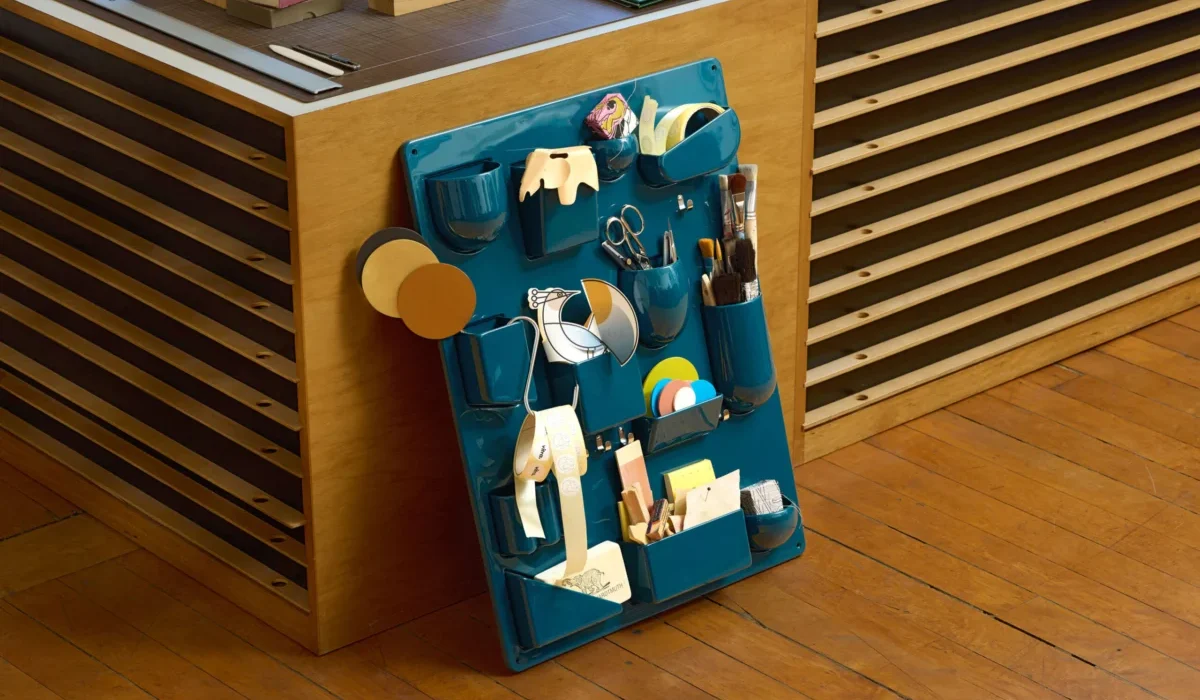
The intersection of mid-century industrial design and contemporary sustainable manufacturing has yielded a fresh aesthetic iteration of a classic storage icon. Designed originally in 1969 by German artist and designer Dorothee Becker, the iconic wall-mounted storage system known as the Uten.Silo is receiving a major palette expansion. Swiss furniture manufacturer Vitra has announced the introduction of six new, vibrant colorways for the Uten.Silo RE II, the more compact version of the legendary wall organizer.
Retailing at $485, the refreshed lineup introduces striking new hues—tangerine, golden olive, citron, lilac, petrol, and cashew—to a piece of domestic infrastructure that has spent over half a century organizing creative studios, modern kitchens, bathrooms, and corporate offices worldwide. This latest release builds directly upon Vitra’s recent operational transition toward closed-loop manufacturing processes, reinforcing the viability of pairing archival design classics with circular economy principles.
The Origins and Evolution of a Mid-Century Masterpiece
To understand the enduring significance of the Uten.Silo RE II, one must examine its genesis in the late 1960s. Dorothee Becker conceived the storage system during a period of rapid evolution in domestic and professional space management. As post-war industrial design embraced plastics, injection molding, and modularity, Becker identified a universal domestic friction point: the proliferation of small, miscellaneous objects that cluttered workspaces, kitchens, and entryways.
Introduced to the market in 1969, the original Uten.Silo was manufactured by Ingo Maurer’s design company, Design M, before eventually finding a permanent home in the catalog of Vitra. The system was revolutionary for its time due to its injection-molded ABS plastic construction, which featured an asymmetrical arrangement of pockets, bins, metal hooks, and clips. It was not merely a functional object; it was a sculptural relief for the wall. Users could store everything from stationery and scissors to tools, makeup, and correspondence.
Over the decades, the Uten.Silo achieved cult status among architects, designers, and interior enthusiasts. It bridged the gap between utilitarian hardware and expressive wall art. The design was produced in two primary sizes: the larger Uten.Silo I and the more spatially accommodating Uten.Silo II. Despite periods of discontinued production due to manufacturing shifts, the demand for authentic vintage models remained exceptionally high on the secondary art and design market, often commanding premium prices among collectors of 20th-century design.
Chronology of Sustainability: The Transition to Post-Industrial Plastic
The modern chapter of the Uten.Silo narrative represents a critical shift in how heritage design brands approach ecological responsibility. For decades, the production of ABS (acrylonitrile butadiene styrene) plastic relied entirely on virgin petrochemical stocks. However, shifting global environmental standards, corporate sustainability mandates, and consumer demand for circular products prompted Vitra to reevaluate its manufacturing pipeline.
In 2025, Vitra executed a major manufacturing pivot by modifying its production process for the Uten.Silo RE series, successfully transitioning the material composition entirely to recycled post-industrial ABS plastic. This shift meant that waste generated during the manufacturing of other plastic goods was collected, reground, and repurposed to mold the structural body of the Uten.Silo.
Following this technical milestone, the brand initially rolled out conservative color options to test market reception and verify the color-fastness and structural integrity of the recycled polymer. Having successfully proven the durability of the post-industrial material, Vitra has now unlocked the ability to introduce complex, highly saturated pigment formulations. The 2026 expansion into tangerine, golden olive, citron, lilac, petrol, and cashew marks the first major color overhaul of the recycled series, proving that sustainable manufacturing compromises neither chromatic brilliance nor structural performance.
Design Anatomy and Functional Versatility
The enduring appeal of the Uten.Silo RE II lies in its meticulous spatial geometry. Measuring significantly more compact than its predecessor, the Uten.Silo I, the RE II model is specifically engineered to fit into tighter architectural footprints—making it an ideal intervention for compact urban apartments, streamlined home offices, and minimalist culinary spaces.

The wall unit features a textured, injection-molded plastic panel outfitted with a diverse array of organizational appendages:
- Deep pockets for notebooks, brushes, and bulkier tools
- Shallow trays for paper clips, erasers, and small accessories
- Metal hooks and clips designed to suspend keys, scissors, tape measures, and hanging items
- Molded recesses that act as catch-alls for daily pocket detritus
By elevating small-item storage off desks and countertops and onto vertical wall planes, the Uten.Silo acts as an organizational clearinghouse. Its installation transforms dead wall space into an interactive, highly visible dashboard of daily essentials. The newly introduced colorways—ranging from the energetic warmth of tangerine and citron to the grounding depth of golden olive, petrol, cashew, and the contemporary softness of lilac—allow the functional object to double as a statement piece of wall art.
Industry Implications and Market Analysis
Design historians and furniture industry analysts point to the continued evolution of the Uten.Silo as a case study in how heritage brands can future-proof their archival catalogs. In an era where consumers are increasingly critical of fast furniture and disposable goods, iconic designs built from durable, high-quality materials carry immense market value.
By shifting to 100% post-industrial recycled ABS plastic, Vitra accomplishes two critical objectives:
- It reduces the carbon footprint and virgin plastic dependency associated with producing a heavy, injection-molded polymer product.
- It aligns a 1960s artifact with modern circular economy frameworks, ensuring compliance with tightening European and global environmental regulations regarding industrial waste and material traceability.
Furthermore, the introduction of a sophisticated, trend-conscious color palette demonstrates a keen understanding of contemporary interior design movements. Modern interiors frequently oscillate between neutral, earthy tones and targeted, high-impact chromatic accents. Hues like golden olive and cashew cater to the ongoing demand for biophilic, grounding earth tones, while tangerine, citron, lilac, and petrol appeal to maximalist, color-blocked, and expressionist spatial design trends.
At a price point of $485, the Uten.Silo RE II occupies a unique market segment. It sits firmly within the tier of investment-grade design objects—accessible enough for design-conscious consumers looking to elevate a workspace or kitchen, yet robust and historically significant enough to be considered a functional collector’s item.
Broader Impact on the Future of Sustainable Vitra Production
The successful material transition and color expansion of the Uten.Silo RE II signal a broader trajectory for Vitra’s extensive catalog of mid-century classics. As chemical recycling technologies and post-industrial supply chains mature, design houses are under mounting pressure to audit their legacy portfolios. Consumers and institutional buyers alike now expect transparency regarding material sourcing, product longevity, and end-of-life recyclability.
By demonstrating that recycled post-industrial plastics can achieve the same rigorous structural tolerances, surface finishes, and vibrant pigmentation as virgin materials, Vitra has established an internal benchmark for future material conversions. The lessons learned from re-engineering the Uten.Silo’s injection-molded framework are expected to inform the ongoing manufacturing updates of other plastic-intensive icons within the brand’s archive.
Ultimately, the 2026 iteration of Dorothee Becker’s creation bridges a 57-year gap between the optimistic, plastic-pioneering design era of the late 1960s and the ecological consciousness of the 21st century. It proves that thoughtful design, when paired with adaptive manufacturing and a willingness to evolve, can remain not only relevant, but essential to the way humans inhabit and organize their living and working environments.
The refreshed Uten.Silo RE II lineup, featuring the complete spectrum of new colorways, is available for purchase directly through authorized retailers and the official Vitra website.