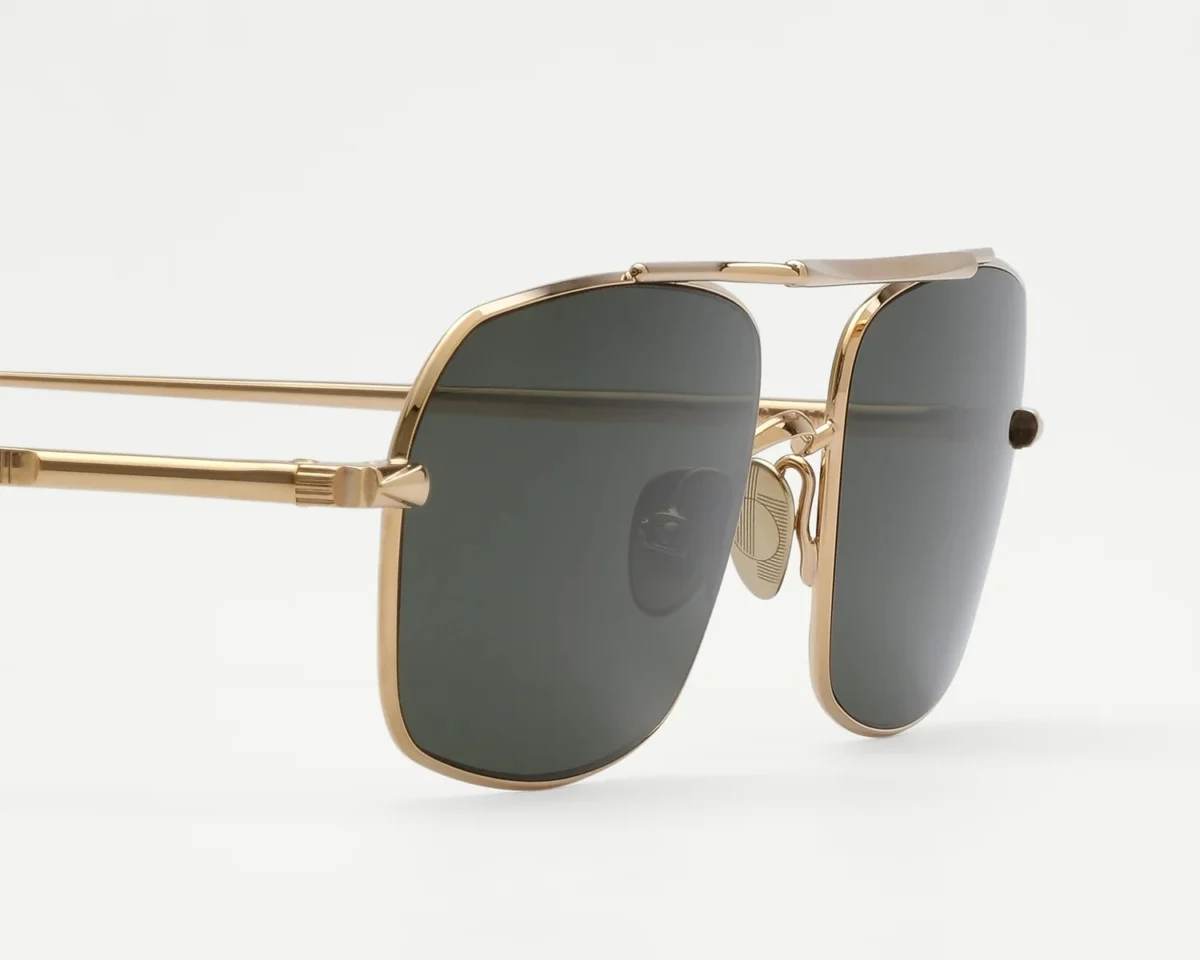
In an industry long dominated by the ubiquitous deployment of titanium, stainless steel, and acetate, independent luxury eyewear label Ahlem has chosen to look backward to move forward. The Los Angeles-based design house, celebrated for its architectural precision and Parisian manufacturing heritage, has officially announced the incorporation of bronze into select silhouettes within its Fall Winter 2026 collection, titled "Echoes of Love." By integrating bronze alloy exclusively into the temples of frames such as the Trévise, Ahlem is attempting to reintroduce a warm, historically rich metal to the contemporary optical landscape, marrying classical metallurgy with modern aesthetic restraint.
Handcrafted by master artisans in Oyonnax, France—a region globally renowned for its centuries-old optical manufacturing traditions—the new bronze-accented styles represent a deliberate pivot in material sourcing. While titanium has rightfully earned its reputation for strength-to-weight ratios and stainless steel for industrial utility, bronze offers a distinct tactile and visual warmth that changes over time through natural patina. This material evolution is underscored by meticulous surface treatments, including the application of palladium and 22-karat gold electroplated finishes, ensuring that the frames maintain a lustrous, high-end appeal while benefiting from the unique structural integrity of the copper-tin alloy.
Main Facts and Design Specifications
The flagship style anchoring this material shift is the Trévise, a frame that exemplifies Ahlem’s obsessive commitment to micro-detailing. Upon close inspection, the bronze temples reveal intricate design elements that distinguish artisanal eyewear from mass-market production. Laser-engraved filigree snakes across the length of the temple, a technique requiring immense precision to avoid compromising the structural gauge of the metal. Further down the architecture of the frame, wearers will encounter bespoke staircase detailing etched into the temple tips, providing both a visual rhythm and a subtle grip.
Central to the structural identity of the collection is a proprietary hinge system, ingeniously engineered around Ahlem’s recurring design motifs: the circle and the triangle. This mechanical component is not merely ornamental; it is designed for longevity, providing a seamless transition between the front chassis and the articulated bronze temples. Comfort has not been sacrificed for the sake of avant-garde design. The frames are fitted with lightweight titanium nosepads, selected for their hypoallergenic properties, durability, and resistance to environmental corrosion.
For consumers seeking a bespoke level of personalization, Ahlem has expanded its optical services. Beyond the brand’s standard suite of optical and sun lenses, buyers can access an extensive library of custom tint options for an additional $100 fee. This allows for precise color-matching and personalization, aligning with the brand’s philosophy of understated, individualized luxury. The Trévise and its companion pieces in the "Echoes of Love" lineup are currently available via the brand’s official e-commerce platform and select high-end optical boutiques, retailing at $660.
Chronology and Background of the Brand
Founded by Ahlem Manai-Platt, the brand has steadily carved out a distinct niche in the global eyewear market since its inception. Manai-Platt, drawing inspiration from her upbringing in Paris and her subsequent life in Los Angeles and New York, established the label with a singular vision: to create timeless optical designs that reject transient trends in favor of architectural permanence.
The trajectory of the company has been marked by a deliberate, measured expansion. Rather than relying on massive licensing agreements or automated mass-production facilities, Ahlem partnered early on with multi-generational workshops in France. This commitment to artisanal production means that every frame undergoes upwards of 50 distinct manufacturing steps, a process that can take several weeks per piece.
Over the past decade, the luxury eyewear sector has witnessed a bifurcated market. On one end, massive conglomerates control a vast portfolio of designer brands, utilizing standardized manufacturing pipelines. On the other, independent creators like Ahlem have thrived by championing heritage techniques, premium raw materials, and transparent supply chains. The introduction of bronze in 2026 is the latest milestone in a continuous material exploration by the brand, following previous experiments with vintage-inspired acetate thicknesses, ruthenium platings, and raw titanium finishes.

Supporting Data and Industry Context
The global luxury eyewear market has experienced robust and steady growth, projected to surpass tens of billions of dollars over the decade. Within this market, the independent segment—often referred to as "indie optics"—accounts for a rapidly increasing share of consumer expenditure, particularly among discerning buyers who prioritize craftsmanship over visible logo branding.
Material innovation remains one of the primary drivers of consumer interest in the premium and luxury tiers. According to industry analyses, while titanium continues to command the largest market share for metal frames due to its lightweight properties and medical-grade durability, there is a rising consumer appetite for alternative metallic finishes that offer emotional resonance and aesthetic differentiation. Bronze, historically utilized in sculpture, coinage, and architectural hardware, has rarely been deployed in contemporary optical frames due to the technical challenges of working with the alloy at micro-scales—specifically managing weight distribution and skin-contact oxidation. Ahlem’s engineering solution—reserving the bronze exclusively for the temples while employing lightweight titanium for the nosepads—successfully mitigates these traditional design hurdles, proving that historical metals can be adapted for all-day modern wear.
Official Responses and Design Philosophy
While independent luxury labels rarely issue conventional corporate statements, the design philosophy articulated by Ahlem Manai-Platt through her collections speaks volumes about the brand’s market positioning. In past interviews and brand briefs, Manai-Platt has emphasized that eyewear should function as an extension of one’s personality and facial architecture, rather than an ephemeral fashion accessory.
Industry insiders and high-end opticians have responded positively to the "Echoes of Love" collection. Independent retail partners note that consumers are increasingly fatigued by homogenous metallic frames stamped out in overseas factories. The introduction of hand-finished bronze with 22k gold and palladium plating directly addresses this consumer fatigue, offering a tangible sense of value and tactile luxury that justifies the $660 price point. By focusing on the interplay between heavy, historic metals and lightweight, modern engineering, Ahlem has managed to capture the attention of both traditionalists and avant-garde collectors.
Broader Impact and Market Implications
The launch of Ahlem’s bronze-temple frames carries several implications for the broader independent eyewear landscape. First, it challenges competing independent designers to look beyond the standard palette of titanium, monel, and acetate. As consumers become more educated about material sciences and manufacturing origins, brands that can successfully innovate with unconventional metals will likely capture disproportionate mindshare in the luxury sector.
Second, the integration of high-end finishes—such as 22k gold electroplating and laser-engraved filigree—signals a return to maximalist detailing executed with minimalist discipline. In an era where digital-first direct-to-consumer brands have popularized minimalist, sometimes sterile wire-frame glasses, Ahlem’s approach demonstrates that consumers are still willing to invest in rich, textured surfaces that reward close inspection.
Finally, the geographical anchoring of the production process in France reinforces the resilience and relevance of traditional European manufacturing hubs. Amid global supply chain uncertainties and rising material costs, Ahlem’s dedication to small-batch, artisanal creation serves as a blueprint for how independent design houses can maintain quality control while continuing to push aesthetic and material boundaries.
As the "Echoes of Love" collection gains traction in boutiques worldwide, the inclusion of bronze may well spark a broader trend across the independent optical community, encouraging other designers to re-examine the periodic table for materials long left behind in favor of industrial efficiency. For Ahlem, however, the move is less about following a trend and more about cementing a legacy of timeless, uncompromising design.