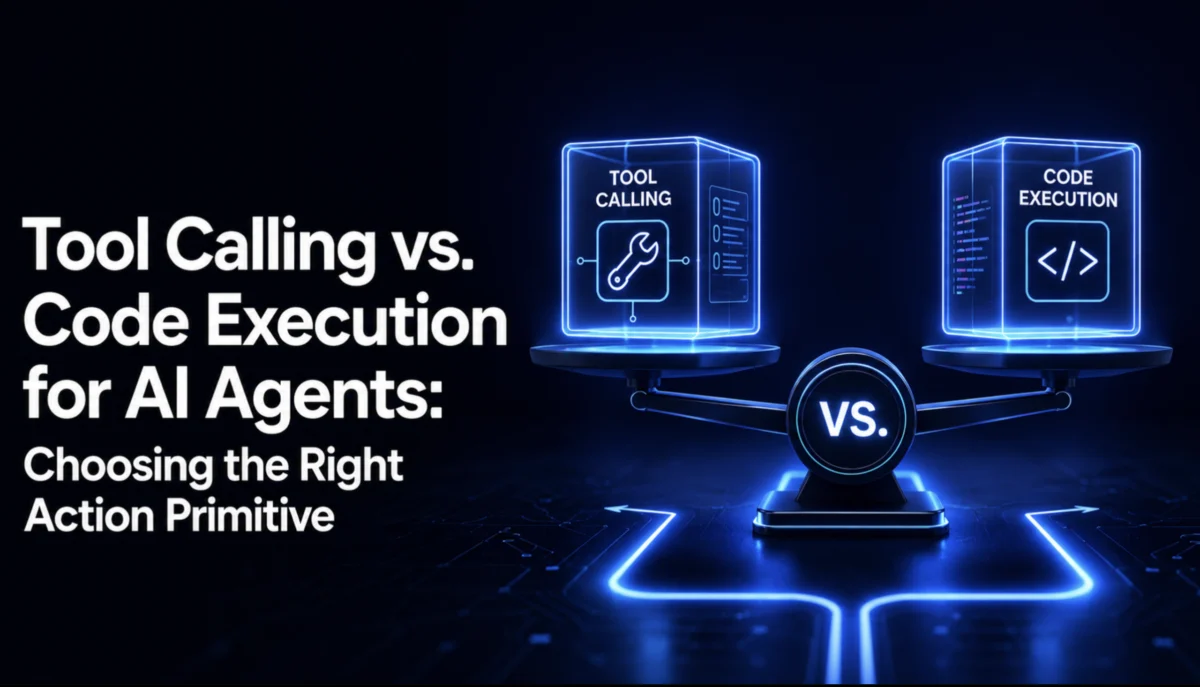
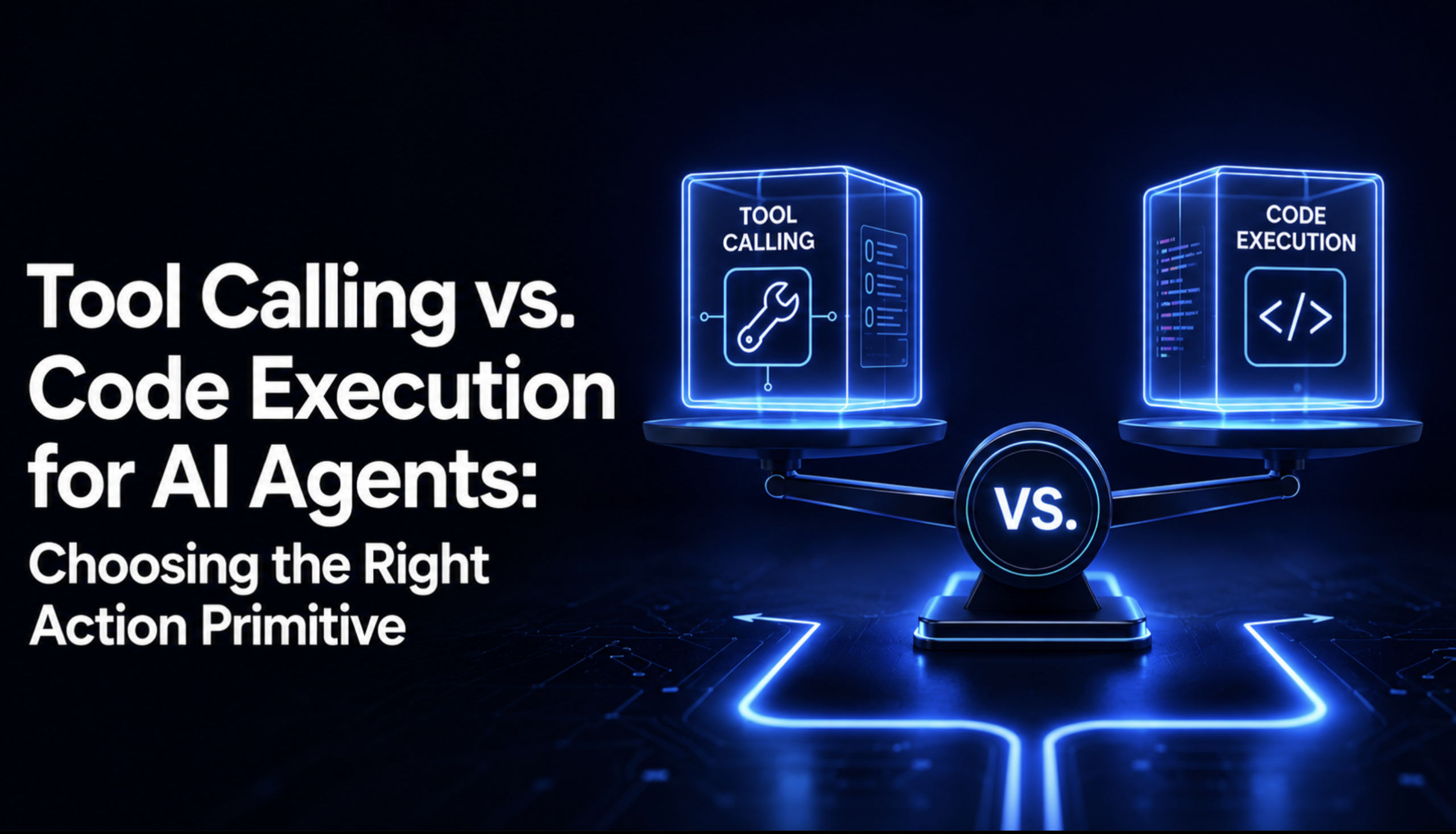
The rapid maturation of autonomous artificial intelligence agents has shifted the engineering focus from basic prompt optimization to foundational architectural mechanics. As enterprise applications demand greater autonomy, reliability, and scale, developers face a critical design choice when enabling models to interact with external systems: whether to rely on traditional tool calling or advanced programmatic code execution. While both approaches serve as core action primitives—the foundational mechanisms by which large language models (LLMs) translate decisions into real-world database writes, API queries, or file reads—their underlying engineering profiles differ fundamentally. These differences carry measurable implications for latency, operational cost, context pollution, and task accuracy.
The Core Architectural Divide: Mechanics and Context Management
To understand the divergence between these two approaches, one must examine how models process actions mechanically. In standard tool calling, which has served as the industry default since the widespread adoption of function calling APIs, a language model generates a structured, constrained request in formats such as JSON. A host application intercepts this output, pauses text generation, parses the payload against a strict schema, executes the backend operation, and feeds the returned result directly back into the conversation history. Every intermediate action remains fully visible to the model, forming a linear, auditable, step-by-step reasoning loop.
Conversely, code execution represents a paradigm shift inspired by software engineering principles. Rather than constraining the model to output a single parameter set at a time, frameworks leveraging code execution provide the model with a sandboxed programming environment (typically running Python or TypeScript). The model writes a complete script—incorporating loops, conditionals, and error-handling routines—that can invoke multiple tools in parallel or sequence internally.
Crucially, the intermediate data generated during script execution stays within the isolated sandbox. Only the final aggregated output returns to the model’s primary context window. This architectural distinction addresses a severe limitation of early agent designs: context window bloat. When an agent attempts to aggregate data across dozens of entities—such as calculating travel budget variances for hundreds of employees or querying weather forecasts across global metropolitan areas—traditional tool calling forces thousands of raw line items through the model’s context. This drives up token consumption, increases API latency, and introduces cognitive friction that frequently degrades task accuracy.
Chronology and Evolution of Agent Primitives
The development of programmatic tool utilization has accelerated significantly over the past 24 months, driven by prominent research initiatives and commercial infrastructure releases:
- February 2024: Researchers published the foundational CodeAct paper (Wang et al.), demonstrating that agents utilizing executable code rather than constrained JSON tool calls achieved up to a 20% higher success rate on complex, multi-step benchmark tasks. This research laid the academic groundwork for treating tools as a code API.
- Late 2024: Leading AI engineering labs began experimenting with Model Context Protocol (MCP) integrations, utilizing code execution patterns to drastically compress data pathways. Early deployments showcased extreme reductions in token overhead—such as a documented 98.7% drop in token usage during complex document-to-database workflows.
- November 2025: Anthropic formalized these capabilities with the release of Advanced Tool Use and Programmatic Tool Calling. By introducing the
allowed_callersparameter and native code execution tools, developers gained the ability to permit models to invoke specific functions from within sandboxed scripts safely. - 2026 and Beyond: Industry consensus has evolved past viewing these primitives as mutually exclusive. Modern enterprise agent deployments increasingly adopt hybrid architectures, pairing single-shot tool calls for immediate lookups with programmatic code execution for heavy analytical aggregation.
Quantitative Impact: Cost, Latency, and Accuracy Metrics
Comparative benchmarking across standardized agent evaluations reveals stark performance variances between tool calling and code execution. Internal benchmarks reported during the rollout of advanced programmatic tooling indicated that average token consumption on complex research tasks dropped from 43,588 tokens to 27,297 tokens—representing a 37% overall reduction in compute overhead.
Beyond cost optimization, accuracy metrics demonstrate a clear advantage for code-based orchestration. On the GAIA benchmark, agent success rates rose from 46.5% to 51.2% when transitioning complex computational workflows to programmatic execution. Internal knowledge retrieval accuracy similarly improved from 25.6% to 28.5%. Analysts attribute these gains to offloading arithmetic, filtering, and sorting operations to deterministic code execution environments, thereby eliminating the hallucination risks inherent when LLMs attempt to perform multi-variable comparisons mentally across lengthy context histories.
Strategic Framework: When to Deploy Each Primitive
Enterprise engineering teams must evaluate specific operational parameters when designing agent workflows to determine the appropriate action primitive:
- Task Complexity and Scale: Single-shot queries—such as fetching the current temperature for a single location—strongly favor traditional tool calling. The overhead of spinning up a sandboxed environment provides no benefit for a single lookup. Conversely, tasks involving fan-out queries, large-scale data aggregation, or iterative filtering require the scalability of code execution.
- Data Sensitivity and Payload Size: When workflows process extensive text transcripts, large datasets, or sensitive Personally Identifiable Information (PII), routing raw payloads through the model’s context introduces security risks and context pollution. Keeping large intermediate data structures isolated within an execution sandbox mitigates these concerns.
- Auditability and Debugging: Traditional tool calling excels in environments requiring strict, discrete event logging. Every individual tool invocation produces a clear, auditable transaction log with distinct arguments and responses. Debugging a complex script generated dynamically by a model during an unexpected failure state presents a significantly more challenging diagnostic task.
- Infrastructure Maturity: Deploying code execution safely requires robust sandboxing infrastructure to prevent arbitrary code execution vulnerabilities. Organizations lacking secure execution runtimes often experience higher operational friction compared to teams utilizing standard API-based function calling.
Industry Implications and the Hybrid Future
The convergence of code execution and tool calling signals a maturing engineering discipline within artificial intelligence deployment. Rather than signaling a complete replacement of older paradigms, the industry has embraced a pragmatic, hybrid methodology. Leading production agents utilize standard tool calling for fast, deterministic, single-turn interactions while dynamically escalating to programmatic code execution when computational demands, data volume, or analytical complexity dictate the need for sandboxed orchestration. As enterprise software increasingly integrates autonomous agents into critical business operations, mastering the strategic selection of these action primitives will remain a foundational differentiator for system architects and developers worldwide.