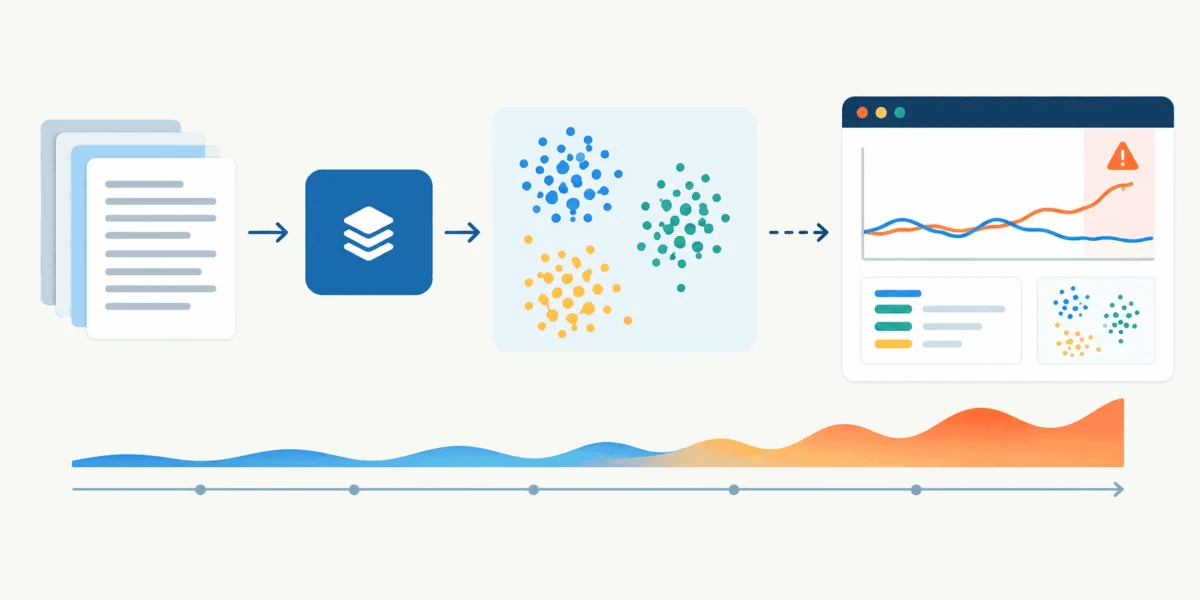
Deploying a large language model (LLM) into a production environment is rarely the final milestone of an artificial intelligence initiative. As digital ecosystems evolve and user demographics shift, the real-world data consumed by these models undergoes continuous transformation. Unlike traditional software applications where code rot is the primary operational hazard, production LLMs face a more subtle and insidious challenge: data drift. Because modern language architectures rely heavily on converting unstructured text into high-dimensional numerical representations—commonly referred to as embeddings—any change in user intent, vocabulary, or topical focus can quietly degrade model performance. Detecting and mitigating this phenomenon, specifically known as embedding drift, has rapidly emerged as a core competency for enterprise machine learning operations (MLOps) teams.
Understanding the Mechanics of Embedding Drift
To appreciate the gravity of embedding drift, one must first examine how production LLMs interact with data. When a user inputs a query or document into an LLM-powered application, the text is passed through an encoder or embedding model. This process maps semantic meaning into a dense vector space, typically spanning hundreds or even thousands of dimensions. Subsequent downstream tasks—such as semantic search, Retrieval-Augmented Generation (RAG), vector database retrieval, and classification—rely entirely on the geometric relationships within this vector space.
In an ideal deployment, the statistical distribution of these production embeddings closely mirrors the baseline distribution established during the training or initial indexing phase. However, real-world events, emerging slang, seasonal trends, and shifts in business focus inevitably alter the incoming data stream. Traditional statistical drift detection metrics, which were engineered for low-dimensional tabular data, routinely fail when applied to high-dimensional embeddings due to the curse of dimensionality. Consequently, organizations require specialized methodologies designed to monitor vector spaces effectively without imposing unsustainable computational overhead.
Core Techniques for Production-Grade Drift Detection
Industry practitioners generally rely on three primary methodologies to track embedding degradation in live environments: domain classification, centroid distance tracking, and density-based anomaly detection. Each approach offers a distinct balance between computational complexity and analytical depth.
The first technique, often called a domain classifier or adversarial validation approach, trains a lightweight machine learning model—such as a random forest or logistic regression classifier—to distinguish between baseline reference data and newly incoming production data. If the classifier achieves high predictive accuracy, measured via metrics like the Receiver Operating Characteristic Area Under the Curve (ROC-AUC), it signifies that the underlying distributions have diverged significantly.
The second method involves tracking the "center of mass" or centroid of the embedding distributions. By calculating the mean vector for both the baseline dataset and the production dataset, engineers can compute the distance—frequently using cosine distance—between these two central points. While computationally efficient, this method sacrifices micro-level nuance, as compressing high-dimensional distributions into a single point can mask multi-modal shifts or structural changes in the data.
The third strategy involves evaluating nearest-neighbor distances and localized density estimations, which help identify subtle shifts in sub-topics even when the overall global centroid remains relatively stable.
Simulating Vector Space Divergence
To establish a mathematical foundation for these detection strategies, practitioners frequently utilize simulation frameworks within standard data science libraries like scikit-learn. By generating synthetic reference embeddings and comparing them against a production set intentionally shifted along a specific mean, teams can validate their alerting thresholds before deployment.
Consider a standard scenario involving 384-dimensional embeddings, mirroring the typical output of widely adopted sentence-transformer models. By initializing a reference matrix from a standard normal distribution and introducing a mean shift to simulate an emerging topic or altered user behavior, engineers can construct a testbed for automated monitoring.
import numpy as np
from sklearn.ensemble import RandomForestClassifier
from sklearn.model_selection import train_test_split
from sklearn.metrics import roc_auc_score, cosine_distances

# Set random seed for reproducibility
np.random.seed(42)
n_samples = 500
n_features = 384

# 1. Reference Embeddings (Baseline / Training Data)
X_reference = np.random.normal(loc=0.0, scale=1.0, size=(n_samples, n_features))

# 2. Production Embeddings (New Data with a simulated shift)
X_production = np.random.normal(loc=0.3, scale=1.0, size=(n_samples, n_features))

# Assign domain labels: 0 for reference, 1 for production
y_reference = np.zeros(n_samples)
y_production = np.ones(n_samples)

X_combined = np.vstack((X_reference, X_production))
y_combined = np.hstack((y_reference, y_production))

# Split into training and testing subsets
X_train, X_test, y_train, y_test = train_test_split(
    X_combined, y_combined, test_size=0.3, random_state=42
)

# Train a lightweight Random Forest domain classifier
drift_classifier = RandomForestClassifier(n_estimators=50, max_depth=5, random_state=42)
drift_classifier.fit(X_train, y_train)

# Evaluate via ROC-AUC
y_pred_proba = drift_classifier.predict_proba(X_test)[:, 1]
roc_auc = roc_auc_score(y_test, y_pred_proba)
print(f"Domain Classifier ROC-AUC Score: roc_auc:.3f")

if roc_auc > 0.65:
    print("ALERT: Significant embedding drift detected! Trigger retraining/review pipeline.")
else:
    print("System stable: Distributions are sufficiently similar.")
When executed, this simulation typically yields a high ROC-AUC score, such as 0.970, immediately triggering the alert mechanism. This indicates that the domain classifier can effortlessly differentiate between the baseline data and the incoming production stream, confirming that a structural shift has occurred.
Evaluating the Centroid Distance Method
As an alternative or supplementary check, organizations often compute the cosine distance between the centroids of the two datasets. This approach provides a rapid scalar measurement of how far the aggregate semantic center has moved.
# Calculate the centroid (mean vector) for both batches
centroid_ref = np.mean(X_reference, axis=0).reshape(1, -1)
centroid_prod = np.mean(X_production, axis=0).reshape(1, -1)

# Calculate the distance (1 - Cosine Similarity) between the two centroids
distance = cosine_distances(centroid_ref, centroid_prod)[0][0]
print(f"Centroid Cosine Distance: distance:.4f")

threshold = 0.05
if distance > threshold:
    print("ALERT: Centroid distance exceeded threshold! System drifting.")
else:
    print("System stable: Centroids are aligned.")
While synthetic testing provides clear boundaries, real-world deployment requires processing genuine text data through integrated MLOps frameworks.
Practical Implementation with Scikit-LLM and Sentence Transformers
Integrating drift detection into a live pipeline often involves combining text vectorization libraries with Python machine learning stacks. Utilizing tools such as the sentence-transformers library alongside integration frameworks like Scikit-LLM allows developers to process real-world text inputs and monitor semantic stability continuously.
To illustrate this in a production-aligned context, consider an enterprise customer support system initially populated with standard administrative queries, which subsequently experiences an influx of inquiries regarding digital assets and cryptocurrency systems.
from sentence_transformers import SentenceTransformer
import numpy as np
from sklearn.ensemble import RandomForestClassifier
from sklearn.model_selection import train_test_split
from sklearn.metrics import roc_auc_score, cosine_distances

# Initialize a lightweight local vectorizer model
vectorizer = SentenceTransformer('all-MiniLM-L6-v2')

# Define baseline support queries and drifting production texts
texts_reference = [
    "How do I reset my password?",
    "Where is the billing menu?"
] * 100

texts_production = [
    "The new cryptocurrency system is failing",
    "How to mint an NFT on the platform?"
] * 100

# Convert raw text into numerical embeddings
X_reference = vectorizer.encode(texts_reference)
X_production = vectorizer.encode(texts_production)

# Prepare dataset for domain classification
y_reference = np.zeros(len(X_reference))
y_production = np.ones(len(X_production))

X_combined = np.vstack((X_reference, X_production))
y_combined = np.hstack((y_reference, y_production))

X_train, X_test, y_train, y_test = train_test_split(
    X_combined, y_combined, test_size=0.3, random_state=42
)

clf = RandomForestClassifier(n_estimators=50, max_depth=5).fit(X_train, y_train)
roc_auc = roc_auc_score(y_test, clf.predict_proba(X_test)[:, 1])
print(f"ROC-AUC Score: roc_auc:.3f")

if roc_auc > 0.65:
    print("DRIFT DETECTED! User queries have changed topic.")
else:
    print("System stable: Embeddings are consistent.")
When evaluated against text data with distinct topical divergence, the classifier achieves a maximum ROC-AUC score of 1.000, confirming that the operational environment has shifted away from the original training baseline. Applying the centroid distance metric to these same sentence embeddings yields similarly definitive results, with high cosine distances flagging the systemic transition from basic IT support topics to financial technology discussions.
Operational Implications and Broader Industry Impact
The necessity of monitoring embedding drift extends far beyond academic interest; it directly impacts enterprise ROI, user experience, and system reliability. When vector databases used in RAG architectures experience unmonitored drift, retrieval precision plummets. Consequently, LLMs receive irrelevant or outdated context, leading to hallucinations, inaccurate customer support resolutions, and degraded conversational quality.
Furthermore, automated drift detection enables proactive MLOps engineering. Rather than waiting for end-users to report system failures or inaccurate outputs, organizations can configure automated triggers that initiate vector database re-indexing, prompt engineering updates, or targeted model fine-tuning the moment semantic divergence crosses predefined statistical thresholds.
As artificial intelligence systems continue to transition from experimental deployments to mission-critical enterprise infrastructure, rigorous monitoring of internal representations like embeddings will remain a foundational pillar of reliable software engineering. By implementing robust domain classifiers and distance-tracking protocols, engineering teams can ensure their production LLMs remain aligned with the dynamic realities of their user base.