










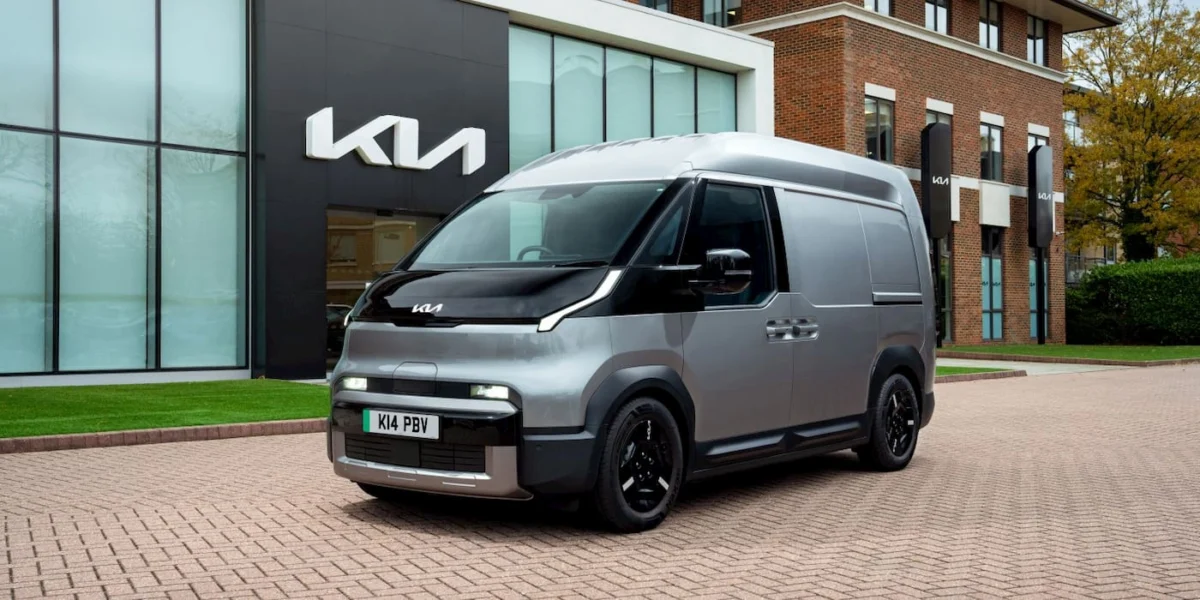
Kia has officially opened order books in the United Kingdom for two highly anticipated additions to its commercial electric vehicle lineup: the PV5 Chassis and the PV5 Cargo L2/H2. These new variants represent a major expansion of Kia’s dedicated Platform Beyond Vehicle (PBV) business strategy, which aims to redefine the light commercial vehicle (LCV) sector through modular design, advanced connectivity, and flexible multi-purpose capabilities. Designed to cater to an array of commercial and municipal applications, the introduction of these vehicles signals a shift in how businesses can leverage dedicated electric architectures for bespoke utility.
The rollout of the PV5 Chassis and Cargo L2/H2 underscores Kia’s aggressive transition from a traditional automotive manufacturer into a comprehensive sustainable mobility and solutions provider. Built upon Hyundai Motor Group’s dedicated modular skateboard platform—known as the E-GMP.S architecture—the PV5 is engineered to transcend the limitations of conventional internal combustion engine (ICE) conversions. By utilizing a scalable skateboard framework, Kia can seamlessly interchange upper body structures, effectively transforming a single foundational platform into passenger carriers, urban delivery vans, or heavy-duty construction transport.
Background and Strategic Evolution of Kia’s PBV Business
The genesis of Kia’s PBV division dates back several years, originating from the parent Hyundai Motor Group’s realization that the commercial sector required a ground-up reinvention to meet stringent global decarbonization targets. While legacy commercial vans have historically been adapted from passenger car platforms or built as heavy steel boxes on traditional ladder frames, the E-GMP.S platform was conceptualized explicitly for intensive commercial duty cycles.

Kia first previewed its PBV roadmap at major global technology and mobility expos, showcasing a modular ecosystem where hardware and software converge. The core philosophy centers on "limitless possibilities," allowing fleet operators to scale, customize, and manage vehicles via integrated software fleets. The PV5 serves as the spearhead of this strategy, acting as the inaugural mid-sized model in a planned family of PBVs that will eventually encompass smaller urban delivery pods and larger freight haulers.
The UK market was selected as one of the primary launchpads for these specialized variants due to its rapidly accelerating commercial electric vehicle adoption rates, driven by ultra-low emission zones (ULEZ), clean air zones across major cities, and proactive government incentives such as the Zero Emission Van Grant (ZEVG).
Engineering Specifications and Performance Metrics
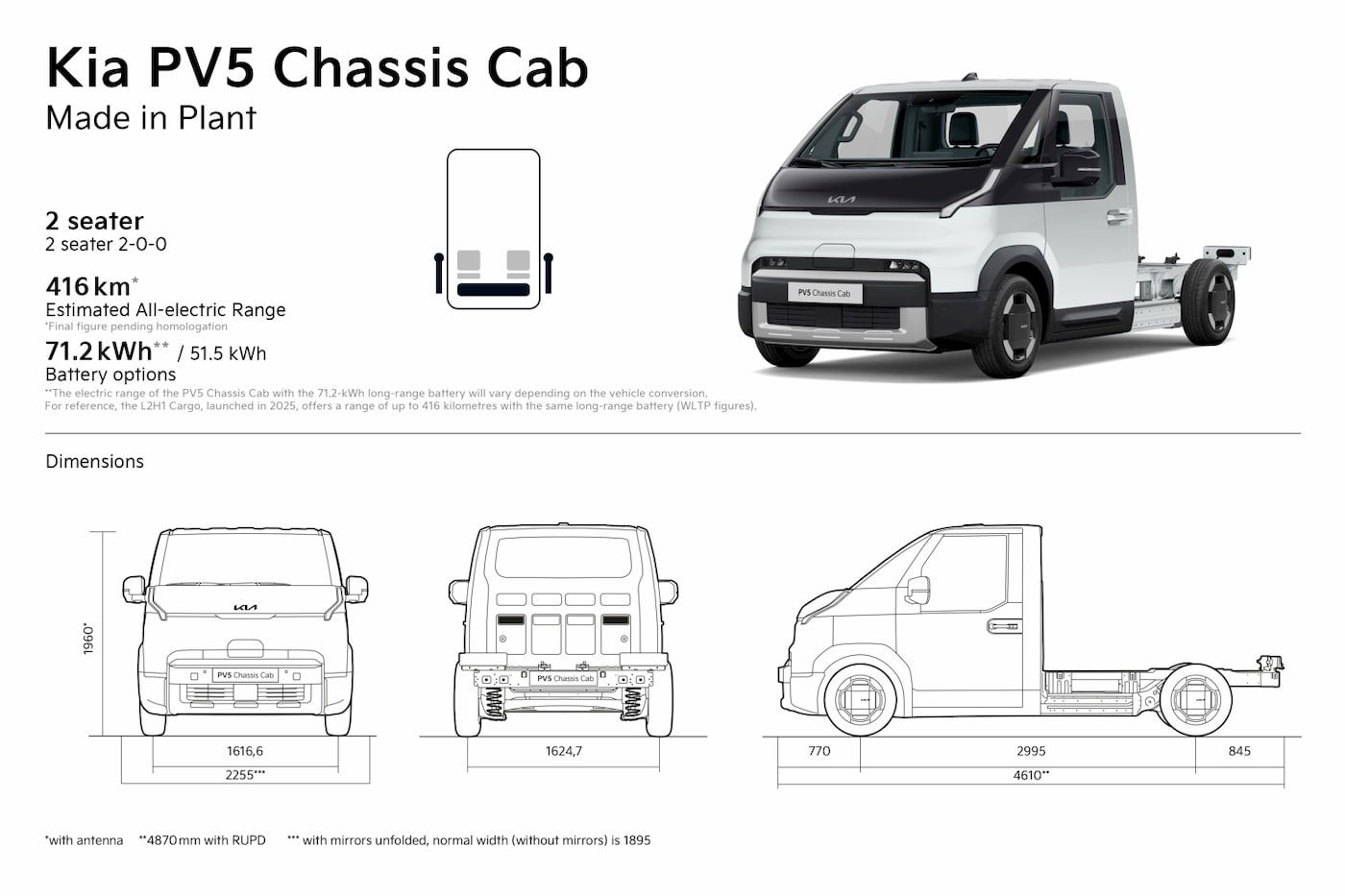
At the heart of the UK-spec PV5 Chassis and Cargo L2/H2 variants is a high-capacity, long-range 71.2 kWh lithium-ion battery pack. While other global markets will receive a more economical standard-range 51.1 kWh option, the UK launch focuses entirely on maximizing operational uptime and minimizing range anxiety for commercial users.
For the PV5 Chassis, the 71.2 kWh battery delivers an estimated WLTP combined range of up to 258 miles (416 kilometers) on a single charge. The vehicle’s physical dimensions are meticulously optimized for urban environments: it measures 4,610 mm in length, 1,895 mm in width, and 1,935 mm in height, resting on a 2,995 mm wheelbase. Coupled with an impressively tight 5.5-meter turning radius, the chassis cab provides exceptional maneuverability through congested metropolitan streets, tight delivery bays, and complex construction sites.
The powertrain supports DC fast charging capabilities at speeds up to 120 kW, allowing fleet operators to replenish the battery from 10% to 80% capacity in approximately 30 minutes during a standard driver break. For overnight depot charging, an 11 kW AC onboard charger facilitates a complete 10% to 100% replenishment cycle in roughly 6 hours and 30 minutes.
The PV5 Chassis: Endless Conversion Possibilities
The PV5 Chassis is designated as an "incomplete vehicle," purposefully engineered as an open-bed architecture designed to accept a vast array of bespoke aftermarket and manufacturer-certified conversions. To streamline the purchasing process for British fleet buyers, Kia has partnered directly with the TGS Automotive Group to offer factory-backed, type-approved conversions right out of the gate.
Initial conversion options available through TGS include lightweight tippers, Dropside configurations, and secure box body solutions. These configurations address specific industry verticals such as municipal waste management, landscaping, utilities, and inner-city logistics.
Payload capacities vary depending on the chosen superstructure. The Dropside variant accommodates a maximum payload of up to 633 kg, while the more specialized Tipper model supports up to 561 kg. Inside the cabin, the driver and front passenger are greeted by a modern, utilitarian interior featuring a 12.9-inch central touchscreen navigation system and a 7.5-inch digital driver display. Standard connectivity features include wireless Apple CarPlay and Android Auto, ensuring that commercial drivers remain seamlessly connected to dispatch and logistics software while on the move.
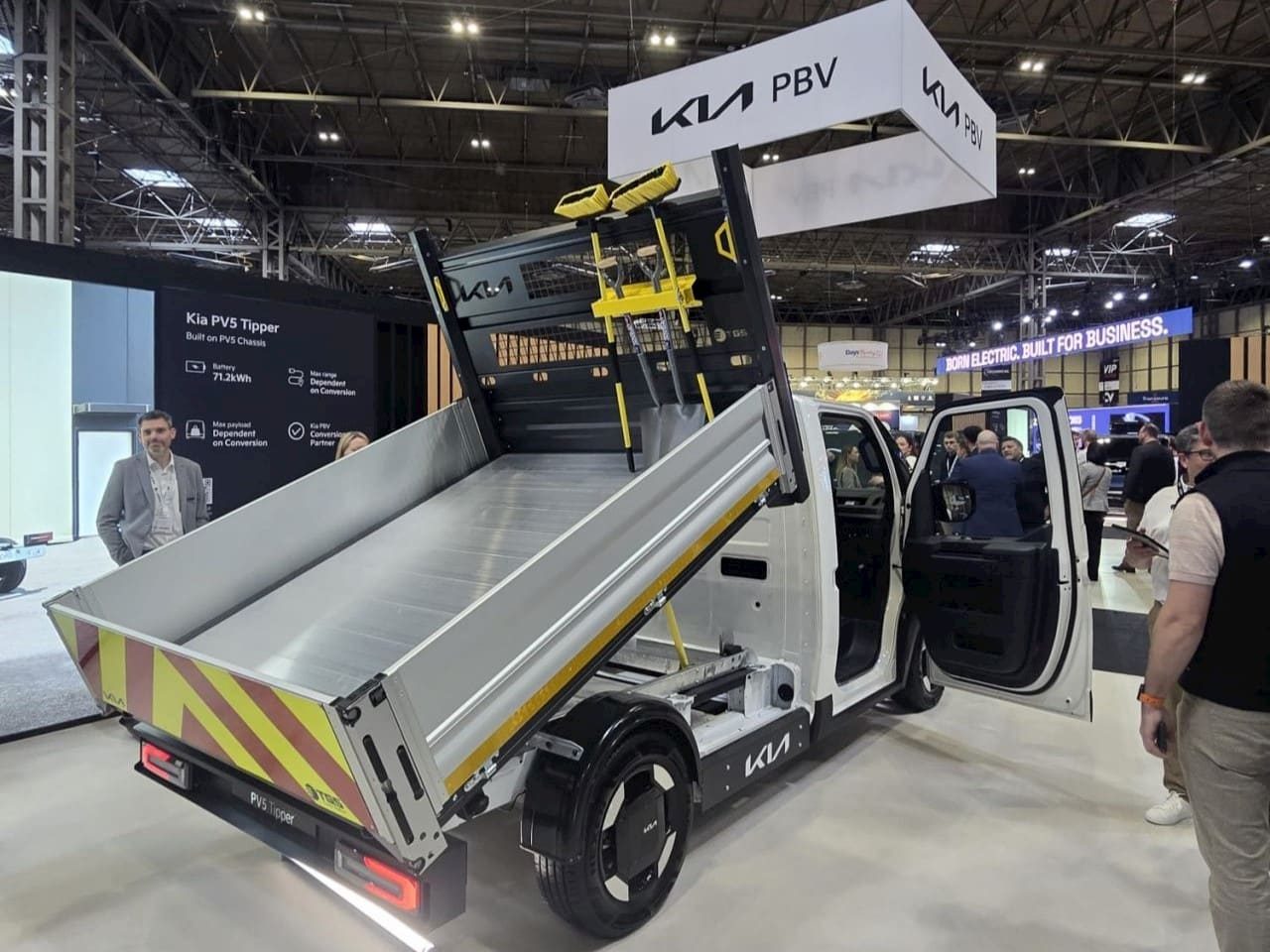
Pricing for the base PV5 Chassis "Plus" Long Range starts at a basic price of £30,605 (excluding VAT), translating to an on-the-road price of £32,916 once the anticipated £5,000 UK Zero Emission Van Grant is applied. Fully converted variants reflect the added engineering and superstructure costs: the PV5 Dropside starts at an on-the-road price of £40,110, while the rugged PV5 Tipper begins at £41,310.
The PV5 Cargo L2/H2: Maximizing Volume and Ergonomics
Running parallel to the chassis launch is the introduction of the PV5 Cargo L2/H2, a high-roof variant tailored for businesses that prioritize internal cargo volume and ergonomic loading efficiency.
The L2/H2 model stretches the physical dimensions of the vehicle to 4,695 mm in length, 1,895 mm in width, and 2,200 mm in height, maintaining the same 2,995 mm wheelbase as its sibling variants. The raised roofline dramatically increases interior utility, opening up an internal cargo height of 1,815 mm and delivering a total load capacity of 5.2 cubic meters—a notable increase over standard low-roof L1/H1 and L2/H1 configurations.
The Cargo L2/H2 is offered in versatile three- and four-door layouts, accommodating either two or three front-seat passengers depending on operational requirements. Three-door variants offer a maximum payload capacity of 630 kg, whereas the four-door iterations feature dual sliding side doors for enhanced loading flexibility, supporting payloads of up to 600 kg. Furthermore, both configurations boast a robust maximum towing capacity of 1,500 kg, making them suitable for light trailer utility.

Powered by the same 71.2 kWh battery pack, the Cargo L2/H2 achieves a WLTP-rated driving range of up to 239 miles. Like the chassis model, it shares the digital cockpit layout, featuring the 12.9-inch touchscreen and 7.5-inch driver cluster.
The UK pricing structure for the Cargo L2/H2 is tiered across "Essential" and "Plus" trim levels. The entry-level Cargo L2/H2 Essential two-seat model starts at an on-the-road price of £35,016 including the ZEVG, while higher trims, such as the "Plus Walk Through" configuration designed for urban delivery drivers who need direct cabin-to-cargo access, top out at £37,500 on the road.
Market Implications and Industry Impact
The simultaneous introduction of the PV5 Chassis and Cargo L2/H2 addresses a critical gap in the commercial electric vehicle marketplace. For years, fleet managers transitioning away from diesel-powered light commercial vehicles faced compromises in payload capacity, conversion flexibility, and body-style variety.
By utilizing the E-GMP.S skateboard architecture, Kia has bypassed the structural limitations inherent in converted internal combustion platforms. The low, flat floor plan maximizes usable volume while lowering the center of gravity, thereby improving driving dynamics and safety even when fully laden. Furthermore, the collaboration with specialized converters like TGS Automotive Group demonstrates a mature market approach, ensuring that fleet buyers do not have to source third-party engineering solutions independently to get a vehicle ready for specialized work.

From an economic perspective, the availability of government subsidies such as the Zero Emission Van Grant significantly lowers the initial capital expenditure barrier for small and medium-sized enterprises (SMEs) as well as large corporate fleets. Total Cost of Ownership (TCO) models for electric LCVs continue to show substantial savings over traditional diesel counterparts through reduced maintenance overhead, lower energy costs per mile, and exemption from urban congestion charges.
As order books officially open across the UK dealer network, initial industry reception suggests strong demand from utility providers, last-mile delivery couriers, and regional contractors seeking to future-proof their operations ahead of tightening environmental regulations. Kia’s strategic expansion of the PV5 family establishes a formidable benchmark for the next generation of purpose-built commercial electric vehicles, proving that modularity and commercial utility can coexist on a dedicated zero-emission platform.