In the rapidly evolving landscape of enterprise software development, artificial intelligence terminology has suffered from widespread conflation, with the term "agent" frequently misapplied across a vast spectrum of automation technologies. From rigid document-processing pipelines and scheduled scripts to rudimentary chatbots equipped with a handful of tools, software engineers and product managers routinely brand diverse programmatic constructs as AI agents. This semantic blurring has triggered a systemic industry challenge: the unnecessary deployment of complex, highly autonomous systems to solve problems that could be more reliably, efficiently, and cost-effectively managed through deterministic workflows. To prevent architectural overengineering, development teams must rigorously evaluate the fundamental distinctions between AI workflows and true agents before writing a single line of production code.
Defining the Architectural Paradigm: Workflows Versus Agents
To establish a clear technical foundation, industry architects typically divide AI-driven automation into two distinct paradigms based on where control logic resides during execution.
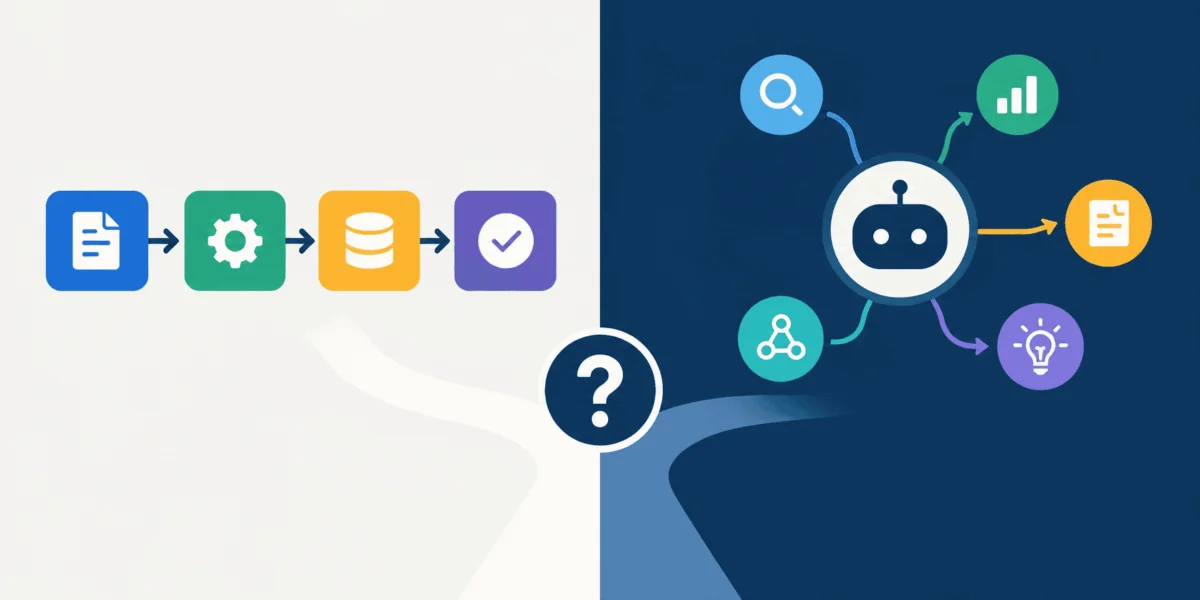
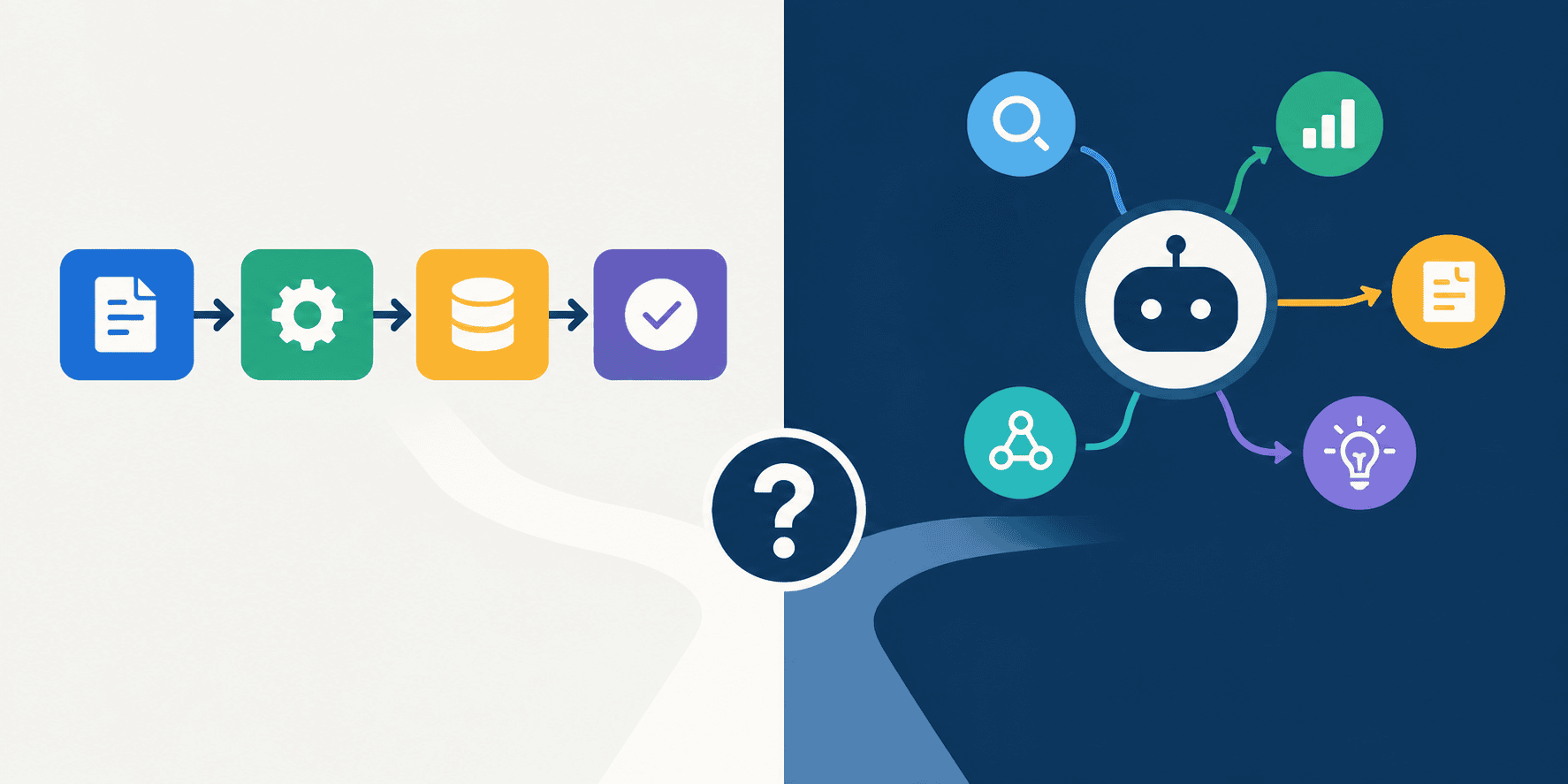
A workflow—frequently referred to in enterprise engineering as a pipeline or processing chain—is a system wherein the control flow is entirely fixed at design time. Human developers explicitly outline the sequence of operational steps, branching logic, validation rules, and termination conditions before the software is ever compiled or deployed. While these systems frequently incorporate large language models (LLMs) to execute specific cognitive tasks—such as text classification, sentiment analysis, or semantic data extraction—the overarching pathway remains strictly predetermined. Even when a workflow incorporates conditional branches that evaluate LLM outputs, the universe of possible paths is constrained and mapped out in advance by human designers.
Conversely, an authentic AI agent operates on a radically different principle: control flow is determined dynamically by the LLM itself at runtime. Given a high-level objective and access to a suite of external tools, an agent autonomously determines which tools to invoke, establishes the operational sequence, monitors intermediate outcomes, and decides when the task is complete. Crucially, an agent possesses the capacity to loop, backtrack, and alter its strategic trajectory based on the empirical observations it gathers as it interacts with databases, APIs, or human supervisors.
Chronology and Evolution of LLM Orchestration Patterns
The journey toward modern LLM orchestration began with simple, single-prompt interactions where developers sent isolated queries to foundation models. As application requirements expanded, the industry recognized the limitations of stateless interactions, leading to the rapid evolution of multi-step orchestration frameworks.
- Phase One (2022–2023): Static Prompt Chaining. Early implementations relied on rigid, linear sequences where the output of one LLM call was fed directly into the prompt of the next, operating without dynamic error-handling or feedback loops.
- Phase Two (2023–2024): Deterministic Hybrid Workflows. As enterprise use cases demanded reliability, engineers introduced programmatic state machines. These systems integrated LLMs into specific nodes of predefined business logic, blending deterministic programming with probabilistic language generation.
- Phase Three (2024–Present): The Rise of Agentic Frameworks. With the advent of more advanced reasoning models, the software ecosystem embraced agentic architectures capable of dynamic planning, tool selection, and recursive execution loops, igniting widespread debate over optimal deployment strategies.
The Single Practical Test for System Architecture
To cut through marketing hype and architectural ambiguity, senior software architects recommend a definitive, highly practical evaluative measure: the whiteboard flowchart test. Before committing resources to code development, engineers must ask a fundamental question: Can a competent technical team draw a complete, comprehensive flowchart of the task before the LLM ever executes?
If the operational process can be mapped out on a whiteboard using a reasonable number of conditional steps and deterministic branches, the immense flexibility, unpredictability, and overhead of an autonomous agent are generally unwarranted. A persistent misconception in modern software development posits that workflows equate to simplistic functionality, whereas agents represent sophisticated engineering. In practice, this hierarchy is false. Enterprise workflows frequently incorporate sophisticated orchestrations, including multi-stage LLM evaluation, advanced retrieval-augmented generation (RAG), automated retry logic, human-in-the-loop approvals, and complex compliance checks. Meanwhile, an application can be strictly classified as agentic while utilizing a minimal codebase, provided the model retains runtime autonomy over its operational path.
Comprehensive Evaluation Checklist Before Implementation
Before selecting an architectural framework, enterprise engineering teams should systematically review a set of foundational criteria designed to align technical capabilities with business requirements.
1. Predictability of Steps and Decision Trees
If project stakeholders can successfully list the major operational phases, branches, and termination points prior to runtime, a workflow is the optimal choice. For example, processing legal contracts involves reading the document, extracting designated data fields, validating formatting, and committing the structured data to a database. Although an LLM is indispensable for semantic extraction, an agent is entirely unnecessary for governing the sequence of operations.
2. Input Variability and Open-Endedness
When incoming requests are highly structured and predictable, deterministic logic remains easily maintainable. However, highly unstructured, open-ended inputs—such as diagnosing unclassified production outages or resolving irregular, multi-faceted customer complaints—often resist rigid flowcharting. In these volatile scenarios, empowering an LLM to dynamically gather data and formulate investigations provides legitimate operational value.
3. Sensitivity to Volume, Cost, and Latency
Economic and performance constraints heavily favor deterministic architectures. Autonomous agents inherently necessitate multiple reasoning iterations, continuous self-correction loops, and frequent tool calls. This iterative behavior translates directly into higher token consumption, increased API expenditures, and elevated latency. For high-volume, cost-sensitive operations—such as handling routine customer service inquiries or processing automated FAQs—workflows remain the industry standard. Agents are economically justifiable primarily for low-frequency, high-value exploratory tasks, such as deep-dive forensic investigations or complex market research.
4. Compliance and Auditability Requirements
Regulatory compliance and corporate governance frequently demand strictly identical execution paths across millions of transactions. Financial underwriting pipelines, identity verification checks, and credit scoring models require rigorous audit trails where every operational decision conforms to explicit, documented policies. Because agents dynamically alter their execution paths based on runtime observations, they introduce compliance liabilities that deterministic workflows effortlessly avoid.
5. Validation via Workflow with LLM Judgment
Engineering best practices dictate that development teams should always begin with the simplest viable architecture. Implementing a hybrid model—where a deterministic workflow utilizes an LLM strictly for localized judgment calls, classification, or policy verification—serves as an ideal baseline. If this constrained architecture successfully fulfills business objectives, transitioning to an autonomous agent introduces needless complexity.
Industry Implications and Strategic Outlook
As artificial intelligence matures into a core enterprise utility, distinguishing between deterministic workflows and autonomous agents represents a critical competency for technology leadership. Industry analysts note that organizations suffering from "agent fatigue"—the phenomenon of bloated budgets and brittle applications resulting from uncritical agent adoption—are increasingly pivoting back toward tightly constrained, highly reliable workflows.
The prevailing consensus among software architects emphasizes a disciplined, bottom-up methodology. Development teams must begin by mapping out deterministic flowcharts and constructing robust workflows. They should systematically measure operational failure points and evaluate whether runtime autonomy is genuinely required. By deploying agents only where problem spaces are fundamentally open-ended, enterprises can harness the transformative capabilities of artificial intelligence while maintaining the cost efficiency, predictability, and reliability essential for modern business operations.