









The 2026 SEMA Show in Las Vegas serves as the annual stage for automotive excess, but few projects have managed to capture the industry’s attention quite like Rob Dahm’s latest MX-5 Miata build. In a display of engineering bravado, the renowned YouTuber unveiled a first-generation Mazda Miata chassis housing an astonishing 13-rotor configuration. While the build appears to be a mechanical impossibility, the reality is a nuanced exercise in aesthetics and functional engineering, blending a show-stopping display piece with a practical, albeit singular, rotary powertrain.
The Anatomy of the 13-Rotor Build
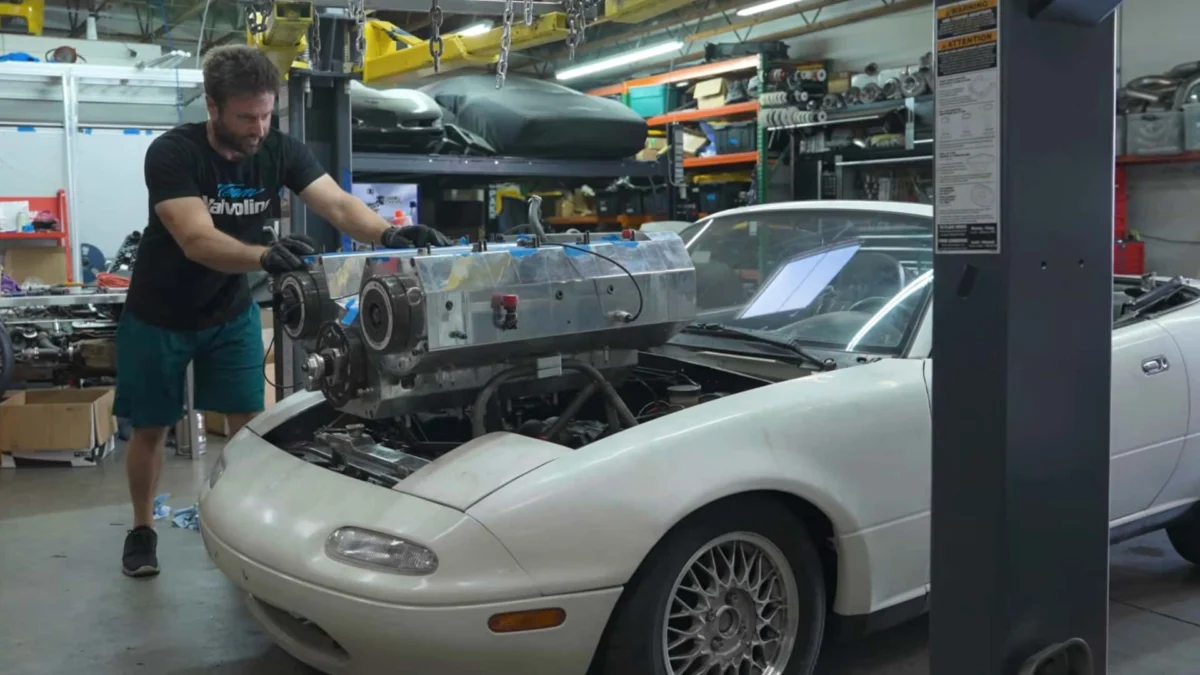
The central feature of the vehicle is a 12-rotor engine assembly positioned in the engine bay, a unit that commands attention with its sheer scale and complexity. However, the engineering reality is that this 12-rotor centerpiece is non-functional regarding the vehicle’s propulsion. Instead, the car is powered by a separate, single-rotor engine equipped with a Garrett GBC22 turbocharger, which provides the necessary torque and horsepower to move the vehicle under its own power.
This dual-engine setup was not a result of a lack of ambition, but rather a strategic decision to solve the logistical nightmare of installing a 12-rotor engine in a chassis originally designed for a compact four-cylinder motor. The 12-rotor assembly is complete with fuel lines, wiring, and ancillary components, creating the illusion of a fully integrated, high-output drivetrain—an engine that, on paper, would theoretically produce 4,500 horsepower. By keeping the aesthetics of the 12-rotor unit intact, the team successfully created a "visual masterpiece" that forces observers to question the limits of what is physically possible within a sub-compact chassis.
Engineering Constraints and Custom Fabrication
The installation process required significant structural modifications to the first-generation Mazda MX-5 chassis. Because the weight distribution of such a massive engine assembly would normally compromise the integrity of a stock frame, the team had to design and weld custom mounting points. These mounts are triangulated into the chassis to counteract two primary forces: lateral oscillation (side-to-side wobble) and the teeter-totter effect caused by the significant shift in the vehicle’s center of gravity.
The integration of three separate turbochargers into the engine bay presented a further challenge. Each turbocharger adds approximately 70 pounds of weight to the front end, placing immense pressure on the Miata’s suspension and steering geometry. To manage this, the builders utilized a precise sequence for the installation of intake manifolds, fuel rails, and turbo plumbing. This "ordered assembly" approach was necessary because many of the components serve a dual purpose, acting as structural braces that keep the heavy machinery stable within the tight confines of the engine bay.
Given the tight turnaround time for the SEMA deadline, the project team relied on a hybrid approach to fabrication. While the mounts and structural supports were built from scratch, the team repurposed labeled wiring harnesses and fuel management systems from Dahm’s previous rotary-focused builds. This integration of legacy components allowed the team to bypass the time-consuming process of creating an entirely new harness, ensuring the car would be ready for its public debut.
A Chronology of the SEMA Development
The project reached a critical phase in the weeks leading up to the SEMA Show. For the team, the first major milestone was not top-speed testing or dyno tuning, but the simple act of making the car mobile. The process of moving the car into a transport trailer became a high-stakes test of the chassis’s stability.
Loading a vehicle with such an extreme weight bias required the team to calculate the exact approach angle to avoid bottoming out on the trailer’s ramp. During the loading process, the rear end of the car slid laterally as the weight distribution shifted, highlighting the precarious nature of the vehicle’s balance. The successful loading of the vehicle was considered a significant victory, proving that the structural reinforcement of the chassis was sufficient for basic operation.
The vehicle officially debuted at the Haltech booth in the Central Hall of the Las Vegas Convention Center. Haltech, a global leader in engine management systems, sponsored the build as a showcase of their ECU capabilities. The presence of the car at such a high-profile location underscores the collaborative nature of the SEMA show, where technology providers and content creators converge to push the boundaries of automotive modification.
Industry Implications and Technical Context
The 13-rotor Miata project serves as a case study in "purpose-built engineering" versus "display engineering." In the automotive aftermarket industry, there is a long tradition of pushing performance metrics to the breaking point. By combining a 12-rotor display engine with a functional single-rotor unit, Dahm has created a piece of "automotive art" that serves as a commentary on the extremes of engine modification.
From an engineering perspective, the project highlights the increasing role of custom fabrication in the modern tuning scene. As engines become more powerful and complex, the limitations of factory chassis have become more apparent. The need for bespoke triangulation, advanced engine management, and custom cooling solutions is now a standard requirement for high-level builds.
Furthermore, the involvement of major aftermarket brands like Haltech signals a shifting trend in how technical products are marketed. By backing projects that prioritize innovation and shock value, these companies are able to demonstrate the versatility of their hardware in real-world, highly modified scenarios. The fact that the engine management system is capable of operating both the functional single-rotor engine and the peripheral systems of the 12-rotor unit is a testament to the sophistication of modern programmable ECUs.
Reactions and Broader Impact
The reaction from the automotive community has been largely positive, with enthusiasts praising the audacity of the project. However, the build also invites a broader discussion about the future of the rotary engine. Mazda, the manufacturer of the original Miata and the pioneer of mass-market rotary engines, has largely moved away from the technology in its modern consumer vehicles. Projects like Dahm’s keep the spirit of the rotary engine alive, demonstrating that there is still a passionate community dedicated to optimizing and expanding upon the rotary’s unique power delivery characteristics.
While critics might point out that the 12-rotor unit is not "truly" functional in the traditional sense, supporters argue that the project succeeds on its own terms. It serves as a conversation starter, a technical exercise, and a piece of spectacle that aligns perfectly with the goals of the SEMA Show.
As the 2026 SEMA Show concludes, the impact of this build will likely be measured by its influence on future projects. It encourages other builders to think beyond the constraints of traditional engine swaps and to consider how aesthetics and mechanics can be blended to create something truly unique. Whether this leads to more dual-engine setups or simply more complex, multi-rotor configurations remains to be seen, but one thing is certain: the bar for "absurdity" in the tuner world has been officially raised.
In summary, the 13-rotor Miata is a testament to the dedication of modern automotive fabricators. By overcoming significant weight distribution issues, structural constraints, and time-sensitive pressures, Rob Dahm and his team have succeeded in creating a project that is as much about the process of building as it is about the final result. As it continues to draw crowds in Las Vegas, the car remains a powerful example of what is possible when technical expertise meets unbridled creative vision.