







The Volkswagen Zwickau facility, once the crown jewel of the German automaker’s transition to an electrified future, has officially inaugurated an advanced industrial dismantling line, marking a strategic shift in how the company manages the lifecycle of its vehicles. Having completed a comprehensive €1.2 billion conversion process that transformed the site into an all-electric manufacturing hub, Volkswagen is now leveraging the factory’s existing infrastructure to establish a circular economy model. By reclaiming parts from pre-production vehicles and, eventually, end-of-life models, the company is attempting to create a sustainable secondary revenue stream that mitigates the high costs of EV production.
A Chronology of Transformation
The metamorphosis of the Zwickau plant represents one of the most significant industrial undertakings in the history of the European automotive sector. The journey began in 2018, when Volkswagen announced it would dedicate the entire factory to the production of vehicles based on its Modular Electric Drive Matrix (MEB) platform.
The timeline of this transition illustrates the speed at which Volkswagen sought to pivot:
- 2018: Commencement of the €1.2 billion facility overhaul, involving the retrofitting of assembly lines and the integration of high-level automation.
- November 2019: The first ID.3 models begin rolling off the production line, signaling the start of the electric era.
- June 2020: The final internal combustion engine vehicle is produced at Zwickau, marking the end of a decades-long legacy of gasoline and diesel manufacturing.
- January 2022: The full transformation is finalized with the inclusion of the ID.5, establishing Zwickau as the primary hub for six different MEB-based electric vehicles across the Volkswagen, Audi, and Cupra brands.
Following this massive capital investment, the current introduction of an eight-stage dismantling line signals the next chapter. The project was completed in just nine months—three months ahead of schedule—a feat attributed to the company’s decision to reuse existing manufacturing equipment rather than procuring entirely new machinery, thereby optimizing capital expenditure.
Operational Scope and Workforce Integration
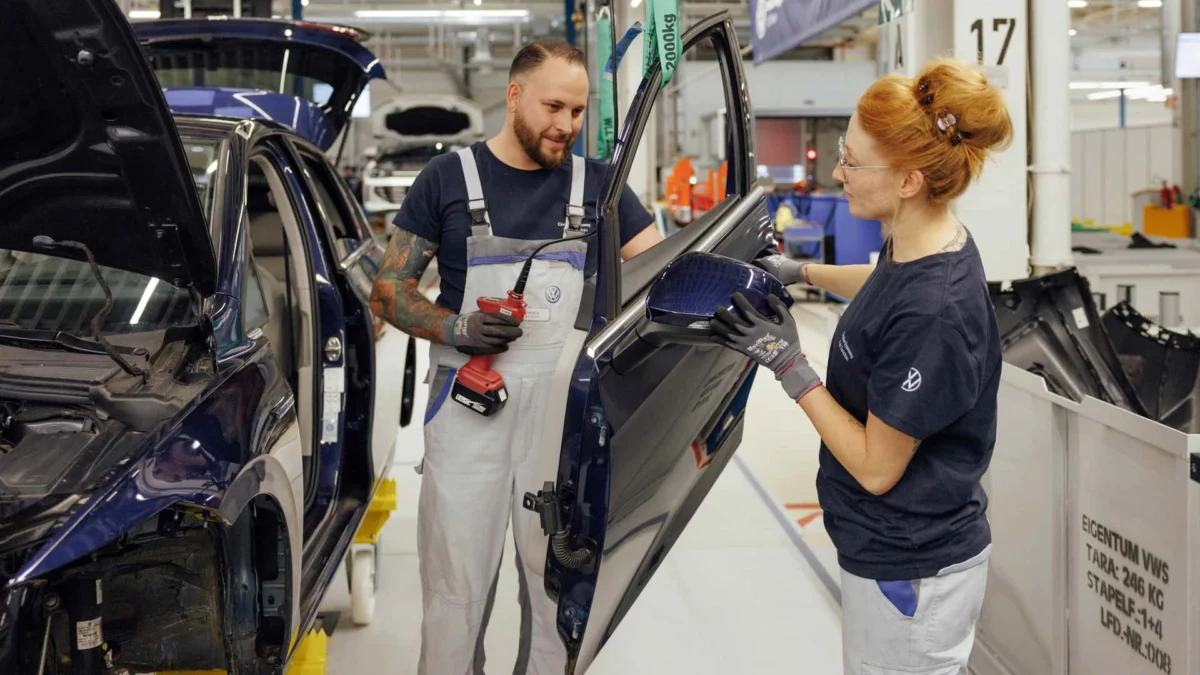
The newly established dismantling facility is not merely a scrap yard; it is a sophisticated industrial process designed for maximum material recovery. As of 2027, the line is expected to process approximately 4,100 vehicles annually across two shifts. This operational shift has been supported by the retraining of 100 employees who were previously engaged in vehicle assembly, ensuring that the plant retains its skilled labor force while adapting to the demands of a circular economy.
Initially, the facility is focused on the systematic deconstruction of pre-production vehicles. These cars, often used for testing, validation, and quality control, provide a steady stream of high-quality components. Volkswagen has confirmed that since July, it has successfully channeled recovered parts—specifically doors, bumpers, electric motors, and transmission components—back into the marketplace. These components are being made available to independent workshops, parts retailers, and the broader Volkswagen service network, offering a more affordable repair option for vehicle owners.
Economic Logic and Circular Economy Goals
The strategic decision to enter the dismantling business is rooted in the financial pressures currently facing the automotive giant. As Volkswagen navigates a period of sluggish EV sales and compressed profit margins, the company is seeking ways to improve the bottom line of its electric fleet. Currently, the production cost of electric vehicles remains significantly higher than that of their combustion counterparts, complicating the company’s profitability targets.
By recycling materials such as plastics and metals, Volkswagen aims to reduce the environmental footprint of its new vehicle production while simultaneously cutting raw material procurement costs. The company notes that plastic recovered from a single vehicle can contribute to the manufacturing of new components for up to three future cars. This approach is not only an environmental imperative but a calculated financial move to stabilize supply chains and reduce reliance on volatile commodity markets.
Future Outlook and Structural Challenges
Despite the innovative nature of the Zwickau dismantling project, the long-term outlook for the factory remains shrouded in uncertainty. Current production plans for the plant do not extend beyond 2031, leaving a significant question mark regarding the facility’s role in Volkswagen’s next decade of operations. The investment of up to €90 million—bolstered by a €10.7 million pledge from the Saxony government—is a strong signal of regional commitment, with the potential to support up to 1,000 jobs in the recycling and dismantling sector. However, whether this operation can scale to a level that replaces the economic output of large-scale vehicle production remains a subject of debate among industry analysts.
The financial pressure is further highlighted by Volkswagen’s recent decision to pause the development of an entry-level electric Golf. The company has explicitly stated that it must ensure it can accommodate the necessary investments before moving forward, illustrating the cautious approach it is taking toward its future product portfolio. In this context, the dismantling line serves as a "bridge" project—a way to maintain industrial activity and generate revenue while the company recalibrates its broader electric vehicle strategy.
Market Implications and Competitive Positioning
While the dismantling facility was born out of a factory that exclusively builds EVs, the actual business of parts resale appears to be brand-agnostic. Visual documentation of the dismantling process includes vehicles that bear the hallmarks of combustion-engine models, such as the Golf. By catering to a wider range of vehicle types, Volkswagen is maximizing the utility of its new dismantling infrastructure.
From an industry perspective, this move positions Volkswagen as a leader in "extended producer responsibility." By managing the end-of-life process, the company gains invaluable data on how its vehicles age, which components fail most frequently, and how designs can be improved for easier future disassembly. This "feedback loop" is a critical component of modern engineering, yet it is rarely implemented with the scale or rigor that Volkswagen is attempting at Zwickau.
Conclusion: A Necessary Evolution
The industrial dismantling line at Zwickau is a reflection of the reality facing many traditional automakers. The transition to electric mobility is not merely a matter of changing the powertrain; it is a fundamental shift in the business model. Volkswagen is essentially acknowledging that the lifecycle of a car no longer ends when it leaves the dealership or even when it is taken off the road.
By integrating dismantling into its core business, the company is creating a buffer against the volatility of the EV market and the rising costs of raw materials. While it is unlikely that dismantling alone will solve the profit margin challenges currently plaguing the Volkswagen Group, it represents a necessary evolution in automotive manufacturing. Whether this project ultimately secures the long-term future of the Zwickau plant or serves as a transitional mechanism for a changing industrial landscape remains to be seen. For now, the focus remains on operational efficiency, worker retraining, and proving that sustainability can indeed be a profitable endeavor for one of the world’s largest car manufacturers.